Skydiving Competitions: The World Championships and Other Events
Discover the exhilarating world of skydiving competitions and learn about the World Championships, other major events, and niche subtopics.
Skydiving has real, scored competition, with judges, video review, electronic timing and national and world titles. The top level is the FAI World Championships, run by the Fédération Aéronautique Internationale, the world body for air sports. In the US, the main event is the USPA National Skydiving Championships. Below is what the events are, how they are scored, who has won them, and how to watch or get started.
Who runs it
The FAI’s skydiving arm is the International Skydiving Commission (ISC). Until 2019 it was called the International Parachuting Commission (IPC); the name changed partly because the commission now also covers indoor skydiving in wind tunnels. The ISC writes the competition rules and sanctions world records and world championships.
World championships in each discipline are generally held every two years. Some years several disciplines share one big event, sometimes called a Mondial. Other years a discipline holds its own world meet. The host country changes each time.
In the US, the United States Parachute Association (USPA) runs the Nationals at a host dropzone that also changes from year to year. You have to be a USPA member to compete.
Where it started: Bled, 1951
The first World Parachuting Championships were held in 1951 at Lesce-Bled, in what was then Yugoslavia and is now Slovenia. The contest was built around landing accuracy.
Monique Laroche of France is recognized by the FAI as the first world champion in parachuting accuracy, from that meet. In 1951 she also set the first parachuting record the FAI ever recognized, a freefall of 3,622 meters (about 11,900 feet) over St. Yan, France.
For the next 25 years, FAI competition stayed with the two “classic” events: accuracy landing and freefall style, in which a jumper flies a set series of 360-degree turns and back loops as fast and cleanly as possible, timed to the hundredth of a second, with penalty seconds added for sloppy moves. Everything else came later.
The events, one by one
Modern competition splits into freefall events, where the work happens before the parachute opens, and canopy events, where it happens after.
Formation skydiving (FS)
Teams build a drawn sequence of formations in freefall, scoring one point for each completed formation. A fifth jumper, the camera flyer, films every jump, and judges score from the video.
Under the current FAI rules, 4-way teams exit at 3,200 meters (10,500 feet) and get 35 seconds of working time. 8-way teams exit at 3,960 meters (13,000 feet) and get 50 seconds.
4-way FS was first run at the US Nationals in 1970 in Plattsburgh, New York, where the Omaha Skydivers won the first gold.
Vertical formation skydiving (VFS)
Same idea as FS, but the team flies head-down and head-up instead of belly-to-earth, which is faster and harder to hold together. VFS was a test event at the US Nationals in 2006 and became a medal event in 2007.
Artistic events: freefly and freestyle
In freefly, two performers and a camera flyer fly routines in every body orientation. In freestyle, one performer does the routine. A full meet is seven jumps: two compulsory rounds with set moves and five free rounds the team designs. Judges score technical difficulty and presentation from the camera flyer’s video, so the camera flyer is scored as part of the team.
The IPC accepted freefly as a discipline in 2000, and the first official US freefly Nationals ran that year with 11 open teams.
Speed skydiving
Jumpers dive head-down in the tightest shape they can hold, and a measuring device worn on the body records their fastest speed over a set distance. A normal belly-to-earth skydiver falls at about 120 mph. Speed skydivers go much faster: the FAI men’s record is 529.77 km/h (329.18 mph), set by Marco Hepp of Germany in 2022 at Eloy, Arizona, and the women’s record is 497.31 km/h (309.01 mph), set by Natisha Dingle of Australia in 2025 in Austria. Speed has been a US Nationals event since 2018, when only four people entered.
Wingsuit flying
The IPC adopted wingsuit flying in January 2015, and USPA added it the same year. In performance competition, each flyer is measured in a 1,000-meter window from 3,000 down to 2,000 meters: one flight for the longest time in the window, one for the greatest distance and one for the highest speed over the ground. There is also a judged acrobatic event for teams.
Accuracy landing
The oldest event is still on the program. Jumpers open high and fly a slow, stable parachute down to an electronic target pad. Dead center is a disc 2 centimeters across (a little under an inch). The pad measures how far from it you touch, in centimeters, up to a maximum of 16 cm. A perfect round scores 0.00, and top jumpers string together many of them. The dead center was shrunk from 3 cm in 2007 to separate the best competitors.
Canopy piloting
Often called swooping. Pilots dive small, fast parachutes toward the ground and level out to skim a course built over a pond. Under FAI rules there are three events:
- Speed: a curved 70-meter course timed to the thousandth of a second by electronic beams at the entry and exit gates.
- Distance: touch the water before the first gate, then fly as far as you can before touching down.
- Zone accuracy: drag a foot through the water gates, then land in a zone 2 meters long and 1 meter wide.
There is also a freestyle version judged on tricks performed while dragging across the water. Canopy piloting was a US Nationals test event in 2004 and a medal event from 2007.
Canopy formation (CF)
Teams open their parachutes and then dock with each other, building stacks and rotations by hooking feet into the lines of the canopy below. CF events debuted at the US Nationals in 1982 in Muskogee, Oklahoma.
Some champions worth knowing
- Monique Laroche (France). First world champion in parachuting accuracy, Bled, 1951.
- Cheryl Stearns (USA). Women’s overall world champion in style and accuracy in 1978 and 1994, and the first woman in the US Army’s Golden Knights parachute team (1977). She holds the women’s record for most jumps, more than 22,000.
- Dan Brodsky-Chenfeld (USA). Six-time world champion in formation skydiving, leading 4-way and 8-way teams with Arizona Airspeed. He survived a 1992 plane crash that killed 16 people, including several of his teammates, and came back to compete and coach.
- Olav Zipser (born in Germany). Widely called the father of freefly. With the FreeFly Clowns in the early 1990s he helped invent head-down flying as people do it today. He founded the Space Games freefly competition in 1997 and won freefly gold at the 2001 World Air Games in Granada, Spain. That same year he and Rook Nelson took freestyle gold at the World Games in Japan.
- Mike Swanson (USA). A Red Bull Air Force member who lists three world titles and four US national titles in freefly, won in the early years of that discipline. He has since moved into wingsuit flying, BASE jumping and film stunt work.
- Julian Boulle (South Africa). Better known in wingsuit racing than in FAI events: he won the World Wingsuit League, a proximity-wingsuit race series in China, and was the first two-time winner of the China wingsuit grand prix (2012 and 2014).
For the current holders of every FAI title, check the FAI’s champions list, since it changes after each world meet.
Other jumping competitions
The Red Bull Cliff Diving World Series is not skydiving, but it is the best-known jumping competition people mix up with it. It started in 2009 for men, with women added in 2014. Men dive from 27-meter platforms and women from 21 meters, hitting the water at up to about 85 km/h (53 mph). Five judges score each dive on takeoff, position in the air and entry, and the score is multiplied by the dive’s degree of difficulty, much like Olympic diving from far higher up.
In skydiving itself, the main ladder is local and regional meets, then the USPA Nationals, then FAI World Cups and World Championships. There are also invitational and record-setting events, such as large-formation record attempts, that are not scored head-to-head.
What the judges actually look at
Almost all freefall scoring is done from video, not by watching from the ground. Judges review each jump on screens, often frame by frame, and count completed formations and add penalties for formations that were not built correctly. That is why the camera flyer matters so much: if the judges cannot see it, it does not score.
Canopy events use electronic measurement: light beams for speed, survey markers for distance, and the pressure pad for accuracy. Speed skydiving uses a measuring device carried by the jumper.
Weather decides a lot. Meets can run late or be cut short for high winds, low clouds or a thunderstorm nearby, and FAI rules let organizers lower exit altitude and shorten working time when clouds force it (to 20 seconds in 4-way, for example).
How to watch
- Look up the current Nationals host and dates on uspa.org. The venue moves around the country.
- Call the host dropzone to confirm spectators are welcome and where you can stand. Rules differ from one site to the next.
- Go on a canopy piloting or accuracy day if you want the most to see from the ground. Freefall events happen two miles up, and you mostly see the video afterward.
- Bring sun protection, water and a chair. Rounds run all day.
- Follow live scoring online so you know who is leading.
How to start competing
Nobody starts at Nationals. You need a USPA license and a membership, and some events add experience or license requirements, especially canopy piloting and wingsuit. The usual route is to pick one discipline, find a coach or a team at your dropzone, train in a wind tunnel if it is freefall work, and enter a small local or regional meet first. Many dropzones run informal “skill” competitions that are a low-pressure first step.
USPA has a readable history of every event added to the Nationals since 1962: A Short Look at a Long History. It is a good next read if you want to see how a few accuracy jumps in Kansas turned into the program above.
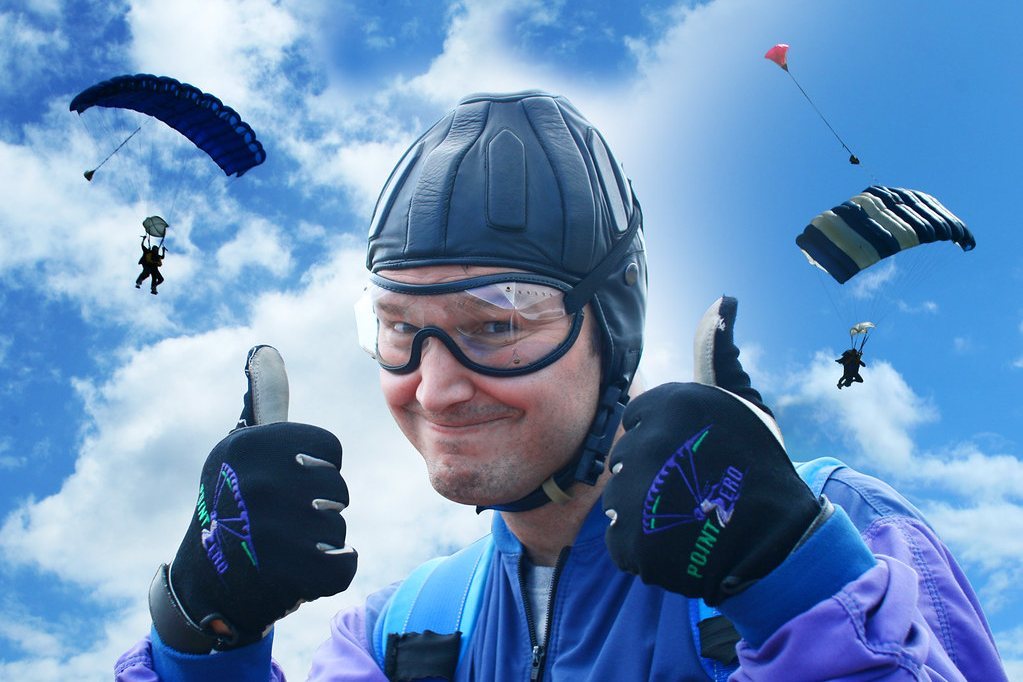
Photo: One giant leap for Matt! (one small step for mankind) by Forgotten Heritage, BY 2.0.