Why Skydivers Stop Speeding Up at 120 mph: The Physics of Freefall
Why does a skydiver hit about 120 mph and stop accelerating? Learn how gravity, drag, body shape, and ram-air wings shape every jump.
You've probably held your hand out of a car window on the highway and felt the air shove it backward, harder the faster you go. Skydiving runs on that same push. Gravity pulls a jumper down, and the air pushes back harder every second. After about ten seconds the two forces balance, and the fall settles at roughly 120 mph. From there, the jumper's body shape sets the speed and the direction. The canopy then turns the fall into flight. Here is how each part works.
Gravity starts the fall, and air takes over
When you leave the aircraft, gravity accelerates you at about 9.8 m/s², the same rate for every object regardless of its weight. A heavier jumper is pulled down with more force, but at the moment of exit they don't gain speed any faster than a lighter one.
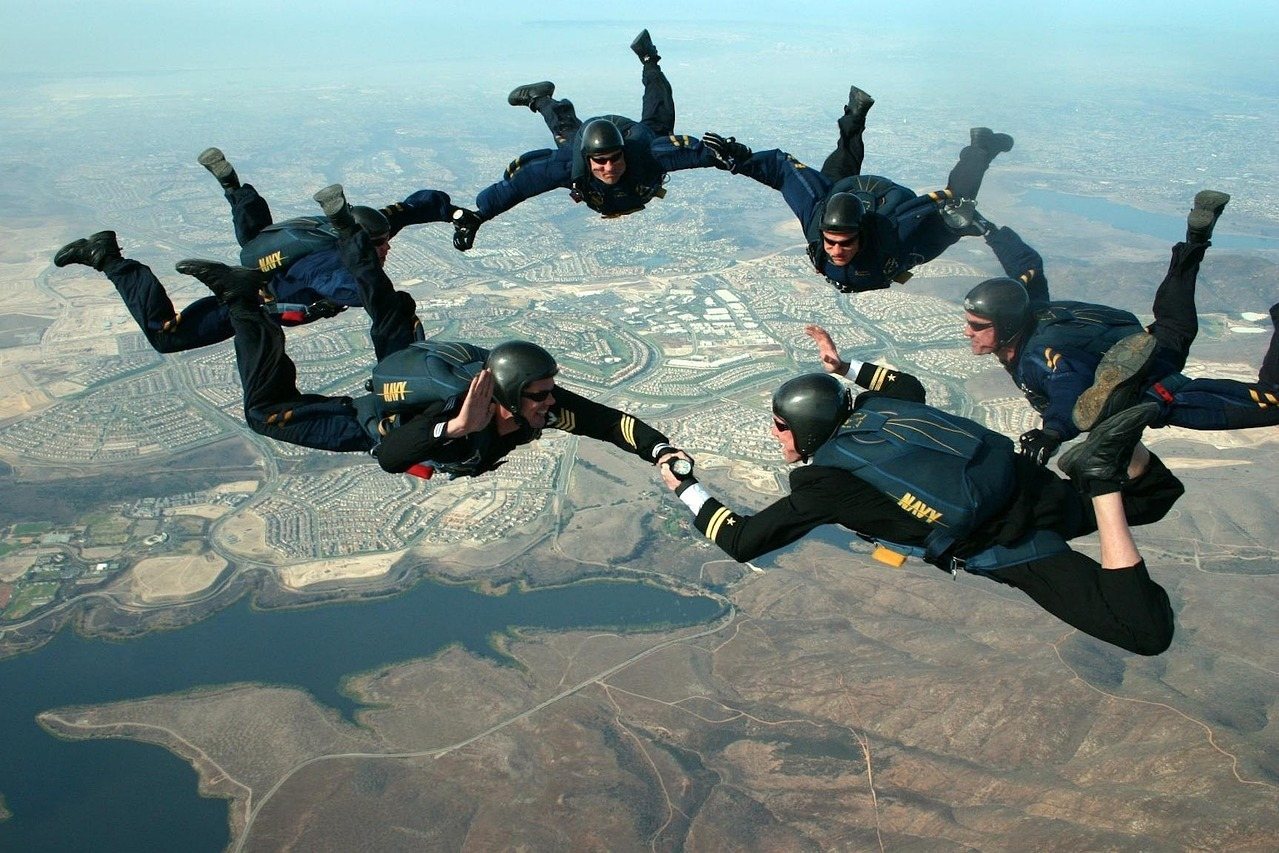
The difference shows up once the air starts to matter. Drag grows quickly as speed rises. It takes about 10 to 12 seconds, and roughly 1,500 feet of altitude, for a skydiver to go from the aircraft's speed to terminal velocity. At that point the air pushes up as hard as gravity pulls down, so the jumper stops accelerating and falls at a steady speed. For an average-sized person lying belly-to-earth, that speed is about 120 mph (193 km/h).
This is why freefall doesn't feel like the stomach-dropping lurch of a roller coaster. Once you're at terminal velocity, you're pressing into a 120 mph wind that holds you up. Jumpers describe it as lying on a cushion of air, and the wind is real enough to steer against.
The equation behind 120 mph
NASA's aerodynamics guides give the drag force as:
`D = 0.5 × ρ × v² × A × Cd`
In this equation, ρ is air density, v is speed, A is the area facing the airflow, and Cd is the drag coefficient, a number that describes how easily a shape slips through air. Drag rises with the square of speed, so doubling your speed quadruples the push.
Terminal velocity is the speed at which drag equals weight. Solving for that speed gives:
`Vt = √(2W / (ρ × A × Cd))`
The equation shows that a skydiver has three ways to change their speed:
- Weight (W): more weight means a higher terminal velocity, which is why heavier jumpers tend to fall faster once they're up to speed.
- Area times drag coefficient (A × Cd): presenting less area, or a sleeker shape, raises the speed.
- Air density (ρ): thinner air pushes back less, so the same body falls faster high up.
A human body is a poor aerodynamic shape. Belly-down with limbs spread, it has a drag coefficient of about 1.0 to 1.3. A streamlined teardrop has a drag coefficient of roughly 0.04 to 0.05. Skydivers are not teardrop-shaped, and the belly-down position works precisely because a spread body catches so much air.
Change your shape, change your speed
Because terminal velocity depends on the square root of 1/(A × Cd), halving the area and drag together raises the speed by about 1.4 times. That takes 120 mph to roughly 170 mph. The real numbers line up with this. In a head-down position, with less area and a cleaner profile, terminal velocity rises to about 150 to 180 mph (240 to 290 km/h).
Competitive speed skydivers push this as far as it goes, holding a tight head-down dive to reach more than 300 mph (480 km/h). The FAI speed skydiving world record is 539 km/h (about 335 mph), set by Sebastian Garcia.
Air density explains the most extreme case. On Felix Baumgartner's 2012 Red Bull Stratos jump from about 128,000 feet, the stratospheric air was so thin that he reached 1,357.6 km/h (843.6 mph). That is a separate category from competition speed skydiving, but it shows how much the "ρ" in the equation matters.
The arch: stability, not speed
Speed is not the goal for most jumpers. Stability is. The foundation of US Parachute Association (USPA) training is the neutral arch. The jumper pushes the hips forward and down so they are the lowest point of the body, keeps the head up, and extends the legs.
This works like a badminton shuttlecock. With the hips low and the limbs trailing upward, the wind hitting the belly naturally rights the body. A belly-to-earth arch keeps the area facing the wind large, so the jumper falls at the slower, steady speed of about 120 mph, which is much easier to control than a head-down dive.
Tracking: turning a fall into forward motion
Bodies can also deflect air sideways. In a track, the jumper sweeps the arms back along the torso, straightens the legs fully, and flattens the chest so the body acts like a crude wing. The aim is horizontal distance. Before opening, jumpers in a group track away from each other so their parachutes don't deploy into one another.
How long the fall actually lasts
The textbook formula `t = √(2h/g)` describes a fall with no air resistance. From 12,000 feet (about 3,658 m), it gives about 27 seconds to reach the ground. That number doesn't apply to skydiving, because a real jumper stops accelerating once drag catches up.
A rough estimate shows the difference. Suppose a tandem pair leaves at 12,000 feet and opens at 5,000 feet. They spend about 11 seconds and 1,500 feet getting up to speed. The remaining 5,500 feet go by at 120 mph, which is about 176 feet per second, so that part takes another 31 seconds or so. That makes roughly 40-plus seconds of freefall. This is an estimate, since actual times vary with body size, position, and air density.
Opening altitude also depends on who is jumping. USPA's Basic Safety Requirements set the minimum opening altitudes:
- 5,000 feet above ground for tandem jumps
- 3,000 feet for students and A-license holders
- 2,500 feet for B, C, and D license holders
From falling to flying: the ram-air wing
Round parachutes slow a jumper mainly by drag, like a very large version of the spread-out body. Modern sport canopies work differently.
The FAA's Powered Parachute Flying Handbook explains that a ram-air canopy has open cells along its front edge. Air rushes into those cells and pressurizes the fabric into a firm wing shape, an airfoil. Like an aircraft wing, it produces lift. This is why a jumper under a ram-air canopy can glide forward, steer, and "flare," pulling down on the controls just before landing to trade forward speed for a softer touchdown. At deployment, the physics shifts from drag fighting gravity to lift.
The rules built around the physics
Because so much depends on equipment working at speed and on clear airspace, US skydiving is tightly regulated:
- Packing: under 14 CFR § 105.43, reserve parachutes must be inspected and repacked by an FAA-certificated parachute rigger within 180 days before use, and main parachutes must also have been packed within 180 days.
- Tandem gear and instructors: 14 CFR § 105.45 requires an automatic activation device on the tandem reserve, a device that fires the reserve if the jumper is still falling fast at a set altitude. The tandem parachutist in command needs at least 3 years of experience, 500 ram-air jumps, and a master parachute license. USPA also requires tandem instructors to hold an FAA Third-Class Medical Certificate or a DOT medical exam. Tandem passengers and students don't need an FAA medical certificate.
- Weather and airspace: jumping into or through clouds is prohibited. Below 10,000 feet MSL, jumpers need at least 3 statute miles of visibility and 2,000 feet of horizontal distance from clouds. In Class E or G airspace, operators must notify air traffic control 1 to 24 hours ahead. Anyone descending between sunset and sunrise must show a light visible for at least 3 statute miles.
- Oxygen: 14 CFR § 91.211 requires supplemental oxygen for everyone aboard above a 15,000-foot cabin altitude. Between 12,500 and 14,000 feet, the flight crew needs oxygen for any portion of the flight longer than 30 minutes.
- Age: at USPA member drop zones, every skydiver must be at least 18, with no exception for parental consent.
USPA's data suggest these rules and the training behind them are working. In 2024, the US recorded 9 skydiving fatalities across about 3.88 million jumps, a rate of 0.23 per 100,000 jumps. It was the first single-digit year since records began in 1961, down from 10 fatalities in about 3.65 million jumps (0.27 per 100,000) in 2023.
The short version
A skydive passes through three stages of physics. Gravity accelerates the jumper for about ten seconds. Drag then catches up and holds the fall near 120 mph, and the jumper's body shape decides whether that speed stays steady, climbs past 300 mph, or turns into forward motion. Finally, a pressurized fabric wing produces enough lift to land on your feet.
Sources (32)
- Wisconsin Skydiving Center: How Fast Do You Fall When Skydiving?
- Skydive Perris: Terminal Velocity in Skydiving Explained
- Skydive Raleigh: How Fast Do You Fall When Skydiving?
- NASA Glenn: Terminal Velocity
- NASA Glenn: Terminal Velocity (gravity and drag)
- NASA Glenn: Shape Effects on Drag
- Owlcation: Terminal Velocity, Free Fall and Drag Force
- FAI: Speed Skydiving
- USPA Nationals: Speed Skydiving Rules
- Skydive CSC: Skydiving Records
- OpenStax College Physics 2e: Falling Objects
- OpenStax College Physics for AP Courses: Falling Objects
- USPA Skydiver's Information Manual
- USPA Skydive School: Category A
- USPA SIM Section 5
- USPA: Foundations of Flight, Angle Flying
- FAA Powered Parachute Flying Handbook
- NTSB Final Report 84828
- eCFR: 14 CFR Part 105
- Cornell LII: 14 CFR § 105.43
- eCFR: 14 CFR § 105.45
- Cornell LII: 14 CFR § 105.45
- eCFR: 14 CFR § 105.17
- Cornell LII: 14 CFR § 105.25
- eCFR: 14 CFR § 91.211
- FAA: Oxygen Equipment brochure
- USPA SIM Section 2
- USPA SIM Section 2-1: Basic Safety Requirements
- USPA: Minimum Age to Skydive
- USPA: Safety FAQs
- USPA: 2024 Non-Fatal Incident Summary, Part One
- FAA Advisory Circular 105-2D