From Balloon Stunt to Sport: How Skydiving Evolved
Follow skydiving from Garnerin's 1797 balloon parachute jump to ram-air wings, wingsuits, AAD safety devices and today's federal rules and licensing.
If you've ever stood at the edge of a high diving board and felt your stomach drop, you know the pull between fear and wanting to jump. Skydiving turned that feeling into a sport. It began in 1797 as a one-man balloon stunt over Paris. Then came static lines, hand-pulled ripcords, wartime mass jumps and steerable rectangular canopies. Those led to formation flying, BASE jumping and wingsuits. Today it runs on electronic backup devices, federal rules and a licensing ladder, and in the United States it now records fewer than one death per 100,000 jumps.
A Canvas Umbrella Over Paris
On October 22, 1797, French aeronaut André-Jacques Garnerin rose over Parc Monceau in Paris in a hydrogen balloon. At about 3,000 feet (roughly 1,000 meters), he cut his basket free and fell under a parachute. It was the first recorded high-altitude parachute descent, and it was also Garnerin's first jump of any kind.
He had come up with the idea while held as a prisoner in Hungary during the French Revolutionary period. He drew on Louis-Sébastien Lenormand's 1783 parachute descent from a tower. Garnerin's device had no rigid frame. It was a canvas canopy about 23 feet across, hung above a basket on a central pole. It had no vent at its top to let air escape, so it swung violently on the way down. That flaw shows how much early parachuting depended on surviving the ride rather than controlling it.
Static Lines and the Ripcord
For the next century, parachutes mostly belonged to balloon showmen. The leap toward a wearable system came in 1906. American aeronaut Charles Broadwick developed a backpack parachute with a static line, a cord tied to the aircraft that pulled the canopy open automatically as the jumper left.
His adopted daughter, Georgia "Tiny" Broadwick, showed the next step almost by accident. In 1914, at North Island in San Diego, she was demonstrating parachutes for the Army when her static line snagged on the plane's tail. She cut the line and opened the parachute by hand. That proved a jumper could open a parachute herself in free fall.
The idea was made official on April 28, 1919, at McCook Field in Dayton, Ohio. Leslie Irvin made the first planned freefall jump using a hand-pulled ripcord. His backpack parachute had been designed by Floyd Smith and Guy Ball. The basic setup of a worn pack opened by the jumper's own hand still underlies sport skydiving today.
War and the Round Canopy
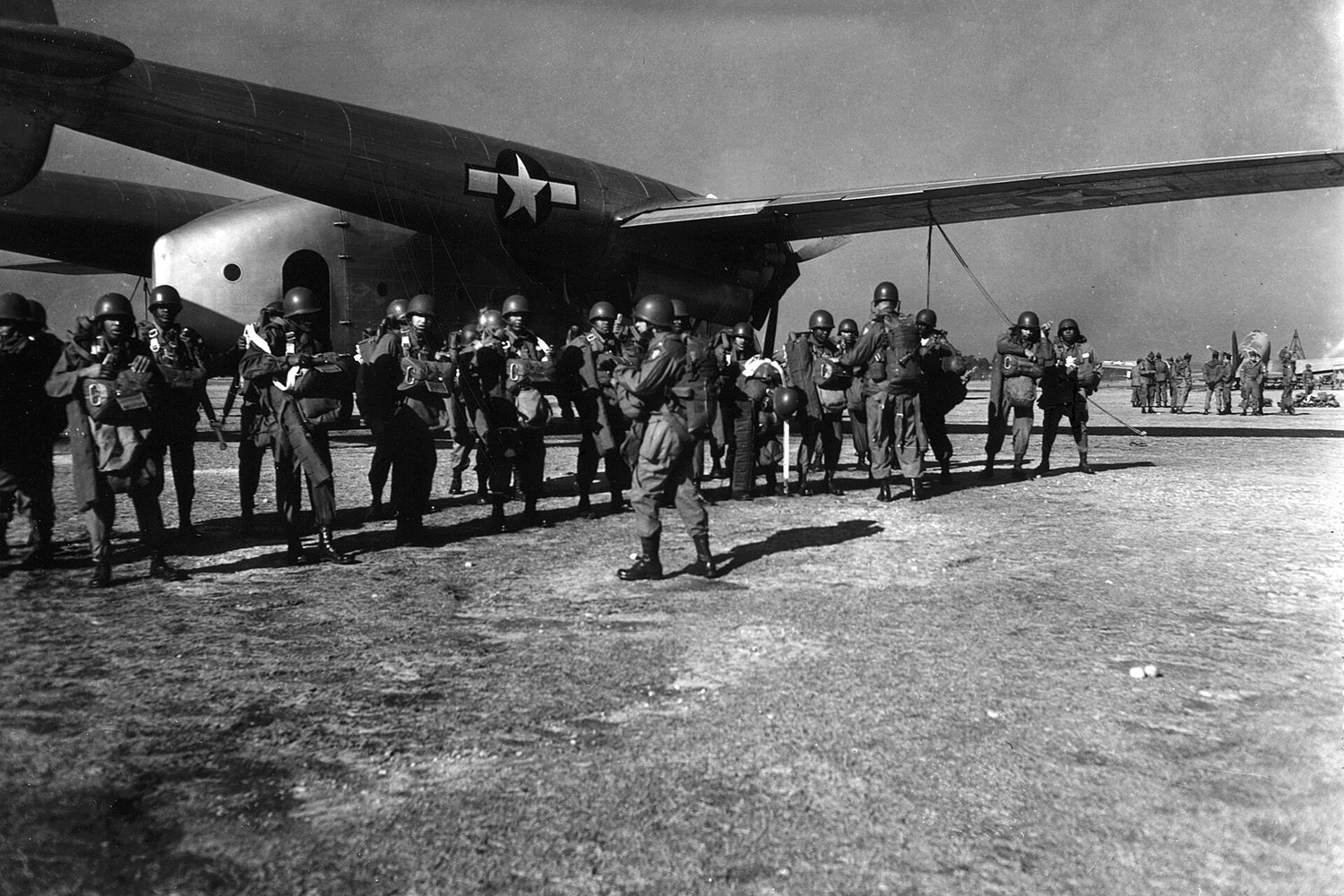
The world wars turned parachutes into military equipment on a huge scale. During the Normandy invasion on June 6, 1944, more than 13,000 U.S. Army paratroopers jumped with the T-5 system. It used a 28-foot round canopy opened by a static line, with a reserve worn on the chest.
Round canopies like the T-5 were built to get many soldiers down at once, not to be steered with precision. They stayed the standard throughout the war.
The Rectangular Wing
The canopy that made modern skydiving possible came later. On October 1, 1964, Domina Jalbert filed a patent for a "Multi-Cell Wing Type Aerial Device." It was granted on November 15, 1966, as U.S. Patent 3,285,546. This was the ram-air parafoil, a rectangular canopy that fills with air and flies like a wing. With it, jumpers could steer, glide forward and slow down for landing. That control opened the door to everything that followed.
Flying Together: Formation Skydiving
While canopy design was changing, jumpers were also learning to fly their bodies toward one another in free fall. In 1964 over Arvin, California, Mitch Poteet, Don Henderson, Andy Keech and Lou Paproski linked hands in the first photographed four-way star.
What started as an experiment became a competitive discipline. In September 1975, Warendorf, West Germany, hosted the First World Championships of Relative Work, the early name for formation skydiving. The event put formation flying into official world championships run by the FAI, the world air sports federation, alongside the older events of classic style and landing accuracy.
Formation events have since split into specialties. Vertical Formation Skydiving (VFS) is a four-person discipline in which jumpers fly both head-up and head-down, with 35 seconds of working time to build formations. Two-person teams that switch between body positions compete in a separate event, Mixed Formation Skydiving (MFS).
Beyond the Airplane: BASE and Wingsuits
Steerable ram-air canopies also let people jump from fixed objects. In 1978, filmmaker Carl Boenish organized jumps from El Capitan in Yosemite National Park using ram-air parachutes. With Jean Boenish, Phil Smith and Phil Mayfield, he later coined the acronym B.A.S.E. It stands for the four kinds of launch points: Buildings, Antennas, Spans (bridges) and Earth (cliffs).
The wingsuit came next. In the mid-1990s, French skydiver Patrick de Gayardon developed the modern wingsuit, which uses fabric between the arms and legs that fills with air to give a jumper real glide. His work inspired Jari Kuosma and Robert Pečnik to found BirdMan International Ltd. in 1999. The company built wingsuits commercially and set up standard training.
Wingsuits are not for beginners. Under the United States Parachute Association's Basic Safety Requirements, a skydiver needs a valid license and at least 200 jumps before a first wingsuit flight.
The Safety Net: Devices and Rules
As jumpers pushed further, the equipment behind them became more reliable. On January 10, 1991, German engineer Helmut Cloth and his company Airtec released the CYPRES, an electronic Automatic Activation Device (AAD). A microprocessor tracks the jumper's altitude and rate of descent. If those numbers show the jumper is falling too fast too low, the device fires a small cutter that slices the loop holding the reserve container closed, and the reserve deploys.
U.S. federal rules now require some of these protections:
- Under 14 CFR § 105.43, anyone using a single-harness, dual-parachute system must have the reserve packed within the previous 180 days by an FAA-certificated parachute rigger.
- Under 14 CFR § 105.45, every tandem jump must use an armed AAD approved by the manufacturer and maintained to its instructions.
- The same rule requires the tandem instructor to have at least three years of parachuting experience, at least 500 freefall jumps on a ram-air parachute, a master parachute license, and certification from the tandem system's manufacturer.
Who Runs the Sport
The organizations behind these standards have changed names as the sport grew up. USPA was founded in 1946 in Mineola, New York, as National Parachute Jumpers-Riggers, Inc. It became the Parachute Club of America in 1957 and took the name United States Parachute Association in 1967.
USPA's licenses follow a clear ladder: at least 25 jumps for an A-License, 50 for a B, 200 for a C and 500 for a D.
Elsewhere, the names have recently moved from "parachuting" to "skydiving." On November 27, 2019, the British Parachute Association began operating as British Skydiving, keeping British Parachute Association Ltd as its legal company name. On December 6, 2019, the FAI General Conference in Lausanne, Switzerland, renamed the International Parachuting Commission the International Skydiving Commission (ISC). The ISC oversees international competition and world records.
How Safe Is It Now?
The numbers show how far the sport has come since Garnerin swung wildly over Paris. In 2024, USPA recorded 9 civilian skydiving deaths across about 3.88 million jumps in the United States, or 0.23 per 100,000 jumps. In 2025 the count rose to 16 deaths across about 3.47 million jumps, or 0.46 per 100,000. That increase is a reminder that the risk never reaches zero. Even so, both years mean millions of jumps with very few fatalities.
From a single canvas canopy to steerable wings, backup computers and a rulebook, skydiving has turned that diving-board feeling into something millions of people choose to do every year.
Sources (42)
- History.com: The first parachutist
- Wikipedia: André-Jacques Garnerin
- Geniuses Club: André-Jacques Garnerin
- Smithsonian Air & Space: The First Parachute Jump
- Wikipedia: Charles Broadwick
- North Carolina Archives: Tiny Broadwick biography
- Wikipedia: Parachuting
- National Air and Space Museum: Georgia "Tiny" Broadwick's Parachute
- National Museum of the U.S. Air Force: Early Free-Fall Parachute
- USPTO: Pulling the Rip Cord
- History on the Net: Paratroopers on D-Day
- The Rigger Depot: T-5 Harness Colors
- Facebook group post on Jalbert's patent
- The Orange Explorer: Powered Parachutes
- Star Crest Skydiving Awards: Arvin Good Guys, Part 1
- Skydiving Museum: Jerry Bird
- USPA: About Competition
- Grokipedia: World Parachuting Championships
- Skydive Chicago: Skydiving Disciplines Explained
- USPA Nationals: Formation Skydiving Rules
- Bridge Day: BASE Jumping, How It Began
- Monkey Nutrition: BASE Jumping, the Ultimate Daredevil Sport
- Wikipedia: Patrick de Gayardon
- USPA SIM Section 5-8
- USPA SIM Section 2
- CYPRES 2 User's Guide (PDF)
- Skydiving Museum: Helmut Cloth
- eCFR: 14 CFR § 105.43
- eCFR: 14 CFR Part 105
- eCFR: 14 CFR § 105.45
- Skydiving Hubs: Reserve Packing and Rigger Certification
- Cornell LII: 14 CFR § 105.45
- Skydive Perris: Skydiving History, Important Moments
- Oz Skydive: What Does It Mean to Be a USPA Dropzone?
- Wikipedia: British Parachute Association
- FAI: British Parachute Association rebrands as British Skydiving
- Wikipedia: International Skydiving Commission
- USPA: Should a Name Change Be Considered?
- USPA: A Milestone in Safety, the 2024 Fatality Summary
- USPA: A Need for Vigilance, the 2025 Fatality Summary
- USPA: A-License Requirements and Forms
- USPA: B, C and D License Requirements and Forms