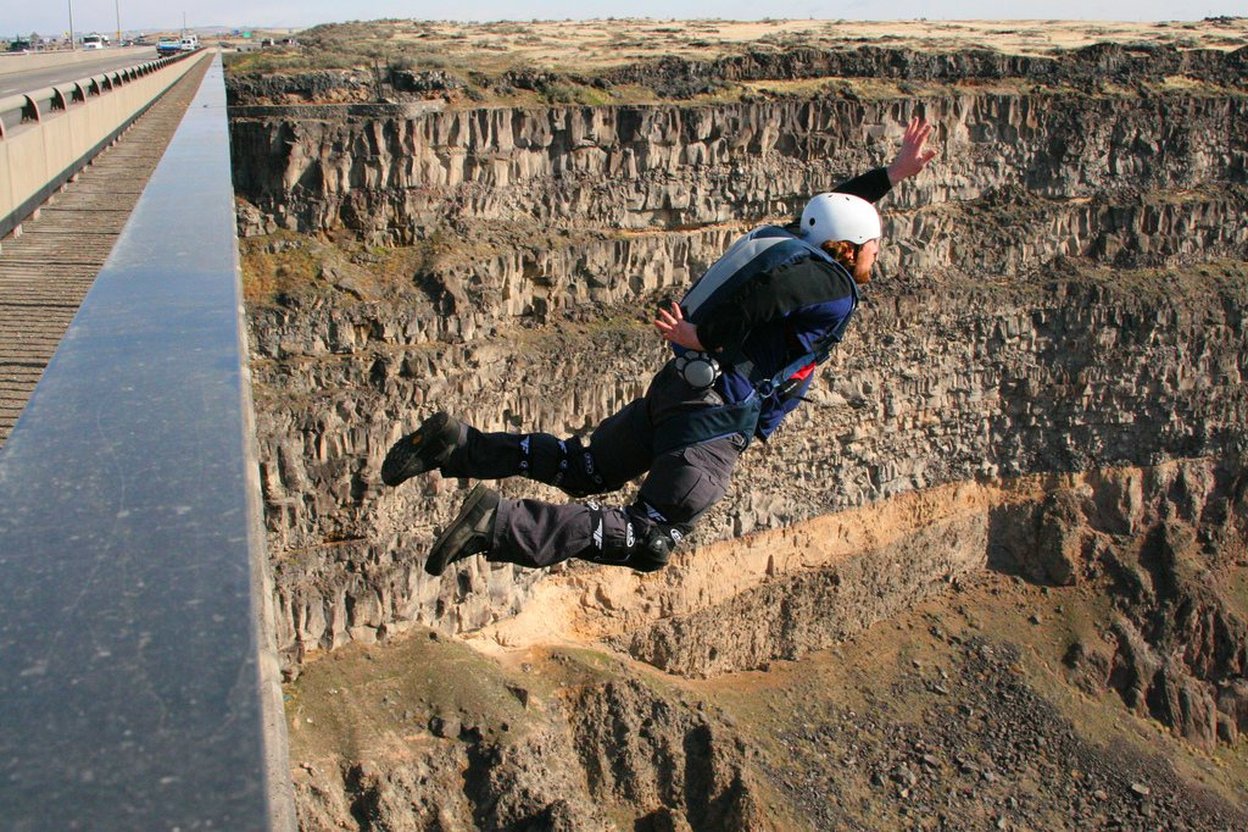
BASE Jumping vs. Skydiving: Why the Risks Are So Different
Both involve jumping with a parachute. But skydiving's fatality rate has fallen to a record low, while BASE jumping remains far more dangerous. What the numbers say and why the two sports are so different.
Skydiving and BASE jumping both end with a parachute. To people outside either sport, they can look like the same thing. But the risks are very different, and the gap has only grown as skydiving has become safer.
What BASE stands for
BASE is an acronym for the four kinds of objects people jump from: Buildings, Antennas, Spans (bridges) and Earth (cliffs). Instead of jumping from an airplane at thousands of feet, BASE jumpers jump from fixed objects, often just a few hundred feet up.
The numbers
Skydiving
The U.S. Parachute Association (USPA) tracks skydiving fatalities each year. In 2024, it reported nine fatalities among an estimated 3.88 million jumps in the U.S., the first time the yearly count dropped to single digits since records began in 1961. That's about 0.23 deaths per 100,000 jumps, the lowest rate ever recorded.
BASE jumping
BASE has no national tracking system, so data comes from studies of specific places. A widely cited study of BASE jumps from the Kjerag Massif in Norway looked at 20,850 jumps from 1995 to 2005 and found nine fatalities, about one death for every 2,317 jumps. Other studies have found similar or higher risk.
By those numbers, a BASE jump is many times more dangerous than a skydive.
Why BASE is so much riskier
Altitude
Skydivers usually open their parachutes at several thousand feet. That leaves time to deal with problems and, if needed, cut away a bad main parachute and deploy a reserve. BASE jumpers jump from much lower, often just a few hundred feet. There's very little time to fix anything.
The reserve parachute
Skydivers carry two parachutes: a main and a reserve. Most also have an automatic activation device (AAD) that opens the reserve if they don't. BASE jumpers typically use a single parachute, because there's no time to use a reserve.
The object
In skydiving, nothing is near you. In BASE, the cliff, building or bridge is right there. An opening that turns the jumper back toward the object ("off-heading") can lead to a strike.
Wind and landing areas
BASE landing areas can be small, rocky or tricky, and wind near cliffs and buildings is often turbulent.
Regulation and training
Skydiving in the U.S. happens at drop zones with trained instructors, licensing, equipment standards and aircraft rules. BASE jumping is less regulated and often illegal on many structures and in many parks.
Wingsuits
Wingsuit BASE flying, where jumpers glide close to terrain before opening, adds even more risk. See wingsuit flying: how it works.
Respect for the people who do it
BASE jumpers are often experienced skydivers who've spent years training, and they talk openly about the risks. When accidents happen, they're felt deeply in a small community. This isn't about judging anyone; it's about understanding the numbers honestly.
If you want to jump
If you're drawn to jumping, skydiving at a USPA drop zone is the place to start. See skydiving for beginners.
Sources (3)
Skydive Arizona: 2024, skydiving's lowest fatality rate ever (USPA data); USPA: How safe is skydiving?; Søreide et al., "How Dangerous is BASE Jumping? An Analysis of Adverse Events in 20,850 Jumps From the Kjerag Massif, Norway" (ResearchGate).
Photo: BASE jumping - Perrine Bridge by Chris McNaught from Twin Falls, Idaho, CC BY 2.0.