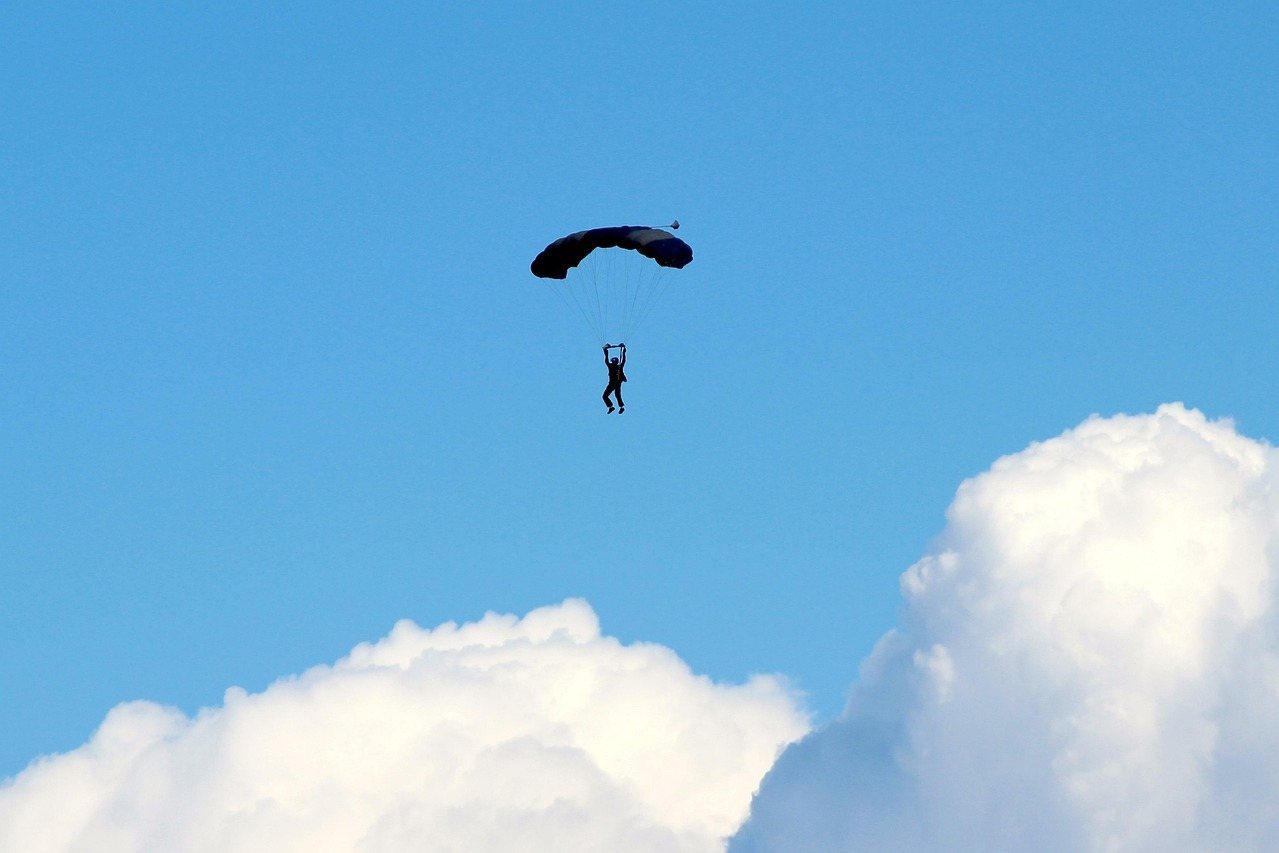
Jumping to New Heights: The Thrilling World of High Altitude Skydiving
Discover the science, thrill and safety measures of high altitude skydiving. Explore famous high-altitude jumps and future advancements. Read more
In sport skydiving, “high altitude” has a precise meaning. The United States Parachute Association (USPA) defines a high-altitude skydive as one made at or above 15,000 feet above sea level but below 18,000 feet, and its rules make supplemental oxygen on the aircraft mandatory for any jump from higher than 15,000 feet MSL. Above 18,000 feet, USPA stops giving advice at all and calls it outside sport-parachuting altitudes. The famous record jumps from the stratosphere, at 100,000 feet and up, are a different world: pressure suits, balloons and years of engineering.
Here is what changes as you go higher, what a high-altitude jump at a dropzone involves, and what the record jumpers actually did.
What “higher” means at a normal dropzone
Most US tandem and fun jumps leave the plane somewhere between about 10,000 and 14,500 feet above the ground. That is already high enough for the thin air to matter a little, but it sits under the line where oxygen becomes a requirement.
The extra altitude buys freefall time. USPA’s own freefall chart, which assumes a steady 120 mph, puts 13,000 feet of freefall at about 74 seconds and 15,000 feet at about 85 seconds. Real numbers vary with body position and the thinner air up high, but the rule of thumb holds: every extra 1,000 feet adds roughly five to six seconds.
Above sea level, not above the ground
The oxygen rule is written in MSL (mean sea level), and that trips people up. USPA’s manual spells it out: MSL is not to be confused with AGL (above ground level) or the dropzone’s elevation.
At a dropzone near sea level, a 14,000-foot exit is 14,000 feet MSL. At a dropzone sitting about a mile up, as in the Denver area, the same height above the ground is about 19,000 feet MSL. Even a 10,000-foot AGL exit there is past the 15,000-foot line. If you jump in the mountain West, ask the operator which number they are quoting and how they handle oxygen.
What thin air does to you
The main danger between 15,000 and 18,000 feet is hypoxia, a shortage of oxygen in the body’s tissues. USPA’s manual says it can impair judgment and motor function and, if it goes on, cause unconsciousness or death. The tricky part is that people often don’t notice it creeping in. The FAA’s Pilot’s Handbook of Aeronautical Knowledge warns that hypoxia can give you a false sense that everything is normal.
The same handbook lists the “time of useful consciousness,” the time you have to act sensibly without oxygen. At 20,000 feet it is 30 minutes or more. At 25,000 feet it drops to 3 to 5 minutes, at 30,000 feet to 1 to 2 minutes, and at 40,000 feet to 15 to 20 seconds. That curve is why record jumpers wear pressure suits and why sport jumpers stay on oxygen right up to the door.
It also gets cold. In the standard atmosphere, temperature falls about 3.5°F for every 1,000 feet you climb. An 80°F day on the ground works out to roughly freezing 14,000 feet up, and well below freezing at 18,000. Dress for the exit altitude, not the hangar. Cold hands also make it harder to work handles, which USPA’s manual flags as a hazard in cold weather.
How a high-altitude jump is run
The federal rule behind USPA’s requirement is 14 CFR 91.211, which bars flying at cabin pressure altitudes above 15,000 feet MSL unless every person on board is provided with supplemental oxygen. USPA’s Skydiver’s Information Manual (section 5-6 in the 2026 edition) lays out how a high-altitude load should work:
- Every jumper and crew member gets their own mask or nasal cannula, even if they all draw from one central oxygen bottle.
- A backup oxygen system should be on board in case the main one fails.
- Everyone puts on oxygen, with flow running, before the plane passes 15,000 feet MSL, and the flow is watched on gauges or flow indicators for the rest of the climb.
- Jumpers stay on oxygen as long as possible and take masks off only at the climb-out or exit signal.
- If the jump run is aborted, everyone puts their oxygen back on and waits for the crew’s instructions.
- No smoking near the aircraft while oxygen is aboard, because oxygen makes fires burn explosively.
USPA also recommends that everyone on the load practice these steps on the ground first and get familiar with the oxygen equipment being used.
Training for it
USPA says jumpers going above 15,000 feet benefit from hypoxia-recognition training that lets you experience your own symptoms safely. The FAA offers altitude chamber training at its Civil Aerospace Medical Institute in Oklahoma City, according to its Balloon Flying Handbook. The FAA notes that symptoms vary from person to person. Its list includes headache, euphoria, tingling in the fingers and toes, blue lips and fingernails, and vision problems. Learning which ones show up first for you is the point of the training.
The flying skills don’t change. You still need stable freefall, good altitude awareness and correct emergency procedures. Many jumpers polish those in a wind tunnel, which USPA’s student rules now accept for some early training.
The record jumps
None of these were things you could book. Each one used a balloon, a pressure suit, and a team.
Joseph Kittinger, 1960
On August 16, 1960, US Air Force Captain Joseph Kittinger stepped out of a balloon gondola at 102,800 feet over New Mexico as part of Project Excelsior, which studied high-altitude bailouts. He fell for 4 minutes 36 seconds with a small drogue chute for stability, in temperatures as low as -94°F, and opened his main parachute at 17,500 feet. On the way up, the pressure seal on his right glove failed and his hand swelled painfully. He kept that to himself so the test wouldn’t be called off. His altitude record stood until 2012.
Felix Baumgartner, 2012
On October 14, 2012, Felix Baumgartner rode a pressurized capsule under a helium balloon from Roswell, New Mexico, and stepped out at 38,969.4 meters, or 127,852 feet. The Red Bull Stratos jump set three records ratified by the FAI, the world air sports federation: exit altitude, freefall distance (36,402.6 meters, about 119,400 feet) and top speed, 1,357.6 km/h or about 844 mph. That made him the first person to break the speed of sound outside a vehicle, at Mach 1.25. Part of his fall was a violent spin before he stabilized. He did not use a drogue, which is why his speed and distance records are listed as “without a drogue.”
Alan Eustace, 2014
Two years later, Google executive Alan Eustace beat the altitude mark. He didn’t ride in a capsule. He hung beneath a balloon in a custom pressure suit and released at about 135,890 feet (41,419 meters by the Smithsonian’s figure). He used a drogue for stability. His suit had heated gloves and thermal protection rated to -110°F, and it is now on display at the Smithsonian’s Steven F. Udvar-Hazy Center in Chantilly, Virginia. When FAI marked the 10th anniversary of Baumgartner’s jump in 2022, Eustace’s exit altitude was still the record, while Baumgartner still held the speed and distance marks.
Michel Fournier, who never got to jump
French parachutist and retired air force officer Michel Fournier spent years trying to jump from about 130,000 feet. According to CBS News, wind gusts shredded his balloon on the ground in 2002 and 2003. In May 2008, at North Battleford, Saskatchewan, the balloon broke away from his capsule while it was being inflated and drifted off empty. A 2010 attempt ended when his reserve parachute deployed inside the capsule during a pre-launch test. He never made the jump. His story is a good reminder of how much has to go right before a stratospheric jumper even leaves the ground.
Gear that changes with altitude
For a USPA-style high-altitude jump under 18,000 feet, the parachute system is the same one you’d use at 13,000 feet. What changes is the aircraft (oxygen system and backup) and your clothing (warmer layers, gloves you can still work handles in).
Above 18,000 feet you are outside USPA’s recommendations. The manual says anyone jumping there should get outside expertise, use specialized oxygen equipment, and build procedures and support for that specific jump. The stratospheric jumps above went further still: full pressure suits, and in Kittinger’s and Baumgartner’s cases a gondola or pressurized capsule for the ride up.
If you want to jump higher than usual
- Get the exit altitude in both AGL and MSL. The oxygen rule uses MSL.
- If the exit is above 15,000 feet MSL, ask how the oxygen is set up, who briefs you on it, and whether there’s a backup system on the plane.
- Practice the oxygen procedure on the ground before the climb, including what to do if the jump run is aborted.
- Dress for the temperature at exit altitude: figure about 3.5°F colder for every 1,000 feet.
- Ask how much extra freefall you’ll actually get. From a normal-altitude airport, a few thousand extra feet is roughly 15 to 25 seconds.
- If you fly or jump at altitude often, consider hypoxia-recognition training so you know your own early warning signs.
Photo by nightowl on Pixabay.