Wingsuit Flying: How It Works and Who Can Do It
Wingsuit pilots glide through the sky at highway speeds in a suit with fabric wings. How wingsuits fly, how skydivers progress to them, and why proximity flying is so dangerous.
You've probably seen the footage — a person in what looks like a sci-fi bat suit launches from a cliff or a plane, tilts forward, and glides across the sky like a giant bird. For a few seconds your brain refuses to categorize it. That's wingsuit flying. And unlike almost every other extreme sport, it comes with a precise, non-negotiable apprenticeship before you're allowed to try it. Here's how the suit actually works, how those numbers compare, and what it honestly takes — in time, money, and skill — to get there.
How a Wingsuit Actually Works
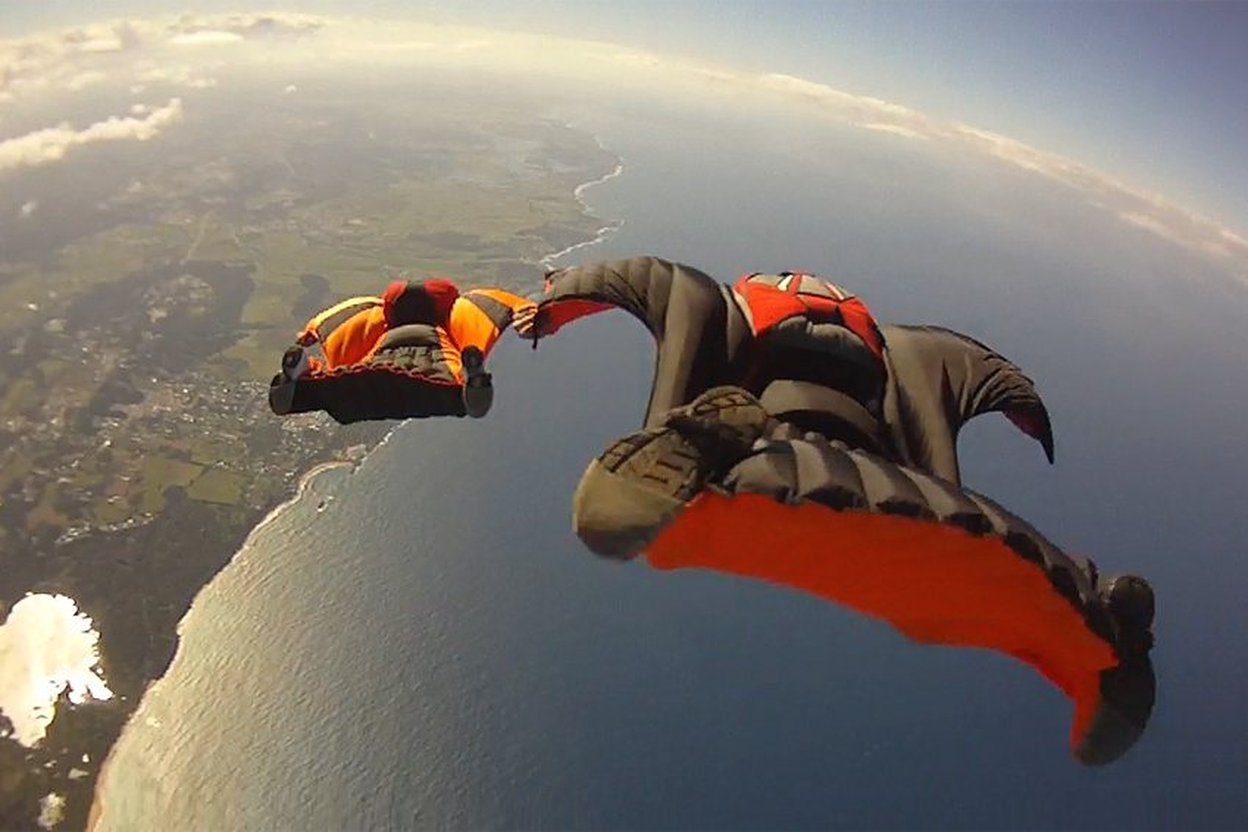
A wingsuit adds three fabric panels to a modified skydiving jumpsuit: one between each arm and the torso, and one between the legs. When the flyer spreads out, air rams through inlet vents and pressurizes those panels into rigid, wing-shaped airfoils. The result is lift — the same force that holds an airplane up — applied to a human body.
The physics are more impressive than they look. A trained wingsuit pilot can achieve a sustained glide ratio of 2.5:1, meaning for every foot of vertical descent, they travel 2.5 feet horizontally. Vertical descent rates drop to around 25–30 mph — roughly 80% lower than a regular skydiver in freefall. The tradeoff is speed in another direction: horizontal speeds typically run 160–200 km/h (about 100–125 mph) during a relaxed glide and can reach 220 mph in a dive.
One number you've probably seen quoted — 396.86 km/h — is British pilot Fraser Corsan's world speed record. That's a peak vertical-diving figure, not a cruise speed, which is why it looks so different from the 160–200 km/h average. These are measuring different things: average horizontal cruise vs. maximum total airspeed in a record attempt. When a source doesn't specify, it's worth asking which axis they're measuring.
Like every skydive, a wingsuit flight ends with a parachute. The suit itself cannot land. Wingsuit pilots typically deploy at 4,000–5,000 feet above ground level, using a main canopy of 120–150 square feet — smaller and more maneuverable than a standard recreational rig.
A History of Problems Solved
The idea of a human glide suit is not new, and early attempts were fatal.
On February 4, 1905, French tailor Franz Reichelt jumped from the Eiffel Tower wearing a wingsuit of his own design. He fell straight down. The suit never inflated. The fundamental engineering problem — how to get a fabric garment to pressurize and hold its shape at speed — would take nearly a century to solve reliably.
The first documented survival came in 1930, when American Rex G. Finney, then 19 years old, used a wingsuit during a parachute jump. Progress stalled for decades.
In the mid-1990s, French skydiver Patrick de Gayardon developed the design that became the template for the modern wingsuit — pressurized wing cells, a stable glide attitude, and a configuration a skilled skydiver could actually control. His work reframed the suit from a novelty into a discipline.
What followed was fast:
- 1997: Sammy Popov built a prototype in Boulder City, Nevada, adding a larger leg wing and longer arm wings for more lift surface.
- 1998: Chuck Raggs added hard ribs inside the wing airfoils, giving the panels more consistent shape under pressure.
- 1999: Finnish skydiver Jari Kuosma and Slovenian designer Robert Pečnik combined those lessons into the "Birdman Classic" — the first commercially available wingsuit, designed from the start to be safe enough to sell to the public. Kuosma simultaneously founded Bird-Man International Ltd to distribute it.
The "Birdman Classic" set the minimum bar: a suit a skilled skydiver could train on. It also established the first instructor programs, which set a minimum of 200 jumps before a student could attempt a wingsuit flight — a threshold that has since become codified by the USPA.
Who Can Do It — the Real Rules
Every article you'll find says "you need 200 jumps." That's true but incomplete, and the missing detail matters.
The full USPA prerequisite for wingsuit training:
- A minimum of 200 freefalls completed within the last 18 months — OR — 500 total jumps
- A current USPA B-license or higher
- Completion of a certified First Flight Course with a qualified wingsuit instructor
The 18-month recency clause is the one most articles skip. It's not enough to have made 200 jumps years ago; they need to be recent, because the skills that keep a wingsuit pilot alive — canopy control, freefall stability, emergency procedures — degrade without practice. The 500-total-jump alternative exists for experienced skydivers whose 200-jump count stretches further back.
Why does the threshold exist at that number? Wingsuit body position is unforgiving. A bad deployment at speed can mean an unstable opening; recognizing a malfunctioning canopy and cutting away cleanly takes reflexes built over hundreds of repetitions. The 200-jump rule isn't gatekeeping — it's the amount of practice the sport has determined you actually need.
From your first tandem jump to wingsuit-qualified typically takes two to three years at a realistic pace.
What It Actually Costs
This is the number almost no editorial article gives you, so here it is in plain terms (prices as of late 2025, based on US community reporting):
To reach your first wingsuit flight:
- AFF (Accelerated Freefall) course to earn your skydiving license: approximately $2,500, assuming you pass every level on the first attempt
- 200 qualifying jumps at approximately $30 per jump: approximately $6,000
- Skydiving rig + wingsuit gear, new or used: $5,000–$10,000
Realistic total before your first wingsuit flight: approximately $12,000–$18,500
That range assumes no failed AFF levels, consistent jumping to stay current, and a mix of new and used gear. It does not include travel to a drop zone, accommodation, or the wingsuit First Flight Course itself.
Gear: What You're Actually Wearing
A beginner wingsuit is significantly smaller than what you see in proximity-flying videos — less surface area means more forgiving handling and a more upright body position. Advanced suits add larger panels, extending the glide ratio and top speed, but demanding proportionally more skill to fly and more precision on deployment.
Regardless of suit size, all wingsuit rigs require a canopy sized for the deployment speeds involved: 120–150 square feet is the standard range. Pulling at 4,000–5,000 feet AGL gives enough altitude to handle a malfunction before terrain becomes the deciding factor.
At the elite end of the sport, altitude introduces another variable. Fraser Corsan, who started in 2001 when there were an estimated 15 wingsuit pilots in the world and has since completed over 1,300 jumps, carries a 45-minute oxygen bottle pressurized to 6,000 psi mounted on his parachute container for high-altitude attempts. His planned record jump — from above 40,000 feet, targeting speeds over 250 mph, covering 20 miles in over 10 minutes of flight — also requires a Class A Airspace Clearance to divert commercial airliners from the flight path. That is a different sport from recreational wingsuiting, in the same way that Formula 1 is a different sport from driving to work.
Training Options: Including the Tunnel
One gap in most wingsuit coverage is the existence of wingsuit-specific wind tunnels — a meaningful shortcut for skill development.
Inclined.se in Sweden unveiled the world's first wingsuit tunnel in 2017. Rather than the vertical tunnels used for belly-flying, a wingsuit tunnel is angled to simulate the body position of a gliding suit, letting pilots practice stability, turns, and pitch control without spending altitude. A U.S. wingsuit tunnel location is planned for Kissimmee, Florida, near Orlando. Tunnel time compresses the feedback loop considerably — a session in the tunnel can replicate dozens of brief freefall intervals, allowing coaches to freeze and correct body position in ways that are impossible at altitude.
The Competitive Side
Competitive wingsuit flying gets almost no coverage, which is odd given how structured it has become.
The first FAI World Cup in Wingsuit Performance Flying was held in May 2015 in Netheravon, UK. The first FAI World Wingsuit Performance Flying Championships followed in November 2016 in Zephyrhills, Florida. Performance flying competitions are scored on objective measures: speed, distance, and time-of-flight tracked via GPS.
One discipline worth knowing about is XRW — Cross-discipline Relative Work — in which wingsuit pilots fly in formation with canopy pilots. The low stall speeds that modern wingsuits can achieve make it possible to match the descent rate of an open parachute closely enough for sustained formation flying. It's among the more visually striking things happening in the sport right now.
The growth of the competitive side reflects the sport's overall expansion. Active wingsuit jumpers have grown by an estimated 300–400% over the past decade. In 2016, Skydive Perris in California alone logged approximately 3,300 wingsuit jumps in a single year. New suit versions from major manufacturers are released every two to three years. When Fraser Corsan started in 2001, there were roughly 15 wingsuit pilots in the world.
Skydive Wingsuiting vs. Proximity Flying: Two Different Things
If the footage you've seen shows someone threading a canyon at 150 mph with ten feet of clearance, that is proximity wingsuit BASE jumping — launching from a fixed object (cliff, antenna, bridge) rather than an aircraft, with no altitude reserve and no room for error. It has claimed the lives of many experienced pilots.
Recreational skydive wingsuiting — the version described throughout this article — happens from aircraft at several thousand feet of altitude, over open terrain, with ample time to deploy a parachute if anything goes wrong. The entry requirements, the risk profile, and the experience base required are categorically different. If you're drawn to wingsuiting because of cliff-flying videos, it's worth knowing clearly: that is not what you would be doing as a beginner, or likely as an intermediate pilot.
Is This for You?
A few honest questions before you commit:
- Budget: Can you realistically put $12,000–$18,500 toward a hobby over two to three years? That's the floor for most US-based aspiring wingsuit pilots before their first actual wingsuit flight.
- Time: Reaching 200 recent jumps requires consistent access to a drop zone across multiple seasons. Geography matters — are you within driving distance of a facility that's open year-round or most of the year?
- Starting point: You don't need a wingsuit on day one. A tandem skydive is the legitimate first step, and the AFF course is the second. The wingsuit comes after a few hundred jumps of building the foundational skills that keep the suit from killing you.
- Fitness: No specific fitness standard is codified in the USPA prerequisites, but freefall body control demands core stability, spatial awareness, and the physical ability to manipulate your body position precisely at speed.
The sport is demanding, expensive, and slow to enter by design. It's also one of the fastest-growing disciplines in skydiving. Whether that's a reason to start or a reason to watch from the ground is a question only you can answer.
---
Sources (7)
- USPA – The Future of Wingsuits
- Sportsmatik – Wingsuit Flying: History, Types, Objective & Equipment
- Flightline Weekly – Wingsuiting: Adrenaline Amplified
- UK Parachuting – Flying The Wingsuit
- Thai Sky Adventures – Wing Suits Skydiving: Ultimate Guide
- The Telegraph – 10 Things No One Tells You Before You Become a Wingsuit Jumper
- Reddit/r/SkyDiving – Finally did it: my first wingsuit flight