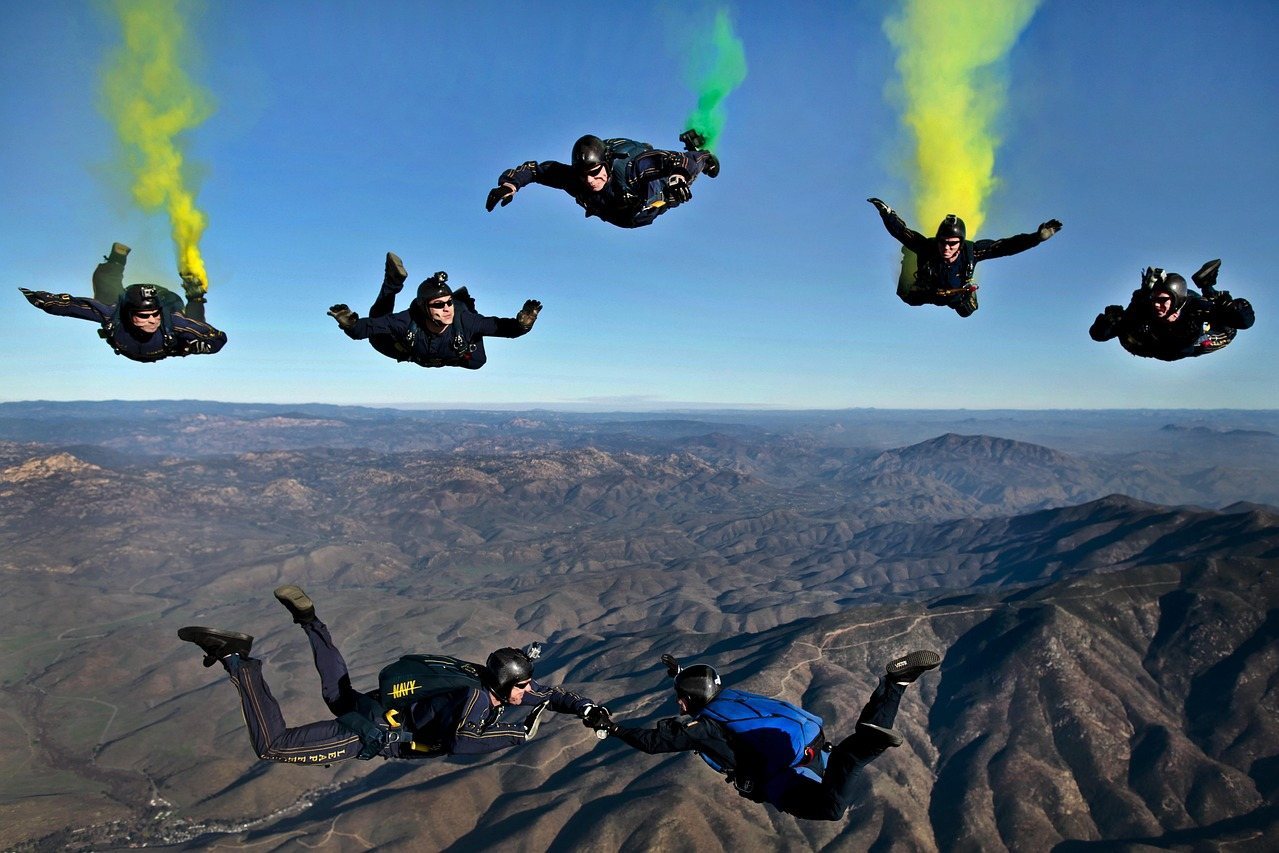
Flying with Precision: Mastering Skydiving Techniques for Optimal Freefall Control
Learn how to control your body during freefall with these skydiving techniques. Mastering them ensures a safe and enjoyable experience.
Freefall control comes from a relaxed, symmetrical arch and small, deliberate changes to it. You press an arm down a few inches to turn, straighten your legs to move forward, and change the shape of your torso to fall faster or slower. In the United States, those skills are taught in a fixed order through the USPA’s Integrated Student Program, laid out in the Skydiver’s Information Manual (SIM). This post walks through that order so you know what each skill is and why it comes when it does.
Read this as background, not training. Nothing here replaces a ground school and jumps with a USPA-rated instructor. Body positions that look simple on paper feel very different at 120 mph, and the details your instructor corrects on video are the details that matter.
What you are controlling, and how fast it happens
The USPA puts belly-to-earth freefall speed at about 120 mph, and a tandem or AFF freefall lasts 30 to 60 seconds (USPA FAQ). At that speed, the air pressing on your body is what you steer with. Any part of you that sticks out further on one side, or tilts at a different angle, pushes you around.
That is why the SIM keeps coming back to symmetry. Most “instability” on a student jump is not a big mistake. It is one knee bent more than the other, a dropped shoulder, or tension in the arms you didn’t notice.
The neutral body position
Everything starts here. Category A of the SIM describes the neutral position this way:
- Hips: forward, with the back arched from the hips, not from the neck.
- Legs: knees about shoulder-width apart, legs extended slightly, knees bent about 45 degrees, toes pointed.
- Arms: upper arms 90 degrees or less from the torso, elbows bent 90 to 120 degrees, both relaxed.
- Head: chin up.
The word that shows up most is “relaxed.” A stiff arch makes you rock. Instructors often call the position a “box,” and you’ll hear it described differently from one dropzone to the next, but the SIM numbers above are the reference.
One myth worth clearing up: turning your head is not how you steer. Your chin stays up and your eyes go to the horizon, which helps you hold a heading. Turns come from your arms and shoulders, covered below.
Altitude first, always
The SIM calls altitude awareness your most important task until the parachute is open. On a first AFF jump you run a circle of awareness: look at the horizon to check your heading, read your altimeter, then look at each instructor for hand signals.
When something feels wrong, students are taught HAALR (Category C):
- Heading: are you turning?
- Altitude: read the altimeter.
- Arch: at the hips.
- Legs: extended to about 45 degrees, toes pointed.
- Relax: let go of the tension you didn’t mean to have.
Category C also uses a simple self-check called AIR: altitude aware, in control, relaxed. If you aren’t all three, the SIM gives you five seconds to fix it.
Turns: start, coast, stop
Turns are taught in Category D with a method called start-coast-stop.
- Start by pressing one elbow down from the shoulder joint only, no more than 45 degrees. Your legs stay neutral.
- Coast by going back to neutral before you reach the heading you want. The rotation keeps carrying you.
- Stop with a small counter-input the other way, then return to neutral.
Students fly 90-, 180- and 360-degree turns in both directions, picking a point on the horizon as a reference. All turns stop by 6,000 feet. The common mistake is too much input: a big arm movement gets you a fast spin that’s hard to stop, while a small one gets a turn you can control.
Moving forward and changing fall rate
To move forward, Category G uses the same start-coast-stop idea as turns: extend your legs to start, return to neutral to coast, then extend your arms and push down slightly to stop.
Fall rate is how fast you’re dropping, and you change it by changing your neutral shape (Category G):
- To go down faster: push your hips forward, raise your chin, and lift your shoulders and knees to spill air.
- To go up (slow down): round your spine, widen and drop your knees, cup your shoulders and chest, and extend your arms, pushing down slightly.
Fall rate is the skill that makes jumping with other people possible. In Category G you match levels with a coach, move into your “slot,” and fly on level all the way in before taking a grip.
Loops, rolls, and getting stable again
Category E is where you get disoriented on purpose: a barrel roll, a back loop and a front loop. The point is not the trick. It is proving you can return to stable, on heading, within five seconds of starting each one.
For each maneuver, the recovery is the same move: go back to the neutral body position. When you’re tumbling, your arch is what turns you belly-down again. Fighting it with flailing arms and legs makes it worse.
Tracking
Tracking is flying across the sky instead of straight down, and it’s how you get horizontal distance from other jumpers before you open. Category F describes it as:
- Smoothly and fully extend both legs, toes pointed, to start forward motion.
- Fully extend your arms to the side, pressed down level with your hips.
- Roll your shoulders and flatten your arch to control pitch.
Students practice a five-second track on heading, then stop by passing through neutral and extending the arms forward and down slightly. In group jumps, the SIM says breakoff should happen at least 1,500 feet above the planned deployment altitude: turn 180 degrees from the center of the group, track away, stop, and deploy.
Deployment: where control pays off
Every freefall skill exists to get you to the right altitude, stable, and clear of other jumpers when you pull.
- AFF students lock on to the altimeter at 6,000 feet and wave off at 5,500 feet by waving both arms smoothly overhead. The pull sequence takes roughly 1,000 feet (Category A).
- Tandems lock on at 6,500 feet and wave off at 6,000.
- Minimum container opening altitudes in the USPA Basic Safety Requirements: 5,000 feet for tandems, 3,000 feet for students and A-license holders, and 2,500 feet for B, C and D licenses (C and D can be waived to no lower than 2,000).
Most modern sport rigs use a hand-deployed pilot chute that you throw from a pouch, not a ripcord. Students also jump with an automatic activation device (AAD), which the BSRs require. An AAD is a backup that fires the reserve if you are still in freefall too low. It is not something you “hit” to deploy.
Category F adds clear-and-pulls: exit and deploy within five seconds, first from 5,500 feet and then from 3,500 feet. It teaches you to get stable quickly and open without a long freefall to settle in.
Where head-down and other advanced flying fit
Head-down, sit-flying and other freeflying positions come after the student program, once you can fly your belly well. Head-down freefall is faster than belly flying, which is why SIM Chapter 5 notes that from 13,000 feet a belly jump gives about 60 seconds of freefall while a freefly jump may be as short as 40. Learn it from a coach who freeflies, and expect to spend time on it in a wind tunnel or with a coach before trying it with others.
Your next step
If you want to learn freefall control, the path is the same at every USPA dropzone:
- Book a first-jump course for AFF (or the dropzone’s instructor-assisted program) at a USPA Group Member dropzone.
- Read Category A of the SIM before ground school so the terms are familiar.
- Expect to work through Categories A to H, then 25 total jumps, a check dive, a written exam (75% to pass) and an oral exam (100%) for your A license.
- Ask for video debriefs. Seeing your own bent knee or dropped shoulder fixes more than any article can.
The one thing to remember: in freefall, small and symmetrical beats big and fast, and altitude beats everything.
Photo by 12019 on Pixabay.