Tandem, Solo, or Formation Skydiving: How Each Jump Works and Which One to Try First
Compare tandem, solo, and formation skydiving: how each jump works, the federal and USPA rules, age limits, training, and which to try first.
You've probably watched a helmet-camera clip of someone leaving an airplane door and wondered whether you could do it, and how. There are three ways in. A tandem jump straps you to a highly qualified instructor and asks almost nothing of you, as long as you're at least 18. Solo skydiving means training through a supervised student program until you earn a license, which takes at least 25 jumps. Formation skydiving is what licensed jumpers do together, building shapes in freefall. Most people meet them in that order.
The rules every jump shares
Whichever kind of jump you make in the United States, the same federal rules apply. Intentional parachute jumps fall under 14 CFR Part 105, which exists to protect other air traffic and people and property on the ground. The Federal Aviation Administration adds detailed guidance on equipment, jump aircraft, and pilot training in Advisory Circular AC 105-2E.
The equipment rules affect every jumper. Anyone using a single-harness system has to wear two parachutes: a main and an approved reserve. A reserve made of synthetic material such as nylon has to have been packed by an FAA-certificated parachute rigger within the previous 180 days. For a reserve containing silk or other natural fibers, the limit is 60 days. Riggers are certified under a separate set of rules, 14 CFR Part 65.
Many rigs also carry an automatic activation device (AAD). It is required by law on every tandem system and by the United States Parachute Association (USPA) on student gear. At least 90% of experienced skydivers choose to use one anyway.
You don't actually jump through the clouds
The image of falling through a cloud bank is common, but it's illegal. Under 14 CFR 105.17, no one may jump into or through a cloud, and jumpers have to stay clear of clouds by set distances. Below 10,000 feet above sea level, the minimums are:
- 500 feet below a cloud
- 1,000 feet above a cloud
- 2,000 feet horizontally from a cloud
At or above 10,000 feet, the minimums are 1,000 feet below, 1,000 feet above, and one mile horizontally.
The airspace itself is managed too. In Class E and G airspace, Air Traffic Control has to be notified between 1 and 24 hours before jumping, or under a written agreement that can last up to 12 calendar months. In Class A, B, C, and D airspace, the controlling ATC facility has to authorize the jump.
How safe it is
USPA tracks civilian skydiving deaths in the U.S. every year:
- 2023: 10 deaths in about 3.65 million jumps, a rate of 0.27 per 100,000 jumps.
- 2024: 9 deaths in about 3.88 million jumps, the lowest count and lowest rate on record at 0.23 per 100,000.
- 2025: 16 deaths in more than 3.4 million jumps, about 0.46 per 100,000.
So even a worse year stayed under one death per 200,000 jumps. The risk is real, but it is small and well measured.
Tandem skydiving: someone very experienced is in charge
On a tandem jump you're harnessed to a "parachutist in command," and federal rules set a high bar for that person. Under 14 CFR 105.45, a tandem instructor must have:
- at least 3 years of parachuting experience
- at least 500 freefall jumps on a ram-air parachute
- a master parachute license from an FAA-recognized organization
- a completed tandem instructor course approved by the equipment manufacturer
The rules also set out what happens before you board. Your instructor must brief you on emergency procedures, the exit, freefall, parachute operation, and landing. The main parachute must be packed by one of three people: a certificated rigger, the instructor who will jump it next, or someone working under a rigger's direct supervision. As noted above, the tandem rig must carry an AAD.
The main limit is age. USPA's Basic Safety Requirements and U.S. tandem equipment makers set 18 as the minimum. The only exceptions are rare manufacturer-approved waivers for people who are terminally ill.
Tandem is the easiest way to feel freefall, but you are a passenger. To fly your own body and open your own parachute, you need training.
Solo skydiving: training toward a license
"Solo" doesn't mean jumping alone from the first day. Student jumps happen under instructor supervision. The training follows USPA's Integrated Student Program, which is set out in the Skydiver's Information Manual (SIM) along with the rules for moving up through license levels. The minimum age is 18 here too.
Packing and equipment are taught during the student program, not added afterward. The program ends with the A-license, which requires:
- at least 25 freefall jumps
- every task on the student progression card completed
- passing oral, written, and practical exams
The license changes what you're allowed to do. With an A-license you can:
- jump without an instructor directly supervising you
- pack your own main parachute
- take part in basic formation skydiving
That last privilege leads to the third kind of jump.
Formation skydiving: flying together
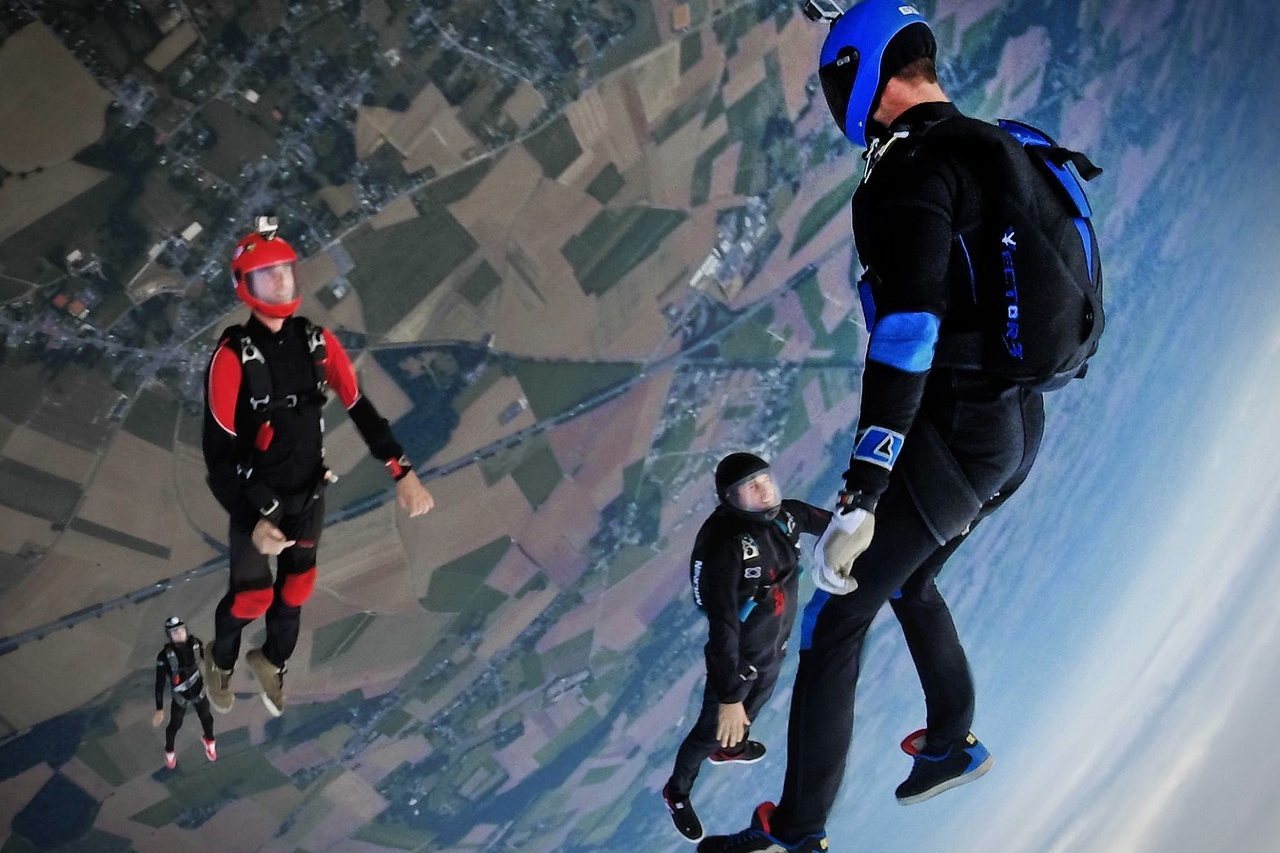
Formation skydiving means jumpers flying to each other in freefall, taking grips, and building planned shapes. Competitive four-way teams go well beyond four people holding hands in a square. They build a sequence of different formations and move between them, including "block" maneuvers where the group reshapes itself.
These jumps are planned on the ground first. Teams walk through the sequence before boarding, often called "dirt diving." That's normal practice across skydiving, not a burden unique to formation work. The added complication is that everyone's timing depends on everyone else.
At the extreme end, the official Fédération Aéronautique Internationale (FAI) world record for the largest formation is 400 people. The World Team built it in Thailand in 2006.
Which one should you try?
For most people the three types work as stages, not alternatives:
- Tandem if you want to feel freefall once, with an instructor who has hundreds of jumps and years of experience making every decision.
- The student program if, after that, you want to fly yourself. Expect at least 25 supervised jumps and a set of exams before you're licensed.
- Formation skydiving once you hold an A-license and want to fly with other people instead of beside them.
Whichever you choose, check that the drop zone is a USPA member. Then you'll know the age limits, training standards, and safety rules described here apply to your jump.
Sources (7)
- eCFR, 14 CFR Part 105, Parachute Operations: ecfr.gov
- eCFR, 14 CFR 105.17, Flight visibility and clearance from cloud requirements: ecfr.gov
- eCFR, 14 CFR 105.43, Use of single-harness, dual-parachute systems: ecfr.gov
- eCFR, 14 CFR 105.45, Use of tandem parachute systems: ecfr.gov
- eCFR, Title 14 (including Part 65, parachute riggers): ecfr.gov
- Federal Aviation Administration (Part 105 guidance, ATC notification and authorization, AC 105-2E): faa.gov
- United States Parachute Association (Basic Safety Requirements, SIM, A-license, fatality statistics, records): uspa.org