Indoor Skydiving: What Really Happens Inside the Wind Tunnel
A guide to indoor skydiving: how wind tunnels hold you up, who may fly, what to wear, how to hold your body, and the real risks.
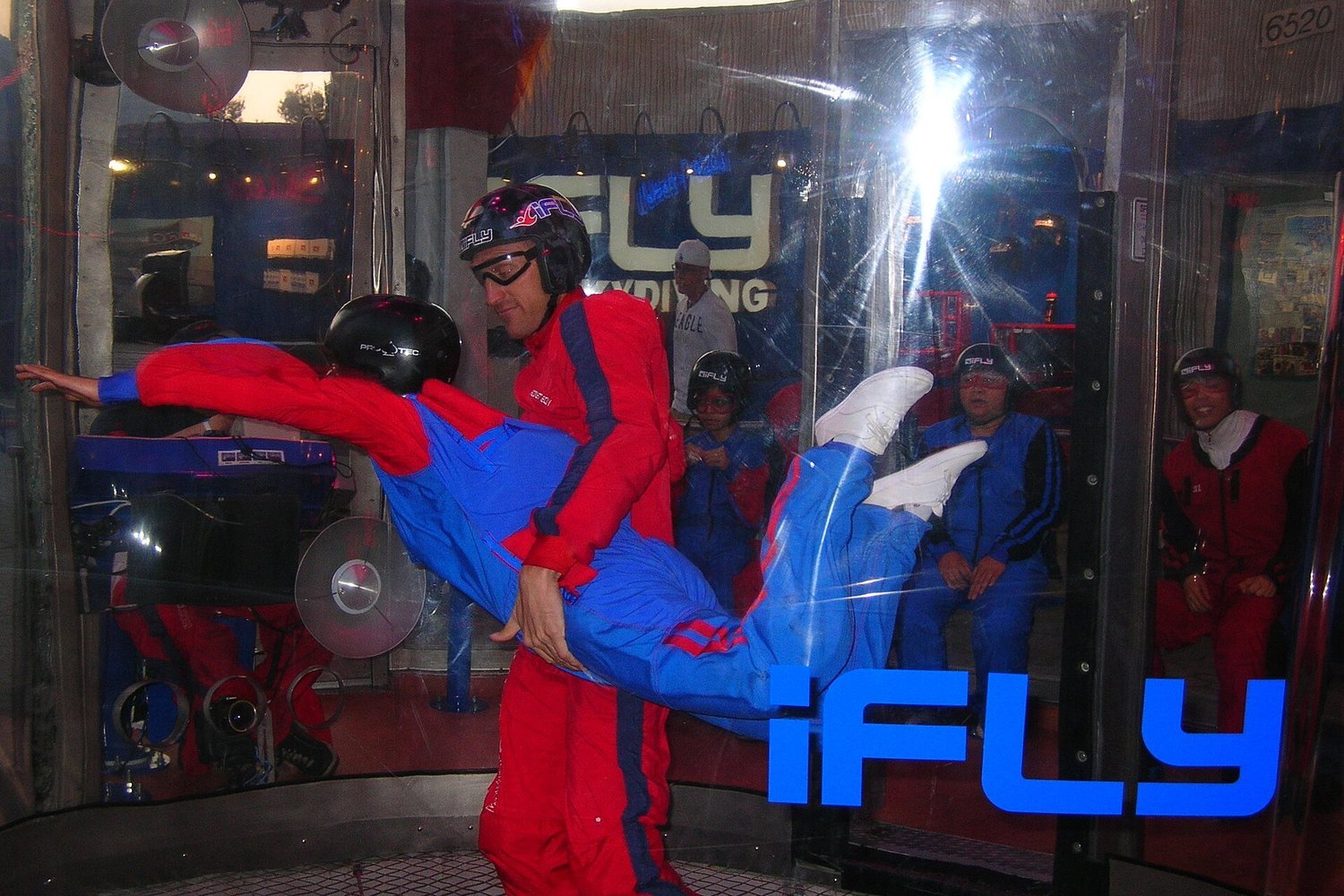
On the highway, you hold your hand out the car window, tilt it, and feel the air lift it. Indoor skydiving does that to your whole body. You float belly-down on a column of air blown up through a vertical wind tunnel, fast enough to hold you up the way freefall would. A first visit usually means two flights of one minute each. Below: where the idea came from, how the tunnel works, who may fly, what to wear, how to hold your body, and what can go wrong.
From Military Test Rig to Weekend Outing
Vertical wind tunnels were not built for fun. At Wright-Patterson Air Force Base in Ohio, a tunnel built between 1943 and 1945 was used to test parachutes and how aircraft behave in a spin. In 1964, Jack Tiffany flew in it without support. That is the first documented flight of a person in a vertical wind tunnel.
Canadian inventor Jean Saint-Germain turned the idea into entertainment. In 1979 he built the "Aérodium" in Saint-Simon-de-Bagot, Quebec. Installations followed in Las Vegas and Pigeon Forge, Tennessee, in 1982. In 1984 he received U.S. Patent No. 4,457,509, for a "Levitationarium for air flotation of humans."
The modern style of tunnel arrived in July 1998. That month, Bill Kitchen's company SkyVenture opened the first commercial wall-to-wall vertical wind tunnel on International Drive in Orlando, Florida. Alan Metni acquired the company in 2002 and expanded it under the brand iFLY, which now dominates the business.
How the Tunnel Holds You Up
Fans push air up through a glass flight chamber. At full power, tunnels can reach about 180 mph, though operators often cap them around 171 mph (275 km/h). Beginners don't need that much. They fly at managed speeds near the terminal velocity of a skydiver falling outdoors, around 120 mph.
Flights are short. At iFLY, a standard session lasts 60 seconds, and introductory packages usually include two turns in the chamber. Sixty seconds may sound brief. Holding a stable position in that much wind takes real effort, though, and a minute goes further than you'd expect.
Who Can Fly
The rules below are iFLY's. Other operators set their own, so check with your tunnel before booking.
- Age: Flyers must be at least 3 years old, and there is no upper limit. A parent or guardian signs the liability waiver for anyone under 18.
- Weight: Up to 260 lbs, you can fly without restriction. Between 260 and 300 lbs, staff do an in-person safety evaluation at check-in. Over 300 lbs, you cannot fly.
- Pregnancy: Pregnant guests may not fly.
- Shoulders: Operators strongly advise against flying, and may refuse you, if you have ever dislocated a shoulder. The upward air puts real load on the shoulder joint.
- Alcohol and drugs: You may not fly under the influence of alcohol or unprescribed drugs. You confirm on the waiver that you are not impaired.
What to Wear and What You're Given
The tunnel supplies a flight suit, a helmet, goggles, and earplugs. The chamber is loud enough that hearing protection is required.
Your shoes are up to you, and they matter. Wear well-fitting lace-up athletic sneakers. Sandals, boots, and slip-on shoes are not allowed, because loose footwear can come off in the airflow. Pads are not part of the standard first-timer kit, so don't count on them.
How to Hold Your Body
Instructors teach a neutral belly-flying position based on the International Bodyflight Association's training material:
- Chin up. Keep your head raised.
- Knees bent and relaxed. Stiff, straight legs make it harder to balance the air.
- Arms bent, hands flat against the wind. Your palms face the oncoming air rather than each other.
Your body works like that hand out the car window. Small changes in angle move you, so the goal is to stay relaxed and symmetrical. If you tense up or twist, the air amplifies the mistake. Fliers call the resulting wobble "potato-chipping."
What Can Go Wrong
Tunnels are often marketed as fine for three-year-olds, and most flights end without trouble. The risk is not zero, though, and it helps to know where it lies.
The belly-flying position pushes the shoulder up and back against fast-moving air. In medical terms, that is abduction and external rotation. Clinical reports indexed by the National Institutes of Health describe flyers who dislocated a shoulder this way. Some also suffered the bone and cartilage damage that often comes with dislocation, known as Bankart and Hill-Sachs lesions. Other case reports describe a stretch injury to the musculocutaneous nerve from holding the arms raised and extended for long periods. That injury left patients with arm weakness and numbness along the outer forearm. This is why a past dislocation is a reason to stay out.
Serious accidents have reached the courts. A 63-year-old man was left quadriplegic after a spinal cord injury at iFLY Rosemont, near Chicago, on January 21, 2021. He sued in Cook County, alleging negligence, willful and wanton conduct, and fraudulent misrepresentation. His suit argued that ads calling the activity safe for three-year-olds contradicted a waiver that called it inherently dangerous. Those are allegations, not findings.
In a separate case, a passenger was injured in a RipCord by iFLY tunnel aboard a Royal Caribbean ship. A federal court in Florida refused to grant the cruise line summary judgment. It found that the waiver did not wipe out her negligence claims under federal maritime law. Waivers still matter, though, so read yours before you sign it.
Who Oversees the Tunnels
No single national body oversees tunnels in the United States. The Consumer Product Safety Commission covers portable amusement rides, but not fixed-site ones. Permanent tunnels therefore fall under state and local rules.
The FAA doesn't step in either. Its skydiving rules govern jumps from aircraft, not flights inside a building on the ground.
State rules vary. Tennessee, for example, classifies indoor skydiving tunnels as amusement devices. They need permits and pass safety inspections by the state's Amusement Device Unit. Tennessee also taxes tunnel admissions as amusement, while skydives from an airplane are exempt.
Industry groups are filling the gaps:
- ASTM International, through its committee on amusement rides, has opened a work item (WK70227) to write a standard practice for indoor skydiving. It would cover design, inspection, and operation of permanent and portable tunnels.
- The International Bodyflight Association certifies instructors. To earn the Level 1 rating needed to teach beginners, an instructor completes a multi-week training program that includes about 12 hours in the flight chamber. You can fairly ask whether your instructor holds an IBA rating.
If You Get Hooked
For some people, the first minute becomes a sport. The Fédération Aéronautique Internationale (FAI), which governs air sports worldwide, runs competitive indoor skydiving. The first FAI World Indoor Skydiving Championships took place in Prague, Czech Republic, from October 21 to 24, 2015.
That is a long way from a hand out a car window. It starts the same way, though: chin up, knees soft, palms into the wind, letting the air carry you.
Sources (35)
- iFLY: Policies
- iFLY: FAQ
- iFLY: Indoor Skydiving for Beginners
- iFLY: How Indoor Skydiving Works
- iFLY Sales: FAQ
- iFLY Utah: FAQs
- iFLY Canada: FAQs
- iFLY Calgary: Help and FAQs
- Paraclete XP: Indoor Skydiving Weight Limit
- PMC: Shoulder dislocation in indoor skydiving
- PubMed 35355644
- PubMed 17321836: Musculocutaneous nerve injury
- PMC7896669
- CBS Chicago: Palos Park man sues iFLY Rosemont
- Fox 32 Chicago: Man sues iFLY after severe injury
- Justia: Taylor v. Royal Caribbean Cruises Ltd.
- Legal Newsline: Claim against Royal Caribbean moves closer to trial
- CPSC: Amusement ride jurisdiction
- CPSC: Amusement rides document
- Tennessee Amusement Device Unit: Definition
- Tennessee Department of Revenue: Sales and Use Tax Guide
- Skydive New England: Can You Skydive at 16?
- Oklahoma Skydiving: Skydiving Age Limit
- ASTM: 3 Most Important Standards for Amusement Rides and Devices
- ASTM: Indoor Skydiving Standards
- Tunnelflight (IBA): FAQs
- Tunnelflight (IBA): Memberships
- Tunnelflight (IBA): Belly Fly Enter
- FAI: Indoor Skydiving
- FAI: Sporting Code Section 5
- Wikipedia: Vertical wind tunnel
- Indoor Skydiving Source: A Complete History of the Vertical Wind Tunnel
- Aerodium: 45 Years of Aerodium Innovations
- Wikipedia: US Thrill Rides
- Wikipedia: iFLY (company)
Photo: IFLY Hollywood 4 by BrokenSphere, CC BY-SA 3.0.