Arizona Sky Divers Welcome You: Why Arizona is a Popular Skydiving Destination
Discover why Arizona is a top skydiving destination with clear, warm weather and stunning landscapes. Learn about local safety measures and experienced jumpers.
Arizona draws skydivers from all over because of three things: dry, sunny winters when most of the country is grounded, a cluster of dropzones between Phoenix and Tucson that includes one of the biggest in the world, and a tandem at the Grand Canyon that you can’t get anywhere else. Come between October and April for the desert dropzones, any time of year for the Grand Canyon, and book morning jumps in summer.
Here is how the state breaks down: when to go, what you actually see from the plane, and where you can jump.
When to go
October through April: the desert season
Phoenix’s normal high is 66°F on New Year’s Day, according to the National Weather Service. That is shirt-sleeve weather on the ground and cold but manageable at 13,000 feet, where the air is typically around 40 degrees cooler than the landing area (temperature drops about 3.5°F per 1,000 feet). Skydive Arizona in Eloy runs seven days a week in winter, 7:45 a.m. to sunset.
The big events land in these months too: Eloy runs Halloween and Thanksgiving boogies most years, and has hosted world championships in the fall; check its events page for this year’s dates. Its Easter boogie ran April 3 to 5 this year.
May through September: go early
The normal Phoenix high on the Fourth of July is 107°F. The desert dropzones keep jumping, but on short, early schedules. Eloy shifts to roughly 6:30 a.m. to 4 p.m. from May through September and doesn’t jump Tuesdays or Wednesdays.
Monsoon season is officially June 15 to September 30. Mornings usually start clear, but clouds and wind build through the afternoon and thunderstorms can shut down jumping fast. Book the first load of the day and expect the occasional weather hold.
The Grand Canyon runs year-round
Skydive the Grand Canyon jumps all year from Grand Canyon National Park Airport in Tusayan, one mile from the park entrance. The airport sits at 6,609 feet, so summer there is far milder than in the desert. The dropzone says May mornings are nearly always ideal, July and August bring afternoon thunderstorms, and January and February can mean landing in snow with the rims capped white. Winter hours start at 10 a.m.
What the views really are
Old guides promise freefall over Sedona’s red rocks, the San Francisco Peaks and Canyon de Chelly. There are no dropzones at any of those places. Here is what you see from the places you can actually jump:
- Eloy, Maricopa, Casa Grande: flat Sonoran Desert and the mountain ranges ringing the valley in every direction. Picacho Peak, a 3,374-foot spire near I-10 between Casa Grande and Tucson, is the landmark in that stretch of desert. On clear winter days you can see a long way.
- Marana: Skydive Marana says you’ll see across Pima County to the Catalina Mountains north of Tucson.
- Grand Canyon: the whole canyon and the pine forest around it. This is the only place in the state where the view is the main reason to jump.
If you’re staying in Sedona or Flagstaff, plan a road trip. Skydive Arizona puts Eloy at 2.5 hours from Sedona.
Where you can jump in Arizona
The Phoenix-to-Tucson corridor
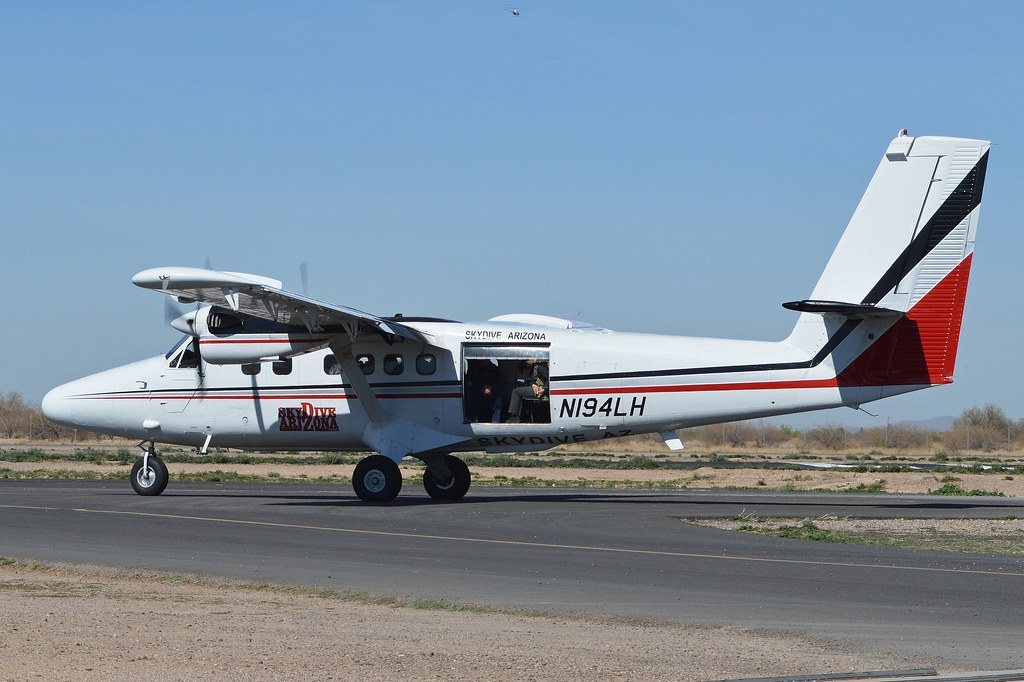
Most of the state’s skydiving happens within about an hour of Phoenix: Skydive Arizona in Eloy, Skydive Phoenix in Maricopa, Phoenix Skydive Center in Casa Grande and Skydive Buckeye west of the city. First tandems there run about $220 to $270 as of fall 2026. Skydive Arizona is the one that makes Arizona a destination. It has been in Eloy since 1991, flies twin-turbine planes and DC-3s, has a wind tunnel and a bunkhouse on site, and hosts world championships and world record attempts.
Skydive Marana (near Tucson)
At Marana Regional Airport, about 20 minutes north of Tucson and an hour south of Phoenix, running since 1991. It is a tandem operation: a 20-minute ground course and you’re in the plane within the hour.
- Tandem: $279, from 12,500 feet. $219 each for groups of four or more; $249 to $259 for military, EMS and students. $75 non-refundable deposit.
- Limits: 18 and older, no exceptions. Under 220 lbs, or up to 250 lbs at $1 per pound over.
Skydive the Grand Canyon (Tusayan)
- Tandem: $329 for the jump alone, $459 with photos and video, $499 for the top package (adds a shirt and the option to pull your own parachute).
- Altitude: 16,000 feet above sea level. Because the airport is already at 6,609 feet, that is about 9,400 feet above the ground. That’s less freefall than a 13,000-foot jump in Eloy, so you’re paying for the view, not the time in the air.
- Weight: tell them before booking if you’re over 210 lbs; surcharges are $35 over 210 and $50 over 230, and over 250 is case by case.
- Getting there: they sell transport from Las Vegas ($124) and Phoenix ($425).
Learning to skydive in Arizona
If a tandem hooks you, Arizona is one of the better places in the country to get licensed because the winter weather lets you jump day after day. The USPA A license takes 25 jumps plus exams. Skydive Arizona’s Economy Package is $4,199 for 24 jumps with free bunkhouse lodging, and its first phase usually takes 4 to 5 days. Skydive Phoenix also runs AFF training. Licensed jumpers can book coaching with AXIS Flight School, which is based at Skydive Arizona.
Safety
Look for a USPA Group Member dropzone. Every tandem in the U.S. falls under FAA rule 14 CFR 105.45: the instructor needs at least 500 freefall jumps and three years in the sport, and the reserve parachute must carry an armed automatic activation device. The sport has never been safer by the numbers. The USPA counted 9 deaths across 3.88 million U.S. jumps in 2024.
Plan your Arizona jump
- Want the most freefall: the desert dropzones, November through March, first load of the day.
- Want the view: the Grand Canyon. Book early in your trip so you have days left if weather cancels you.
- Want a license: Eloy in winter, with a week or more set aside.
- Bring government photo ID and wear sneakers. Expect an 18-and-over rule at most Arizona dropzones.
- Prices here come from each dropzone’s own site in October 2026. Sale prices change often, so check before you go.
Photo: DHC6-200 Twin Otter 'N194LH' by HawkeyeUK - Support your local Air Museum!, BY-SA 2.0.