Falling with Grace: The Beautiful Physics of Skydiving
Discover the physics behind skydiving. Learn about equipment, techniques, and safety to make the most of your freefall experience. Read now!
A skydiver stops speeding up at roughly 120 mph because the air pushes back as hard as gravity pulls. That balance point is terminal velocity. Almost everything else about a jump comes from the same tug of war: how you stay stable, how you speed up or slow down, why a parachute flies instead of just dropping, and why the landing is where most people get hurt.
Gravity gets you moving
Gravity accelerates anything you drop at about 9.8 meters per second every second (32 feet per second every second). With no air, you would keep adding that much speed each second all the way down.
There is air, though, and the faster you move through it, the harder it pushes back. Drag grows quickly with speed, so at some point it equals your weight. The net force drops to zero and your speed levels off.
You get there faster than most people expect. The terminal velocity article on Wikipedia works through the numbers for a belly-down skydiver: about half of terminal speed after 3 seconds, 90 percent after 8 seconds, and 99 percent after about 15 seconds.
Terminal velocity is not one number
Your top speed depends on your shape, your weight and how thick the air is. For a skydiver flying belly-to-earth with arms and legs spread, the same source gives about 55 m/s, or 180 feet per second. That is roughly 120 mph, the figure you hear at every drop zone.
Change your shape and the number changes:
- Head-down, limbs pulled in: about 90 m/s (300 ft/s), a little over 200 mph.
- Competition speed skydiving: about 150 m/s (490 ft/s), roughly 335 mph, in a tight head-down dive.
- A good track: as slow as about 40 m/s (90 mph) vertically, while moving across the sky (more on that below; source: Wikipedia, Tracking).
Once you hit terminal velocity you do not feel weightless. Drag is now holding up your full weight, so you feel a steady, loud wind pressing on your whole front. The floaty, stomach-drop feeling people expect is mostly absent, because you leave a plane already moving forward and the air starts supporting you within seconds.
Here is what that means on a tandem from 14,000 feet. USPA’s rules say tandem parachutes must be open by 5,000 feet above the ground (source: USPA Basic Safety Requirements). Covering about 9,000 feet at 180 feet per second takes 50 seconds, plus a few seconds to get up to speed. That is why drop zones quote close to a minute of freefall from that height.
How body position steers the physics
The arch keeps you face-down
The basic stable position is the arch: hips pushed forward and down so they are the lowest point, chin up, arms and legs spread and relaxed. USPA’s student program teaches it first because an arched, belly-to-wind position is stable and gives the parachute a cleaner, more reliable opening.
The physics is the same as a badminton shuttlecock. Your heavy middle sits low, and your arms and legs trail higher in the airflow, where they act like the feathers. If you tip, the drag on your limbs swings you back to face-down. Drop zones like Skydive Orange use exactly that comparison when they teach it.
One correction to a common claim: arching does not create lift that fights gravity, and it does not make you fall slower. Belly flyers learn the opposite. To fall faster, you arch more; to fall slower, you flatten out, or “de-arch,” and present more of your body to the air (source: Skydive Monroe). Groups use this to match fall rates so a light jumper and a heavy jumper can fly side by side.
Tracking turns falling into flying
Tracking is how you move across the sky instead of straight down. You straighten your legs, bring your arms back to your sides, and flatten or slightly cup your body. Now your body works like a crude wing. Experienced trackers approach a 1:1 glide, covering nearly as much ground as they fall, while their vertical speed drops toward 90 mph.
It is not a trick. It is a safety skill. When a group finishes its formation, everyone turns 180 degrees away from the center and tracks off so they are far apart before they open. USPA recommends breaking off at least 1,500 feet above the highest planned opening altitude for groups of five or fewer, and 2,000 feet for bigger groups (source: USPA SIM, Formation Skydiving). USPA also notes that a flat track started with the legs gets more horizontal separation than diving.
Flying with a team
Formation skydiving is falling at the same rate as other people and docking on them on purpose. There are no radios or talking in freefall. Groups walk through the jump on the ground first, then use fall-rate control (that arch and de-arch again) and small moves of the arms and legs to close the gap and take grips.
USPA recommends starting with just two jumpers, you and a current USPA coach or instructor, and building from there. It is a skill for licensed jumpers, not something you need on your first jump.
What the parachute changes
Opening a canopy swaps a person-sized shape for a large wing. Drag jumps, you slow from about 120 mph in a few seconds, and you settle into a much gentler descent.
Ram-air wings vs round parachutes
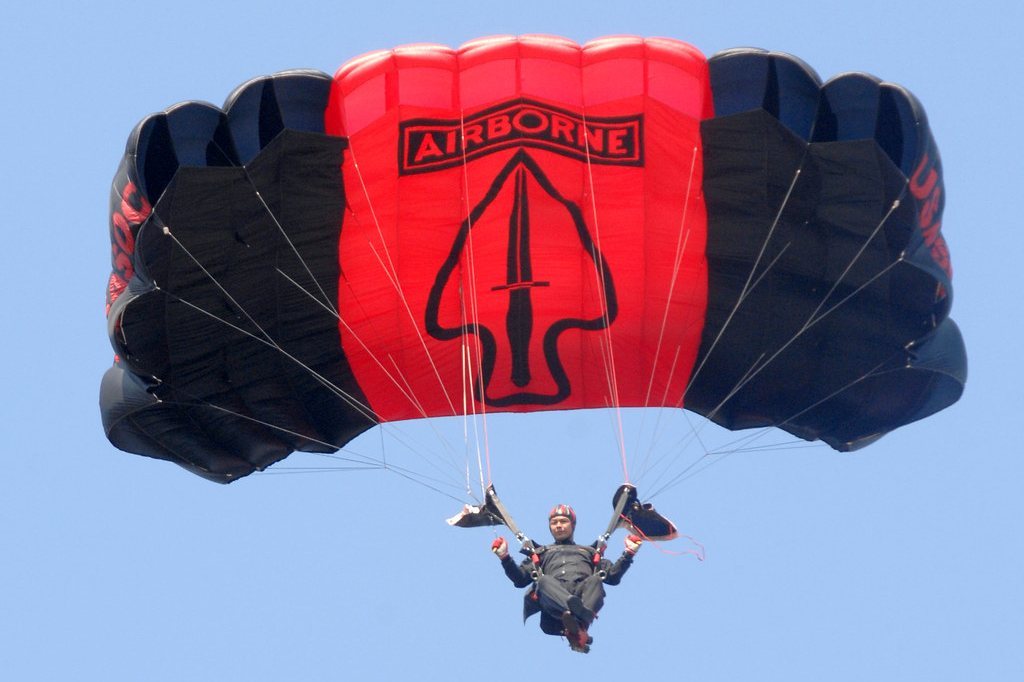
Modern sport and student main canopies are ram-air wings. Air rams into open cells at the front, inflates the canopy into a wing shape, and the canopy flies forward and down like a glider. That forward speed is what lets you steer, pick a landing spot and flare.
Some real numbers:
- Student ram-air canopy: about 1,000 feet per minute down (roughly 17 ft/s), about 20 knots forward, and a glide ratio of around 2.5 to 1 in no wind (source: Skydive the Ranch). Opening at 4,000 feet gives you about four minutes under canopy.
- Typical sport canopy: about a 3 to 1 glide, three feet forward for every foot down, according to Skydive Arizona safety advisor Bryan Burke (source: Basic Aerodynamics of a Ram-Air Parachute).
- Military round canopies: the US Army’s T-10 comes down at 22 to 24 ft/s, and its replacement, the T-11, at about 19 ft/s, slowed down on purpose to cut landing injuries (sources: Wikipedia, T-10; Wikipedia, T-11).
So the old idea that round parachutes come down slower does not hold up. A student ram-air descends no faster than these military rounds, and it can flare to near-zero vertical speed right at the ground, which a round cannot. Today you mostly see rounds on military mass jumps and as some older reserves.
Smaller, faster canopies carry more weight per square foot and come down and fly faster. That is why your instructor matches your canopy size to your weight and experience, and why the numbers above are ballpark, not promises.
How the flare works
A flare is both toggles pulled down together just before touchdown. Burke’s explanation: the light, high-drag canopy slows down faster than you do, so your body swings forward under it like a pendulum. That tilts the wing to a steeper angle to the oncoming air, it makes extra lift for a few seconds, and your descent nearly stops while you burn off forward speed.
A bit of history: the first frameless parachute descent was André-Jacques Garnerin’s, on 22 October 1797 over Parc Monceau in Paris. He cut loose from a hydrogen balloon at roughly 3,000 feet under a canopy about 23 feet across, and his basket swung violently all the way down (source: Wikipedia). A later fix was a vent in the top of the canopy to stop the swinging.
How the gear is checked
Under federal rule 14 CFR 105.43, both parachutes on a sport rig must have been packed within the last 180 days. The reserve must be packed by an FAA-certificated rigger. The main can be packed by a rigger, by the person who will jump it, or by someone working under a rigger’s direct supervision. If the rig has an automatic activation device (AAD), it must be maintained to the manufacturer’s instructions (source: USPA SIM, Federal Aviation Regulations).
Student rigs must have a working AAD, a main canopy suited to student use, and a steerable reserve sized for the student’s weight. Solo students are also held to wind limits: 14 mph for ram-air canopies and 10 mph for round reserves (source: USPA Basic Safety Requirements).
Landing is where the physics bites back
In 2025, USPA counted 16 skydiving deaths in the US out of 3.47 million jumps, about 0.46 per 100,000. The same page says most accidents come from simple human error, often a bad call while landing a parachute that works fine (source: USPA, How Safe Is Skydiving?). USPA’s 2025 fatality summary lists four deaths from intentional low turns, more than any other single cause, and no student deaths for only the second year since records began in 1961 (source: USPA 2025 Fatality Summary).
Injuries tell the same story. In 2025, 5.6 percent of USPA members reported an injury that needed medical treatment, and the most common was an ankle hurt on landing.
The physics of a low turn is simple. A turning wing dives, so it trades height for speed. Start a turn too close to the ground and you hit the ground fast, still diving. USPA’s landing priorities, in order:
- Land with the wing level, flying in a straight line.
- Land in a clear, open area, away from obstacles.
- Flare before touchdown, with feet and knees together, ready to do a parachute landing fall (PLF), a roll that spreads the impact up your legs and side.
USPA puts it plainly: landing into the wind is desirable, but not at the risk of a low turn. If you need to turn low to miss something, use a braked turn, from the half-brakes position, which turns flatter and loses less height (source: USPA SIM, Skydiving Emergencies).
On a tandem, your instructor flies the canopy and does all of this. Your job is usually to lift your knees and legs when told so the instructor’s feet touch first. Some tandem landings are standing and some are slides on your backside. You will hear which in your briefing.
Before you book a first jump
- Ask whether the drop zone is a USPA Group Member and whether its instructors hold USPA ratings.
- Ask about the weight limit. It is set by the gear and varies by drop zone, so check with the one you pick.
- Expect weather holds. Wind and cloud cancel jumps often, so leave the rest of the day open.
- Pick your path: tandem (harnessed to an instructor), AFF (solo freefall with instructors holding on at first) or static line (a line from the plane opens your canopy at exit, so you learn canopy skills before freefall; not every drop zone offers it).
- Listen in ground training and ask until the answers make sense. If you go on to jump solo, the arch, the flare and the landing roll are skills you will use on every jump.