Skydiving and Art: How It Has Inspired Artists and Designers
Learn how skydiving and art are connected. Discover how artists and designers have been inspired by the aesthetics, thrill & equipment of skydiving.
Skydiving and art cross paths in a handful of real, documented places: a parachute Leonardo da Vinci drew around 1485 that a skydiver actually rode in 2000, Italian Futurist painters who tried to paint the view from an airplane, Yves Klein’s famous staged “leap,” the judged freestyle and freefly events where the camera flyer’s video is the finished piece, and a few design stories, from the kite maker behind today’s square canopies to a wedding dress sewn from a parachute that saved a pilot’s life.
A lot of what’s written about “skydiving-inspired art” online names artists and products nobody can find. Everything below is something you can look up, and in several cases go see in person.
Leonardo’s parachute: a drawing someone jumped
Around 1485, Leonardo sketched a pyramid-shaped parachute in the notebook collection now called the Codex Atlanticus. His note says a man with a linen tent “12 arms wide and 12 tall” could jump from any height without hurting himself.
For about 500 years it stayed a drawing. Then in 2000, British skydiver Adrian Nicholas built one to the sketch, using wood and canvas, and was carried up by hot-air balloon to about 10,000 feet. He reported a smooth ride down. The thing weighed roughly 185 pounds, though, so he cut away from it at around 2,000 feet and landed under a normal parachute rather than have that frame land on top of him.
That’s the cleanest example of art and skydiving meeting: a sketch by a painter, proven by a jumper. Nicholas had a long skydiving career, with more than 8,000 jumps.
Aeropainting: the Futurists who painted from the sky
In 1929, the Italian Futurists, led by Filippo Tommaso Marinetti, put out a manifesto on aeropainting (aeropittura). Their argument was simple: the view from a moving aircraft is a new kind of reality, and painting it means dropping fine detail and going for shapes, speed and tilt.
The painting skydivers tend to recognize is Tullio Crali‘s Before the Parachute Opens (Prima che si apra il paracadute), from 1939. Crali was a pilot himself; he first flew in 1928. The painting looks down on the ground from above, broken into hard geometric blocks, and it’s held at the modern art gallery in Udine, Italy.
If you’ve made a jump, the subject will make sense to you. From altitude the ground doesn’t rush at you the way people expect. It looks like a map of fields and roads that slowly gets bigger, and that flattened, patterned look is what the Futurists were after.
Yves Klein’s “Leap into the Void”
The most famous photo of a person falling in modern art isn’t a skydive at all. In October 1960, French artist Yves Klein hired photographers Harry Shunk and János Kender to shoot him leaping off a wall, arms out, over a quiet street near Paris.
Below him, out of frame, friends held a tarp to catch him. The photographers printed two negatives together, one of Klein in the air and one of the empty street, so the finished picture shows a man diving into nothing with no catch in sight. Klein then printed it in a one-day mock newspaper sold at Paris newsstands. A print of Leap into the Void is in the collection of the Metropolitan Museum of Art in New York.
Jumpers like it for an honest reason: it captures the half-second after you leave the door, before the wind takes over, and it does it by faking the landing.
When the skydive is the artwork: freestyle and freefly
Skydiving has its own art forms, and they are judged.
Freestyle skydiving is a solo performance in freefall: spins, layouts and poses done like a gymnast or dancer, while a second jumper films. Deanna Kent performed what’s credited as the first freestyle skydiving for her husband Norman Kent’s 1989 film From Wings Came Flight. Competition followed fast: the first international event ran in 1990, Tamara Koyn brought props such as pink streamers into world competition in 1991, and the sport’s world body, the FAI, recognized freestyle in 1996.
Today the FAI groups these under “Artistic Events.” Freestyle is one performer plus a camera flyer. Freefly is two performers plus a camera flyer. Teams fly compulsory moves and free routines, and the judges score from the camera flyer’s footage. That means the person holding the camera is half the art: the judges can only score what the camera caught.
Norman Kent is the name most skydivers know from that side of the camera. He filmed the aerial work for Hollywood skydiving movies including Terminal Velocity, Drop Zone and Cutaway, and later worked on big releases like Godzilla (2014). He made his first jump at 19 and came to the sport as a photographer.
Design: a kite maker’s wing and a parachute wedding dress
The square canopy came from kites
Every rectangular parachute you see over a drop zone traces back to Domina Jalbert. In the 1930s he was building big kites for advertising. He came up with the ram-air wing in 1957: two layers of fabric split into cells, inflated by the air flowing into the open front, so the canopy holds a wing shape with no frame.
He patented the multi-cell design in the 1960s, and with parachute maker Theodore Hulsizer he had a working ram-air parachute by 1971. That design is why modern canopies steer and flare like wings instead of drifting down like Leonardo’s pyramid or a round military chute.
The parachute wedding dress at the Smithsonian
In August 1944, B-29 pilot Maj. Claude Hensinger bailed out over Japan when his engine caught fire on the way back from a bombing raid. He kept the nylon parachute, used it as a blanket while he waited for rescue, and held onto it after the war.
When he proposed to Ruth in 1947, he offered her the parachute for a gown. She wanted something like the dresses in Gone with the Wind, so a local seamstress, Hilda Buck, made the bodice and veil, and Ruth made the skirt herself, pulling up the parachute’s strings so the dress ran short in front with a train in back. They married on July 19, 1947. Their daughter and their son’s bride later wore it too, and the family gave it to the Smithsonian.
If you want to make art from your own jumps
- Wait on the camera. USPA recommends being licensed with at least 200 jumps before you jump with any camera, no matter how small (Skydiver’s Information Manual, section 5-7). A camera adds snag points and distraction, and new jumpers get hurt chasing footage.
- Before that, buy the video. On a tandem or student jump, the drop zone’s camera flyer shoots it for you. That footage, or stills pulled from it, is plenty to paint or draw from.
- Sketch the ground the day you jump. The map-like view fades from memory fast. A few lines on paper that evening will be closer to what you saw than anything you draw a month later.
- See the real pieces. Leap into the Void at the Met, Crali in Udine, the Hensinger dress at the Smithsonian, and FAI artistic event footage online show what the crossover actually looks like.
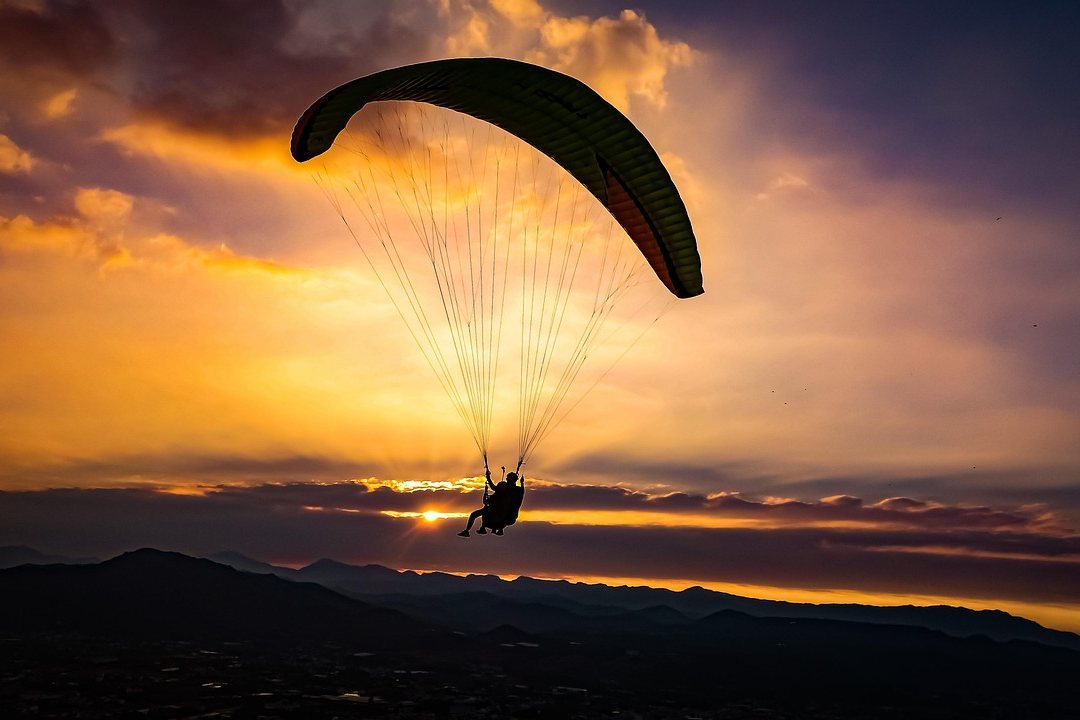
Photo by CavalryLu on Pixabay.