Skydiving: The Ultimate Confidence and Courage Booster
Discover the life-changing benefits of skydiving in this detailed article. Build confidence, develop courage, and conquer your fears today!
A skydive builds confidence in one specific way: it hands you proof that you can be scared out of your mind and still do the thing. That’s real, and there’s research behind it. What a jump won’t do is erase fear or fix anxiety in one afternoon. The courage you get comes from acting while afraid, and it carries over to the rest of your life only if you use it.
Here’s what the research actually shows, what a first jump asks of you minute by minute, and how to get the most confidence out of it.
What the studies say happens to first-time jumpers
The best look at this is a 2015 study by Vanessa Meyer and colleagues in Frontiers in Human Neuroscience, “Experience, cortisol reactivity, and the coordination of emotional responses to skydiving.” They followed 29 first-timers making tandem jumps and 15 experienced skydivers, tracking self-reported anxiety and happiness along with the stress hormone cortisol.
- Fear peaked early. Anxiety was highest when people arrived at the drop zone, not in the plane or at the door, and dropped from there.
- It flipped by the end. Average anxiety fell 50% from before the jump to after. Average happiness rose 41% from before the jump to the moment of landing.
- Feeling good helped the body settle. People who reported more happiness after landing had their cortisol come back down faster.
That lines up with what most jumpers will tell you: the drive to the airport and the waiting are worse than the jump itself.
Why doing it beats thinking about it
Psychologist Albert Bandura’s 1977 paper “Self-efficacy: Toward a unifying theory of behavioral change” laid out where our belief in our own ability comes from: doing the task yourself, watching others like you do it, being talked into it, and reading your own body’s signals. In his work with people afraid of snakes, those who handled the snakes themselves gained more than those who only watched someone else do it.
Skydiving is a clean example of that first source. You can watch a hundred jump videos and still not know if you’d go. After you’ve gone out the door once, you know. Nobody can argue you out of it, including you.
Fear doesn’t leave. You get better at working with it.
This part surprises people. A 2013 study from Northumbria University in the UK, published in Physiology & Behavior, compared 11 first-time jumpers with 13 skydivers who had more than 30 jumps. The experienced group said they were less anxious, but their cortisol still climbed about the same as the beginners’ did.
The Meyer study found something close: experience didn’t switch off the stress response, it changed how it ran. Experienced jumpers came back down faster.
So the courage skydivers talk about isn’t the absence of nerves. It’s knowing your heart will pound, your mouth will go dry, and you’ll go anyway. That’s the version of courage that’s useful at a job interview or a hard conversation, too.
What a first jump actually asks of you
Most first-timers make a tandem jump, strapped to an instructor who handles the parachute. Here’s the day, in order.
On the ground
You check in, sign a long waiver, and get a short briefing. USPA says tandem training is generally under 30 minutes. You’ll learn how to arch your body, where to put your hands at the door, and how to lift your legs for landing. Then you wait, sometimes a long time, for weather and for your load to be called. This is where Meyer’s subjects felt the worst.
In the plane
The ride up is loud and cramped. Your instructor hooks your harness to theirs and tightens everything until you can barely slouch. The door opens and cold air pours in. Everyone ahead of you is gone in seconds. This is the moment that feels like it’ll be the hardest, and for most people it’s over before they’ve finished thinking about it.
Freefall and canopy
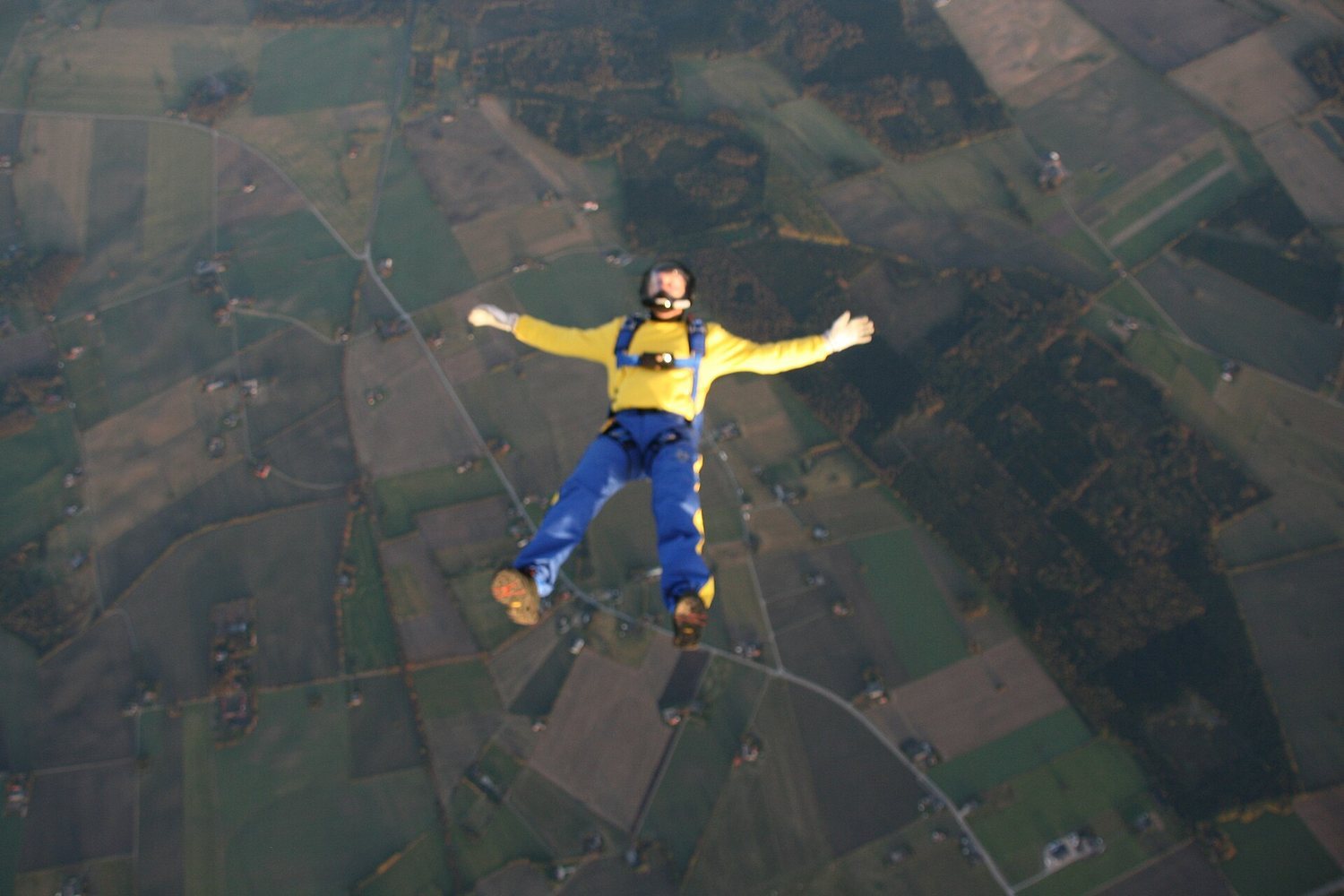
USPA puts freefall at about 120 mph for 30 to 60 seconds. The first few seconds are pure noise and wind. People expect a stomach-drop like a roller coaster. Once you’re out of the plane’s slipstream it feels more like lying on a wall of air. Then the parachute opens, the noise stops, and you float down for a few minutes, often with a turn at the controls if your instructor offers it. You lift your legs, slide in on your rear, and it’s done.
Your job through all of it is small: show up, listen, arch, lift your legs. That’s part of why it works as a confidence builder. The scary part is huge, but what you have to do is simple enough that you can’t fail it by being nervous.
Is the risk worth it?
Confidence built on a bad bet isn’t worth much, so here are the real numbers. According to USPA’s 2024 fatality summary, there were 3.88 million skydives in the U.S. that year and nine deaths, about one per 430,000 jumps. It was the first single-digit year since USPA started keeping records in 1961.
That’s low, not zero. Pick a drop zone that’s a USPA Group Member, ask how long your instructor has held their tandem rating, and check the drop zone’s own age and weight limits before you book, since they set those themselves.
How to make the confidence stick
One jump gives you a story. What you do with it decides whether it changes anything.
- Write down what you were afraid of the night before. Be specific. Read it again after you land. That gap is the lesson.
- Notice where the fear peaked. If it was in the parking lot and not at the door, that tells you something about every other thing you’ve been dreading.
- Use it within a week. Pick one thing you’ve been putting off, like a phone call, a sign-up or an ask, and do it while the jump is fresh.
- If you want more, take the next step on purpose. A second tandem or a student course turns one brave afternoon into a skill, and Bandura’s point holds: each time you do it yourself, the belief gets harder to shake.
- Don’t do it to prove something to someone else. Being pushed out the door by friends gives you a good video, not much confidence. Book it because you want to know if you can.
Photo: SkydiveroverEslovSweden by Degrer, CC0.