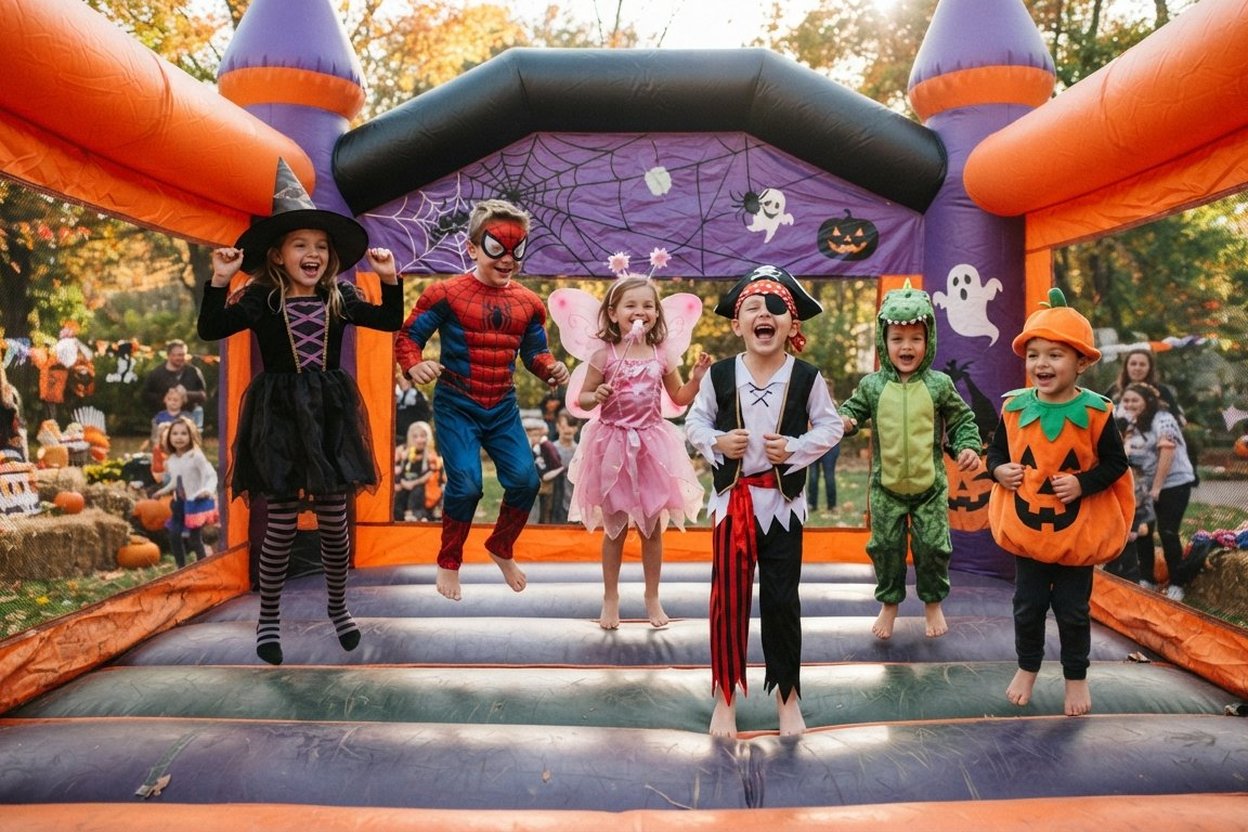
Halloween costumes in a bounce house: what comes off before kids jump
Remove masks, drawstrings, and shoes before kids bounce in inflatables. Learn what's safe and why each piece matters.
The bounce house is up, the kids are in costume, and someone in a rubber mask and cape is already at the entrance. You don't have to choose between the costume and the bounce house. You just do them in order. Before anyone jumps, take off the drawstrings, capes, masks, glasses, and shoes, including costume boots. A fitted base layer can stay on. Take the costume photos before the bouncing or after it, then put the full costume back on for the candy walk.
What comes off before anyone jumps
Do one check at the entrance and do it the same way for every child. If it dangles, ties, covers the face, or has a sole, it comes off. That means drawstrings, capes, cape ties, tails, and long accessories. Masks come off, and so do eyeglasses. Shoes come off, and costume boots count as shoes. Socks depend on the unit. Some operators require them and others allow bare feet, so go by what the rental sheet says.
The national guidance points the same way. The CPSC's 2015 safety bulletin on inflatables says to remove shoes and glasses before play. It also says to keep sharp objects out of pockets and off clothing because they can puncture the bouncing surface. Nationwide Children's Hospital's proper-use list adds jewelry. The Ninja Jump safety card posted by United Inflatable Rides says to remove shoes, eyeglasses, and sharp objects. One rental company, The Bounce House Shreveport, names costumes directly: capes, tails, masks, tutus, and long superhero accessories can snag on climbing walls and netting. Its advice is to take costume photos before or after bouncing.
Drawstrings, capes, and anything that can catch
A cord, ribbon, cape tie, or tail can slip into a gap at the top of an inflatable slide, through a net, or along a seam. If the child keeps moving and the cord doesn't, the cord pulls on whatever it's tied to. Often that's the neck. A knot, toggle, or pompom on the end makes it more likely to wedge in place.
This hazard is well documented. CPSC staff know of 26 deaths and 73 nonfatal incidents from neck or hood drawstrings on children's outerwear from January 1985 through June 2019. The children ranged from 18 months to 15 years old. The most common scenario was a drawstring catching on a playground slide, often when a toggle or knot lodged in a gap at the top. The agency also describes waist drawstrings caught in the door of a moving school bus.
That record led to the 2011 federal rule, 16 CFR Part 1120, which the Commission approved 5–0. It treats children's upper outerwear in sizes 2T to 16 with drawstrings as a substantial product hazard if the garment doesn't meet ASTM F1816-97. Under current CPSC guidance:
- Hood and neck drawstrings on upper outerwear in sizes 2T to 12 are a substantial product hazard.
- Waist and bottom drawstrings in sizes 2T to 16 may stick out no more than 3 inches when the garment is stretched to its full width. They can't have toggles, knots, or other attachments on the free ends.
- A "drawstring" means any non-retractable cord, ribbon, or tape used to pull the garment closed.
The rule covers outerwear such as jackets, vests, and sweatshirts. According to the American Sewing Guild's summary of CPSC guidance, dresses, skirts, and pants are not upper outerwear. So a costume cape over a party outfit may fall outside the rule's wording. The hazard is still the same. CPSC's 1994 drawstring warning listed a cape alongside jackets and sweatshirts among garments whose strings caught on playground equipment. In 2010, CPSC announced a recall of about 13,500 girls' wool coats because the drawstrings on a detachable cape, finished with faux pompoms, could strangle a child. No incidents were reported. The fix was to remove the cape drawstrings or remove the cape. Doing the same before your kids bounce costs nothing.
Masks, hoods, wigs, and glasses
A mask can seem fine on the sidewalk. The CPSC's Halloween guidance says eye and nose holes should allow full vision and adequate breathing, and that makeup may be safer than a mask. The American Academy of Pediatrics (AAP) says the same about non-toxic makeup and decorative hats. Inside a bounce house, though, kids are breathing hard, and side vision matters more because other children come at them from every direction.
That matters because of how bounce-house injuries happen. A Nationwide Children's study of emergency-department data from 1995 to 2010 found:
- Falls were the most common cause, at 43 percent.
- Stunts and collisions came next.
- About 1 in 5 injuries (19 percent) were to the head and neck.
- Fractures made up 28 percent of injuries and strains or sprains 27 percent.
In 2010 that came to more than 30 children a day. CPSC estimated more than 18,000 bounce-house injuries treated in emergency departments in 2018. These numbers count all inflatable injuries, not costume injuries. Still, a mask that limits side vision makes collisions more likely.
Glasses come off with the mask. That rule appears on the CPSC bulletin, the Ninja Jump card, Nationwide Children's list, and the rules of several rental companies. Decorative contact lenses are not a costume-day substitute. The AAP says they are a medical device that needs an eye exam and a prescription, and a poor fit can cause permanent vision loss.
Hard helmets, horns, and crowns come off too. So do hoods and hats that slide down. The AAP says hats shouldn't slide over the eyes, and a bounce house makes them slide.
Shoes, costume boots, and socks
Shoes are the one rule every source agrees on. The CPSC bulletin says to remove them, and so do Best Jump LLC, Bounce Brothers, Bay Bounce, and the Ninja Jump card. According to The Bounce House Shreveport, hard soles can catch a seam, scuff the vinyl, and hurt another child, and outdoor shoes track in grit. Costume boots, plastic princess heels, and buckled pirate boots are all shoes and come off.
Socks vary by operator:
- Bounce Brothers requires socks.
- Bounce House Family Entertainment Center in Williamsburg, Virginia, requires socks in its inflatables. As of October 2026, it sells them for $2 for a child and $4 for an adult if you forget them.
- Bay Bounce allows bare feet or socks.
- The CPSC bulletin says to remove shoes. It doesn't require socks or ban bare feet.
For a rental, follow the sheet that comes with the unit. Grip socks from a trampoline park are their own question. One rental company notes that some inflatable-only venues ban them because the extra grip can grab the surface. Check before you pack them.
Jewelry, zippers, props, paint, and party mess
Parents often try to leave smaller costume pieces on. Most of them come off for one of two reasons: they can hurt someone, or they can damage the unit.
- Belts, watches, necklaces, and jewelry: Best Jump and Bounce Brothers ban belts and jewelry. Bay Bounce and Nationwide Children's say jewelry comes off.
- Metal zippers, studs, rhinestones, and stiff sequins: Buckeye Bounce Houses bans visible metal zippers. The Bounce House Shreveport says zippers, studs, buckles, rhinestones, and stiff sequins can scratch or gouge vinyl. It also recommends tying long hair with a soft elastic instead of a hard clip.
- Swords, wands, and full pockets: The AAP warns against sharp or long swords, canes, and sticks even on the sidewalk, because a child can be hurt with them in a stumble. Best Jump bans toys and other objects inside the unit. The CPSC wants pockets empty.
- Candy buckets and silly string: Bay Bounce bans candy, gum, food, and drinks. Best Jump, Bay Bounce, Buckeye, and the Ninja Jump card all ban silly string.
- Face paint and glitter: Play Party LA bans face paint, paint, glitter, confetti, and slime. It says breaking its rules forfeits the security deposit. Other companies may handle this differently, so read your sheet.
Don't tape, tie, or hang decorations on the inflatable either. Bounce Brothers says that can cause severe injury, and that silly string, food, and sharp objects can bring cleaning, damage, or repair charges.
What they wear instead, and who watches the entrance
A fitted shirt and leggings can stay on, and so can a themed T-shirt in the costume's colors. That way the kids still look like the character, just without the parts that catch. The full costume goes back on afterward for photos and trick-or-treating, with shoes back on for walking. The AAP says costumes and shoes should fit and the costume should be short enough not to trip a child or catch on things. CPSC tells families to avoid overly long or baggy costumes. CPSC also says loose, flowing fabric is a fire hazard near jack-o'-lantern candles. Polyester or nylon is a better choice than sheer cotton or rayon, but any fabric can burn if it touches a flame. Flame-resistant fabric protects against candles. It doesn't make a cape safe to bounce in.
Halloween injuries are a separate count from bounce-house injuries. CPSC estimated an annual average of 3,200 Halloween-related emergency-department injuries over the three years before its 2022 guidance. A quarter of those were falls, including tripping on costumes.
Put one adult at the entrance. The CPSC bulletin says an adult must supervise the whole time the unit is in use, and that everyone on it at once should be similar in size. For a bounce house or a slide under 15 feet, the minimum is one operator who can see every rider. For taller slides, or units built for younger children, it's two.
For how many children can be inside and the weight limit, go by the plate on the unit and the rental sheet. Company defaults don't match:
- Best Jump lists 10 riders for a bounce house, with a 200-pound limit per person.
- Play Party LA caps its 8-by-8 at 3 or 4 children ages 2 to 8.
- Bay Bounce allows 8 children in a 13-by-13.
The Ninja Jump card doesn't recommend its unit for children under 3. The 2012 study authors went further at the time. They suggested parents consider limiting bouncers to children 6 and older, one at a time, or keeping riders close in age and size. That was the researchers' advice in 2012, not a rental rule. Either way, the person at the entrance decides who goes in and what they're wearing, and the costume goes back on for the walk.
Sources (21)
- CPSC 2015 Safety Bulletin: Inflatables, Residential and Commercial
- Nationwide Children's Hospital: Inflatable Bouncer Safety
- United Inflatable Rides: Ninja Jump Safety Manual
- The Bounce House Shreveport: What to Wear to a Bounce House
- CPSC: Safety Tips to Keep Hazards from Haunting Your Halloween
- HealthyChildren.org (AAP): Halloween Safety Tips
- CPSC: Drawstrings in Children's Upper Outerwear
- 16 CFR § 1120.2 Definitions
- 16 CFR § 1120.3 Substantial product hazard list
- CPSC 2011: New Drawstring Safety Rule for Children's Outerwear
- CPSC 1994: CPSC Works With Industry to Remove Drawstring Hazard
- CPSC 2010: S. Rothschild Recalls Girls' Coats with Drawstrings
- American Sewing Guild: Drawstrings in Children's Clothing
- Nationwide Children's 2012: 15-Fold Increase in Inflatable Bouncer Injuries
- CPSC 2019: Be Grounded in Safety When Using Bounce Houses
- Best Jump LLC: Safety Instructions
- Bay Bounce: Safety Rules
- Bounce Brothers: Safety Rules and Code of Conduct
- Bounce House Family Entertainment Center: FAQs
- Buckeye Bounce Houses: Rules
- Play Party LA: Rules