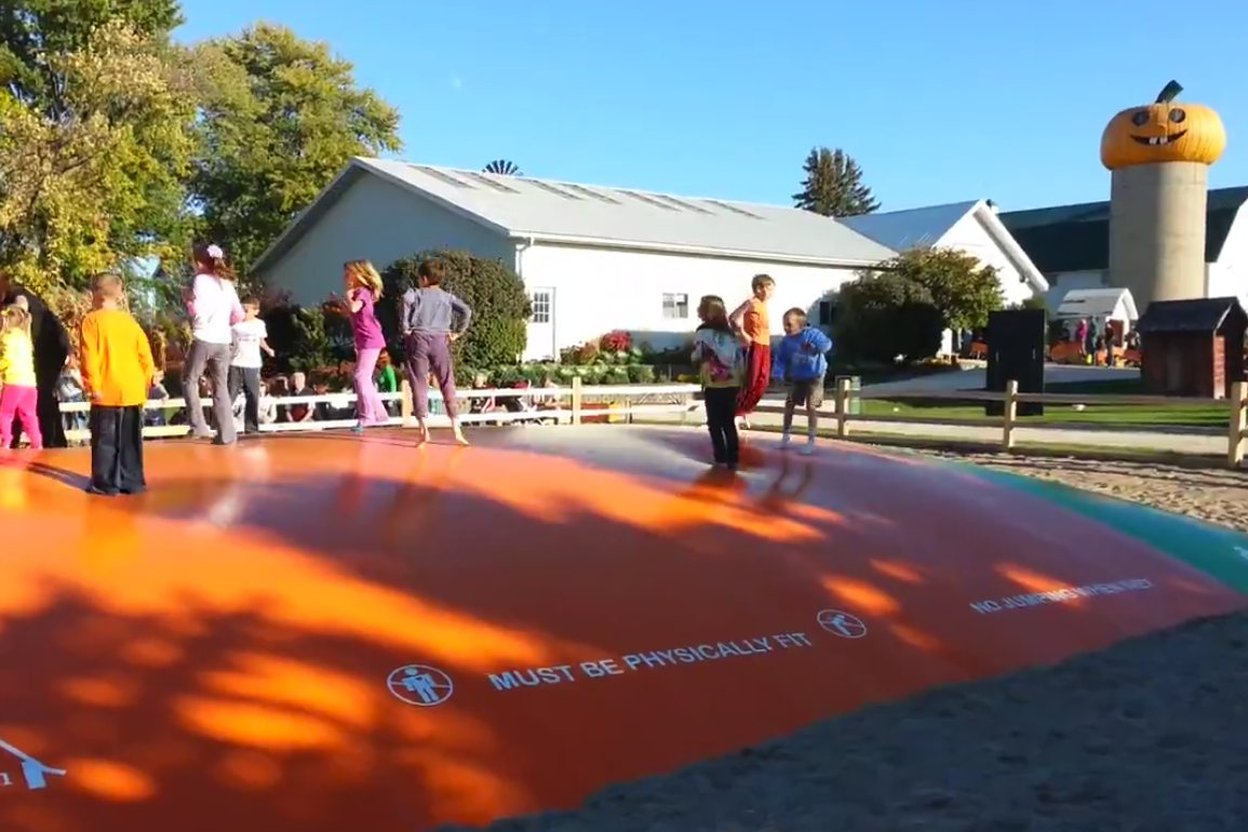
Pumpkin-patch bounce house: a one-minute check before your kids climb on
Know what to check at a pumpkin patch bounce house in just one minute before your kids jump.
You've finished the corn maze, the hayride line is long, and your kids have already spotted the big inflatable at the edge of the field. Before shoes come off, take one minute to check six things, in the order you can see them: the wind, the anchors, whether the unit is firm and intact, where the blower is, who is already jumping, and whether anyone is actually watching. If all six look right, let them jump. If one doesn't, skip it or get them off. This guide shows what each check looks like from the fence.
The walk-up check
In an August 2015 safety bulletin, U.S. Consumer Product Safety Commission (CPSC) staff wrote that the inflatable incidents they reviewed came mainly from improper operation, supervision, and setup. You can see all three of those from outside the unit. The CPSC's public checklist for families covers the same ground: wind, staking on a flat surface, distance from trees, power lines, and fences, kids of similar age and size, the occupancy limit, no flips or wrestling, children kept away from generators and air pumps, and an adult watching.
Most fall farms have one of two kinds of inflatable. One is a walled bounce house. The other is an open jump pillow, a big inflated mound with no sides. You check both the same way. The limits, though, come from that particular unit, not from pumpkin patches in general. Two real farm pages show how different they can be:
- KC Pumpkin Patch posts a height maximum of under 52 inches and a 225-pound weight limit for its jumping pillow.
- Fallstivities Pumpkin Patch tells guests to follow the height, weight, and age rules posted at each activity. If none are posted, the activity operator decides.
So read the sign at the unit in front of you. Then start with the sky.
Wind, before anyone climbs on
Wind comes first because an inflatable is basically a sail tied to the ground, and a pumpkin patch is usually an open field with nothing to block a gust. The 2015 CPSC bulletin warns that an inflatable can start to move at very low wind speeds and can become airborne as the wind picks up.
No single national mile-per-hour cutoff exists. Here's what the federal guidance says:
- Home units: the 2015 bulletin says not to use one when wind exceeds 20 mph, and to take great care when gusts might suddenly go past that.
- Commercial units: operators are told to follow the manufacturer's wind limit. Depending on the ride, those limits range from 15 to 25 mph.
- Any inflatable: once wind, including gusts, exceeds 25 mph, the bulletin says it is dangerous to run any inflatable. It should be emptied and deflated right away.
- The CPSC's 2019 consumer release puts the maximum at 15 to 25 mph and gives a simple test: if the treetops are swaying, it may be too windy.
You won't have a wind gauge, but the bulletin's Beaufort chart tells you what to look for:
- 13–18 mph: dust and loose paper lift and small branches move. Units not designed for winds above 15 mph should be emptied.
- 19–24 mph: small trees sway. Units not rated up to 25 mph come down.
- 25–31 mph: large branches move, wires whistle, and an umbrella is hard to hold. Every inflatable gets emptied and deflated.
A sunny day can still be dangerous. Knox and coauthors, writing in the Bulletin of the American Meteorological Society in 2022, documented 132 wind-related bounce-house incidents worldwide from 2000 through 2021. Those incidents caused at least 479 injuries and at least 28 deaths. Where nearby wind data existed, 22 percent of the incidents happened at speeds below any ASTM standard, and 51 percent happened below the highest ASTM threshold. When a weather cause could be identified, the most likely ones were cold fronts passing through, dust devils, and thunderstorm winds. The University of Georgia's summary of the study notes that some incidents happened under clear skies. Health Canada's advice is short: don't use these structures when it's windy or rainy.
So if you see dust lifting, small branches moving, or small trees swaying, the kids come off and the unit should be emptied.
Anchors, ground, and what's around the unit
Even in mild wind, a unit is only as safe as its anchors. CPSC staff say to use every anchor point every time and to recheck the anchors before and during use. From the fence, walk around the unit and look for a line or strap at each anchor point. Check that each line is fastened so it can't slip off the top of its stake.
Anchors come in two types:
- Stakes: if the manufacturer gives no instructions, the bulletin calls for straight stakes 18 inches long in hard soil and up to 42 inches long otherwise. At least 75 percent of each stake should be in the ground, driven straight down, and the exposed ends should be covered so nobody trips. Sandy, loose, or wet soil needs longer stakes, which matters after a rainy October week.
- Sandbags or weights: these are acceptable only when the unit's manual allows them, and then only at the weight the manual states.
If the maker didn't supply tie-downs, CPSC staff recommend half-inch solid-braided polypropylene rope rated at a 3,700-pound minimum tensile strength. A unit should never be anchored to a tractor, ATV, trailer, or other vehicle. That's worth knowing on a farm.
Anchors that are in the ground can still fail. On October 13, 2022, KCCI reported that a gust flipped a bounce pillow at a pumpkin patch in Cumming, Iowa, during a school field trip. The station said about 16 kids were on it and fewer than five were hurt. Owner Fred Howell told the station the anchors were in place but the tie-downs gave out.
Also look at the ground and what's nearby. The CPSC wants a flat, even surface and no tree branches, power lines, or fences close to the unit. Health Canada's consumer guidance goes further. It calls for soft, level ground such as grass, cleared of rocks and sticks, with at least 2 metres of clearance on every side. That's Canadian home-use advice. U.S. commercial guidance allows whatever anchoring the manufacturer specifies.
Inflation, damage, the blower, and the label
A safe unit is firm. The CPSC bulletin says sagging walls or pillars mean the unit isn't properly inflated, and that any sign of air loss means it should stop being used. Also look for:
- Tears or open seams. Illinois, for example, requires a daily fabric check with immediate repair. That's one state's rule, not a national one.
- A wet surface. KC Pumpkin Patch's pillow rules say no jumping when the pillow is wet or deflated.
- The blower. The CPSC says the blower should have a built-in ground-fault circuit interrupter (GFCI), and that children should stay away from generators and air pumps, especially near standing water. Illinois requires fans to be shielded with fencing, mesh, or a full enclosure. If kids can reach the blower or the generator, that's a problem. Health Canada's home advice adds: use the blower the product came with, skip extension cords, and don't use the unit if the cord, plug, or pump is damaged.
Then find the label or the posted sign. The capacity, weight limit, and wind number for that unit are the ones that count. At Fallstivities, for example, socks are required on all jumper activities.
Who is on it, and who is watching
A unit can stay firmly on the ground and still send kids to the ER. A Nationwide Children's Hospital study published in Pediatrics in December 2012 found a 15-fold increase in U.S. emergency visits for inflatable-bouncer injuries from 1995 to 2010. By 2010, more than 30 children a day were being treated, about one every 45 minutes. About 28 percent of the injuries were fractures, about 27 percent were strains or sprains, and 19 percent were to the head and neck. Falls caused 43 percent, followed by stunts and collisions.
The CPSC's 2015 bulletin counted 3,991 injuries, including 12 deaths, reported to the agency for 2003–2013. Separately, the CPSC estimated more than 18,000 bounce-house injuries treated in emergency departments in 2018. Health Canada lists the main causes as kids bumping into each other (especially over the user limit), tipping or lifting in wind, collapse, and falling off.
The rules on the jumping surface:
- Similar sizes only. The CPSC's example is no toddlers in with 8-year-olds.
- Posted occupancy, no more.
- Shoes and glasses off. Nothing sharp in pockets.
- No flips, wrestling, or climbing the walls, and one child at a time on a ladder or slide.
The 2012 study's authors went further. As their own advice, not a national rule, they suggested parents consider limiting use to children 6 and older.
As for staffing, the CPSC recommends at least one operator on a commercial bounce unit. It recommends two on units for younger children or slides over 15 feet tall: one watching capacity and one watching riders. Operators should have a clear view of the whole interior with no blind spots. If no attendant has that view, you are the attendant, so stay where you can see your child.
What to ask, and when to skip it
Rules depend on the state. The 2022 Knox study found that 17 states had no guidelines for inflatables or specifically excluded them, and 19 states cited ASTM standards. In Texas, a bounce house operator needs at least $1 million in liability coverage per occurrence. The insurer handles the inspection, and riders should be able to see a one-year compliance sticker on the unit. Illinois requires units to meet ASTM F2374 and to be checked daily. In other states, nobody may have inspected the unit at all.
Before your kids go on, ask the staff two questions:
- Who is the attendant for this unit?
- What wind speed shuts it down?
If the unit shifts, sags, or the wind is already lifting dust and moving small branches, take the kids off. The pumpkins, the hayride, and the cider donuts will still be there. If someone does get hurt, the CPSC asks that it be reported to local authorities and at SaferProducts.gov.
Sources (12)
- CPSC, 2015 Safety Bulletin: Inflatables, Residential and Commercial
- CPSC, "Don't Get Swept Away" (Aug. 8, 2019)
- Knox et al., NOAA Repository
- University of Georgia news summary (Aug. 9, 2022)
- Health Canada, Trampolines, bouncy castles and inflatable play structures
- KCCI, Cumming, Iowa pumpkin patch report (Oct. 13, 2022)
- KC Pumpkin Patch, Jumping Pillow
- Fallstivities Pumpkin Patch, Policies
- ScienceDaily, Nationwide Children's inflatable bouncer study (Nov. 26, 2012)
- Ill. Admin. Code tit. 56, § 6000.270 (Cornell LII)
- Texas Occupations Code § 2151.1012
- Texas Department of Insurance, Amusement ride FAQ