ASTM F2374 on a Bounce House: What the Label Promises and What It Doesn't
What the ASTM F2374 label on a rental bounce house covers, where states make it law, and what to ask before kids climb on.
You're booking a bounce house for a Halloween party or a Thanksgiving weekend get-together. The rental company's website says its units are "built to ASTM F2374." That means the commercial inflatable was designed, made and meant to be run under the industry's main safety standard for inflatable amusement devices. It does not mean a government agency approved it. It also doesn't apply to the bounce house you'd buy for your own backyard. Here is what the standard covers, what it leaves out, where state law makes it mandatory, and what to ask before anyone climbs in.
What F2374 means on an inflatable
ASTM F2374 is published by ASTM International, the standards body behind thousands of technical specs used in American industry. Its full title is "Standard Practice for Design, Manufacture, Operation, and Maintenance of Inflatable Amusement Devices." The current edition is F2374-24, last updated June 25, 2024. Earlier editions such as F2374-22 are now listed as historical.
The 2024 edition goes well beyond how the vinyl is sewn. It covers the whole life of a commercial inflatable:
- Design and manufacture
- Installation
- Operation
- Maintenance and inspection
- Training
- Auditing
- Major modification
So a unit that claims F2374 compliance makes two claims. The manufacturer says it was built to the standard. The operator should also be setting it up, running it and maintaining it under the same document. A well-built unit that's staked badly or left running in a gusty wind isn't being used "to F2374."
The standard is a voluntary consensus document, not a law and not a certification issued by a government. F2374 also tells its users that they're responsible for setting their own safety practices and for checking which regulations apply to them. "ASTM F2374" on a spec sheet tells you which rulebook the company says it follows. It doesn't tell you that anyone outside the company has checked.
What it covers and what it leaves out
F2374 is written for commercial use. It applies to land-based inflatables for dry play, wet play or both. That includes units with a continuous air supply (the blower runs the whole time), captured-air units, and combinations of the two. It names settings such as amusement parks, family entertainment centers, gyms, schools and temporary events. Party rental companies and indoor jump centers fall squarely in its territory.
Its exclusions are just as useful to know. F2374 does not cover:
- Consumer inflatables sold for private home use by children
- Devices for stunt work, safety and rescue, or aerial and aviation use
- Exhibit floats
- Inflatables with no affixed floor
- Floating water devices and water walking balls
- Jumping pillows built over a sub-terrain pit
- Air devices that move foam cubes in a trampoline-park foam pit
There's one more detail that matters if you're buying used equipment for a rental business. The standard's design and manufacturing sections (sections 5 and 6) don't apply to devices made before the standard's publication date. An older unit can't be retroactively "built to" a newer edition. The operation, maintenance and inspection practices are a separate question from how the unit was originally made.
The biggest exclusion is the one most families run into: the bounce house in your own backyard.
Home bounce houses are a different standard
Inflatables sold for private home use fall under ASTM F2729, "Consumer Safety Specification for Constant Air Inflatable Play Devices for Home Use." Its current edition is F2729-24, last updated September 30, 2024. F2374 itself points home-use devices to F2729.
F2729 sets performance requirements, test methods and labeling rules for inflatables used at home, and it's aimed at children ages 2 to 12. The U.S. Consumer Product Safety Commission (CPSC) has noted that the 2018 revision of the home-use standard updated its anchoring and staking requirements. That matters because a home unit blowing away is one of the scenarios the CPSC warns about most.
Which standard should you look for? It depends on how the unit will be used:
- Buying a bounce house for your own kids at home: look for F2729. A home unit makes no sense to judge against F2374, which is written for commercial operation.
- Renting from a party company, or booking a unit for a school carnival or church fall festival: F2374 is the relevant standard, because the company is running a commercial device.
- Starting a rental business: buy commercial units built to F2374. A backyard-grade F2729 unit wasn't designed for commercial rental use.
Does the law require it?
On its own, F2374 is voluntary. It becomes mandatory when a state writes it into its rules, and some states have done exactly that.
Virginia is the clearest example. Its amusement device regulations (13VAC5-31-200) say inflatable amusement devices "shall be operated, maintained and inspected in accordance with ASTM F2374."
Illinois ties the standard to the unit's manufacture date. Under its rules for inflatable attractions (56 Ill. Adm. Code 6000.270), an owner may not put an inflatable into service unless it complies with the applicable edition: F2374-17 for units made on or after January 1, 2021, and F2374-10 for older units. The same section requires daily checks of the fabric for rips and tears. It also requires anchoring that follows the manufacturer's instructions and guarding on the fans and blowers. Note the edition: Illinois names F2374-17, not the newer 2024 edition, which shows that "complies with F2374" can mean different editions depending on where you are.
Louisiana uses registration and inspection. Under its Amusement Rides Safety Law (R.S. 40:1484.5), an inflatable device can't be operated in the state without a current certificate of registration, a registration plate and a registration decal from the Office of State Fire Marshal. Each device must be inspected at least once a year by a third-party inspector, and the inspection certificate is valid for no more than 12 months. If an inspector finds a problem, the fire marshal can issue a cease-and-desist order until it's fixed.
Other states handle inflatables differently. Some regulate them closely, some loosely, and some barely at all. If you run a rental business, check with your state's amusement ride regulator before your first booking. That might be the labor department, the agriculture department or the fire marshal, depending on the state. If you're a parent, it's fair to ask a rental company which state rules it operates under.
Why the standard exists, and practical takeaways
Bounce houses are fun, and they also send a lot of kids to the emergency room. The CPSC estimated more than 18,000 bounce house injuries treated in U.S. emergency departments in 2018, and it counted 12 deaths linked to inflatables from 2003 to 2013. The hazards are well known:
- Wind lifting or rolling a unit
- Sudden air loss when a blower fails or comes unplugged
- Tripping over ground anchors
- Kids getting too close to unguarded blowers
Fall weather adds to the risk. Autumn afternoons can turn gusty fast, and the CPSC advises against using inflatables in windy conditions. It suggests a maximum somewhere in the 15 to 25 mph range, and says that if treetops are swaying, it's too windy. A unit's manufacturer may set its own wind limit, and that limit is the one to follow.
For parents booking a rental, ask the company:
- Is this unit built to ASTM F2374, and which edition?
- Is the company registered or inspected in our state, if the state requires it?
- Does the company carry liability insurance?
- How will the unit be anchored? The CPSC advises staking it on flat ground, away from trees, power lines and fences.
- What's the wind limit, and who decides to shut it down?
- Who supervises? The CPSC says an adult should watch at all times, jumpers should be grouped by size, and kids should stay away from generators and blowers.
For rental owners and anyone starting out:
- Keep the manufacturer's operation and maintenance manuals for every unit, and follow them.
- Know which F2374 edition each unit was built to. In states like Illinois, that depends on the manufacture date.
- Learn your state's rules on registration, inspection and anchoring before you take bookings.
- Talk to an insurer that covers inflatable rentals before your first job, not after.
- Train every crew member on setup, anchoring, wind shutdowns and supervision.
A compliant unit is a good start, but good setup, anchoring and supervision on the day of the event matter just as much.
Sources (8)
- ASTM F2374-24 store page
- ASTM F2374-22 store page (historical)
- ASTM F2729-24 store page
- Virginia Administrative Code, 13VAC5-31 Part V
- Illinois Administrative Code, 56 Ill. Adm. Code 6000.270 (ILGA)
- Illinois 56 Ill. Adm. Code 6000.270 (state-rules.com)
- Louisiana R.S. 40:1484.5, Amusement Rides Safety Law
- CPSC: "Don't Get Swept Away" bounce house safety release (2019)
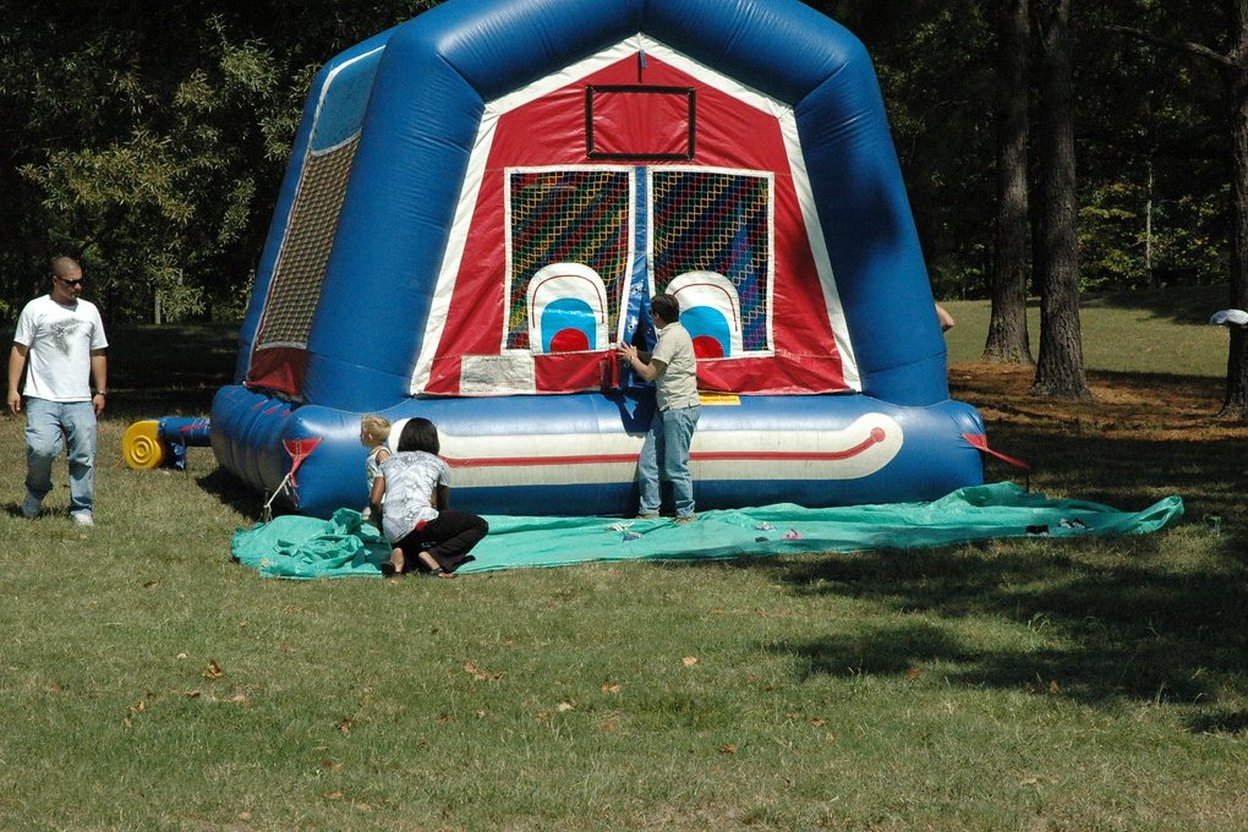
Photo: RENT THIS INFLATABLE BOUNCE HOUSE by Fort Eustis Marketing 2010, BY 2.0.