Can You Set Up a Bounce House on Concrete or a Driveway?
Yes, a bounce house can go on concrete or a driveway. Use 75 lb weights at every anchor point, add mats at the entrance, and watch the wind.
The party is Saturday, the bounce house is booked, and the only flat open space you have is the driveway. Maybe it's a Halloween costume party, or a way to keep the cousins busy after Thanksgiving dinner. Yes, you can put a bounce house on concrete or asphalt. You can't use stakes, though, so you'll hold it down with heavy weights, put padding where kids climb in and out, and watch the wind closely. Here's how to do each one.
The short answer: yes, but use weights instead of stakes
On grass, an inflatable is held down with stakes driven into the ground at each anchor point. A driveway won't take a stake, so every anchor point needs to be tied to something heavy: sandbags or weights the manufacturer approves.
Start with the unit's manual. Regulators say this too. Kentucky's rule says inflatables must be anchored the way the manufacturer's manual requires. Maryland's Department of Labor says to anchor to the manufacturer's specifications at every position the manufacturer requires. Oklahoma says to follow the ASTM standard or the manufacturer's specifications, whichever is stricter. ASTM F2374 (the current edition is F2374-24) is the industry standard that covers how inflatables are designed, built, run, maintained and inspected.
The numbers below are fallbacks for when the manual doesn't give one. They come from a few states and one city: Kentucky, Maryland, Oklahoma and Tucson, Arizona. There's no national law behind them, and the rules mostly cover commercial and rental operations. Rules vary by state, but these give you a solid, cautious place to start.
How to anchor on a hard surface
Use every anchor point. Tucson Fire Department's anchoring sheet says every anchor point must be anchored, and Maryland says to anchor at all of the manufacturer's required positions. Leaving one corner loose so you can fit around a parked car doesn't count.
Find the right weight. Go with the manual first. If it doesn't give a number, the official sources agree on 75 pounds per point:
- Kentucky: If the manual is silent, use rods or pins at least ½ inch thick, driven 18 inches deep at a 45-degree angle. If that's impracticable, as it is on a driveway, use 75 lb of sandbags at each anchor point.
- Maryland: On hard surfaces where stakes can't be used, secure the unit with sandbags of at least 75 lb, or with other weights made for the job and specified by the manufacturer.
- Tucson: Sandbags, blocks and other non-stake anchors must be at least 75 lb at each point.
- Oklahoma: Units must be securely anchored with stakes, weights or sandbags. Oklahoma doesn't give a separate number for hard surfaces.
The stake rules show why pavement needs a different approach. Maryland's guideline describes outdoor stakes of 30 to 42 inches long, with 18 inches as a minimum unless the manufacturer says otherwise. A driveway has no room for any of that.
You may come across lower figures online. One rental-software anchor calculator suggests 40–60 lb per point on hard surfaces, depending on wind. That's less than every official source listed here, so treat 75 lb as your minimum.
Bigger units need more. Tucson requires at least 150 lb of anchoring at each side point on slides, twice the standard figure. Tall slides and large combo units catch more wind, so check the manual carefully for these.
Only use anchors meant for anchoring. Tucson says anchors can be used only for anchoring, so no tying off to a fence or a vehicle. Use weights made for the purpose, and check that ropes and straps aren't frayed or worn. Maryland's checklist includes inspecting them.
Protect the kids and the bounce house
Once the unit is held down, the next concern is the hard surface underneath. Concrete is rough on vinyl, and it's much rougher on kids.
Check the surface first. A risk-control fact sheet from Alliant Loss Control Services, hosted by Cal State LA, says to set inflatables on a flat surface. It says not to use ground that is uneven, wet or covered in debris. Sweep away gravel, leaves and anything sharp. Look for cracks and broken edges, and pick the flattest part of the driveway, since many driveways slope toward the street.
Put a tarp underneath if needed. The same sheet recommends a protective tarp under the unit if needed. On rough pavement, a tarp helps keep the floor from rubbing.
Pad the entrance and exit. On a hard surface, the Alliant sheet says to put safety mats around the entrance and exit. Place them tightly together, with no tears, to prevent trips and ankle sprains. Kids falling out of the doorway is a big reason for this. A tumble that's harmless on grass can hurt on concrete.
Clear hazards around and above the unit. The sheet sets a 20-foot clearance from anything that could puncture the inflatable. It also says to mark gas, water, sprinkler and power lines and keep the unit away from them. Maryland's checklist adds overhead clearance from tree branches and power lines, enough open space around the unit, and an inspection of the blower and its cord. Driveways often run under service lines and overhanging trees, so look up before you inflate.
Wind, weather and supervision
Weights only work as long as the wind stays within limits. Fall afternoons can turn gusty, so keep checking the weather during the party, not just at setup.
- Maryland: Monitor wind at all times. If wind goes above 15 mph, check the manufacturer's recommendation.
- Tucson: Bounce houses must not be used in winds of 25 mph or more.
- Oklahoma: Shut down in storms or high winds. Its guide gives a 15–25 mph range.
When the wind goes over the manufacturer's limit, Maryland says to deflate and secure the unit right away. Get the kids out first, then pull the plug.
Weather isn't the only risk. The Alliant sheet recommends adult supervision at all times, sessions of 15 minutes or less, and separate times for adults and children. The injury numbers explain why. A 2012 Pediatrics study from Nationwide Children's Hospital found a 15-fold increase in emergency department visits for children's inflatable bouncer injuries from 1995 to 2010. In 2010, more than 30 children a day were treated. Falls caused 43% of the injuries, and 28% were fractures. A 2021 study led by CHOC reported 82,748 injuries among kids ages 2 to 17 in 2015–19, compared with 5,599 in 2000–04.
Checklist and rules for renters and operators
Before the first kid climbs in:
- Read the manual's anchoring section and weight requirements
- Pick the flattest spot, swept clean, dry and free of cracks
- Put down a protective tarp if the surface is rough
- Anchor every point with at least 75 lb (150 lb at each side point on slides, per Tucson), unless the manual calls for more
- Use proper weights only, never fences or cars, and check ropes and straps
- Lay mats tightly at the entrance and exit
- Clear 20 feet of puncture hazards, and check overhead for branches and power lines
- Check the wind, and plan to deflate right away if it goes over the limit
- Keep an adult watching at all times, with short sessions and kids separate from adults
For new rental operators: Look up your state's amusement rules before you take driveway bookings, and confirm your insurance covers hard-surface setups. State inspection programs are real. Maryland's Safety Inspection Unit says it completes more than 6,000 amusement attraction inspections a year. Oklahoma sends operator questions to its Department of Labor amusement office at 405-521-6100.
For parents renting: When you book, ask the company how they anchor on pavement. Ask what they use, how much weight goes on each point, and whether they bring mats and a ground tarp. A good operator will have quick, specific answers.
Sources (10)
- Kentucky Administrative Regulations, 302 KAR 16:121
- Maryland Department of Labor, Inflatable Guidelines
- Oklahoma Department of Labor, Inflatable Amusement Device Guide
- ASTM F2374-24
- Tucson Fire Department, Bounce House/Inflatables Anchoring (2023)
- Reservety, Bounce House Wind Load and Anchor Calculator
- Alliant Loss Control Services, Bounce House Safety (Cal State LA)
- Nationwide Children's Hospital, 15-fold increase in inflatable bouncer injuries (2012)
- WTVR, Bounce house study (2012)
- CHOC, Bounce house injuries continue to jump
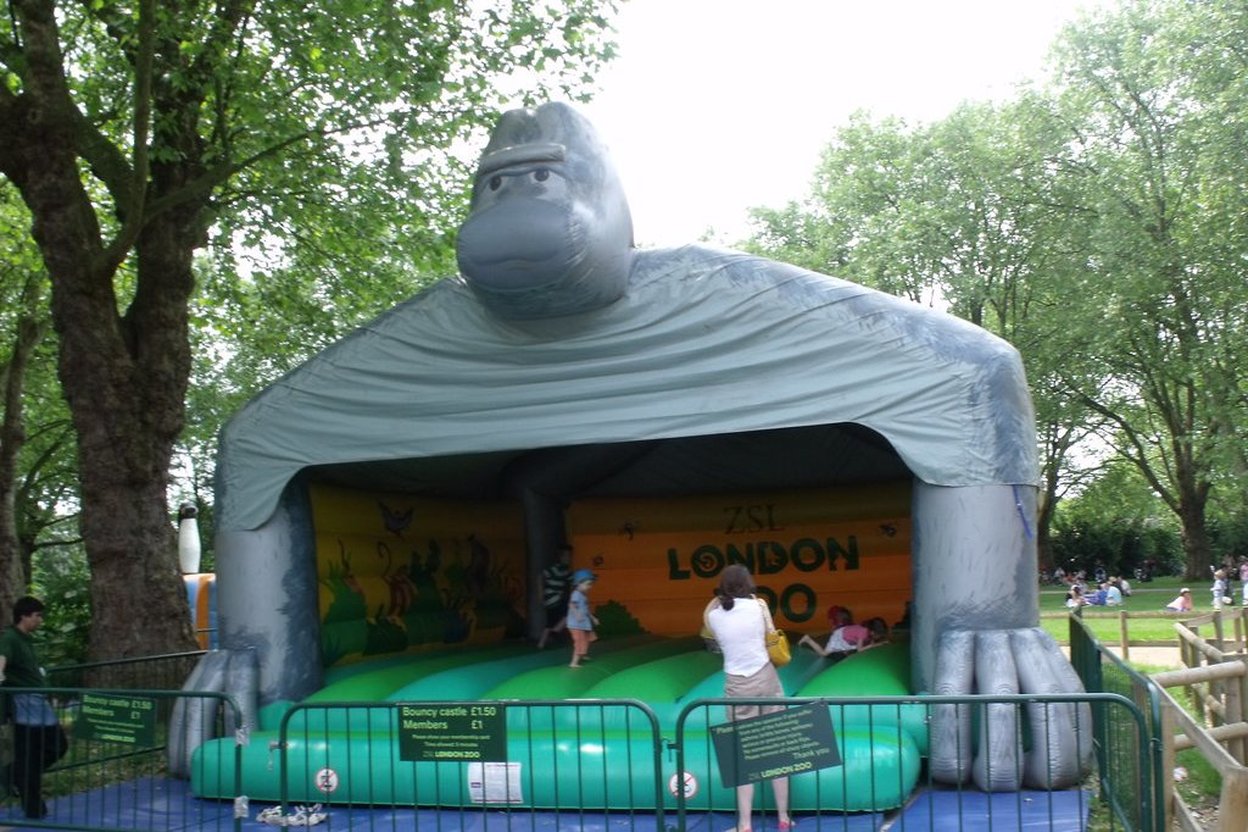
Photo: London Zoo - Gorilla Bouncy Castle by ell brown, BY 2.0.