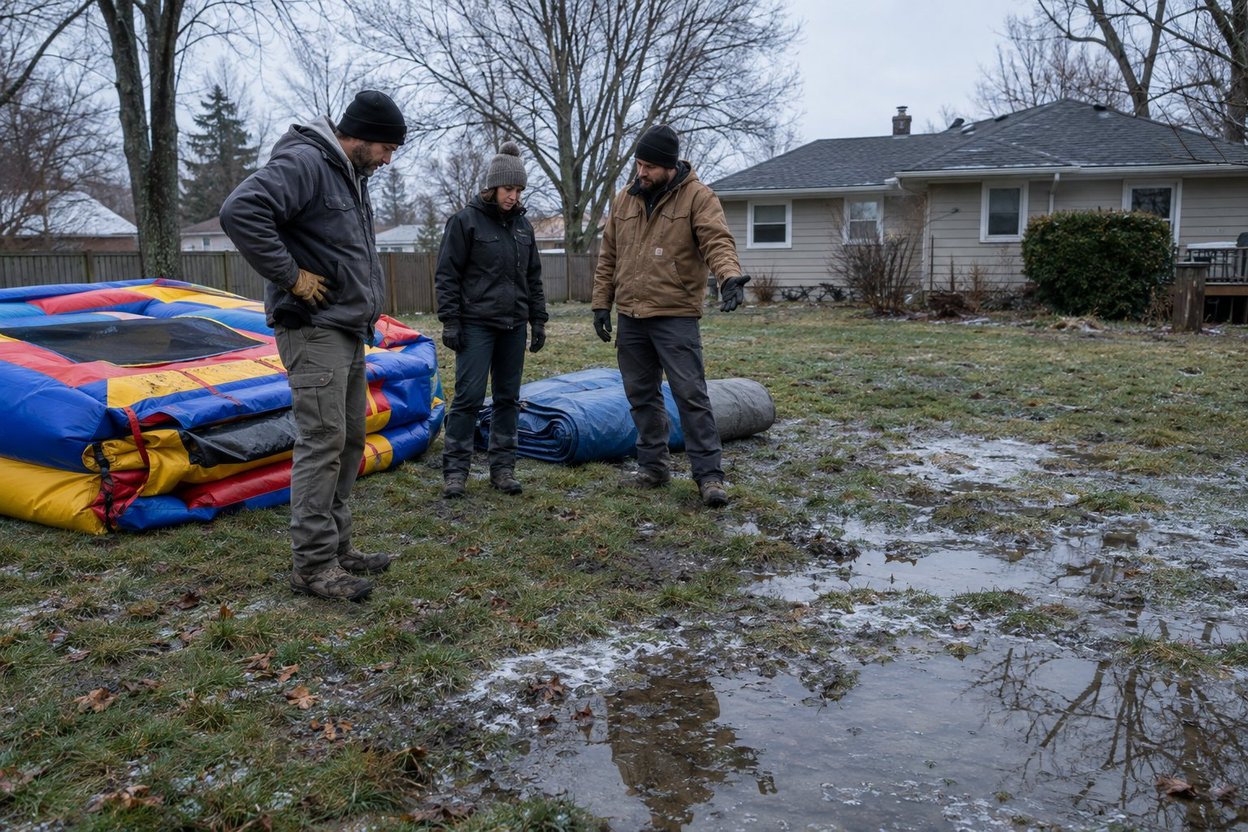
What happens to a rental booking when the yard is frozen or soaked?
Soaked or frozen lawns are rarely covered by bounce house rental contracts. Learn what policies say, what to ask, and how to protect your deposit.
It's the morning of the party. The bounce house arrives at 10. The lawn is still squishy from two days of rain, or white with frost from a cold October night. Can you cancel? Do you get the deposit back? No law answers that. Your rental contract does. Most companies spell out what happens with rain, wind and storms. Very few say anything about soaked or frozen ground. If you agree to set up anyway, you usually lose any claim to a refund.
The short answer
No national rule covers rental cancellations for weather. Each company writes its own terms, and they vary a lot. The posted policies of small rental companies tend to follow a pattern:
- Rain, high wind and storms are covered. Most companies will refund or reschedule if the forecast is bad enough, as long as you ask before their deadline.
- Light rain usually isn't covered. At least one company says outright that light rain or scattered showers don't cancel a rental.
- Ground conditions almost never come up. A lawn that is soaked from yesterday's storm, or frozen hard on a clear November morning, falls into a gap in most contracts. That gap is worth closing before you pay.
- Going ahead means accepting the risk. Several companies state that if you choose to set up in doubtful weather, there's no refund, even if the unit has to come down early.
So treat "what if the yard is a swamp?" or "what if the ground is frozen?" as a question to ask out loud, not something to assume. The rest of this article explains why those conditions matter and what the contract terms look like.
Why soaked ground is a problem
An inflatable stays put because of its anchors, and on grass that means stakes. Wet or muddy ground holds stakes less firmly. Safety guidance points out that soggy soil makes anchoring less effective and makes the surface around the unit slippery. A Connecticut operator interviewed by NBC Connecticut went further and advised against setting up on soft ground such as mud or sand at all.
That operator also gave useful staking details. Stakes driven straight down tend to pull out, so they should go in at about a 45-degree angle. The stakes that come from the factory are often plastic and about 9 inches long, and sturdier ones cost under $5 at a hardware store. Soft ground makes even good stakes less reliable.
Rain by itself is a different question. A consumer guide from Amplify Credit Union says most bounce houses can be used in rain but not in thunder and lightning. It also says grass is the preferred surface because it's easier on the material, and that grass usually recovers once the inflatable is gone. Its one warning is that heat trapped under a tarp or a deflated unit can damage the lawn.
If your rental is a water slide or combo unit, plan for the mess. One rental company's FAQ says heavy water use can leave a mud puddle that lasts a couple of days. A lawn that was already soaked will only get worse.
Why frozen ground is a problem
Frozen ground creates the opposite problem: stakes may not go in at all. Late-fall parties are where this comes up. A Halloween bash on October 31 or a family gathering around Thanksgiving on November 26 can fall on a morning when the top layer of soil is hard.
Temperature is also an issue apart from the ground. One 13x13 bouncer manual tells owners to avoid outdoor use in snow, sleet or hail, and in temperatures below 50°F or above 100°F. Other manuals may set different limits, but it's a good reminder that cold weather is a manufacturer concern too.
Frozen ground is rarely written into rental contracts, so you can't assume what will happen to your booking. Ask the company directly. Also ask what it uses when stakes won't work. The usual alternatives are sandbags or water weights. One manufacturer recommends adding sand or water bags to the stakes. Some cities don't allow staking at all in certain spots. Tampa's vendor rules for park shelters reportedly ban staking and require vendors to bring at least 500 lbs of weights. Yucca Valley, California, reportedly requires vendors to identify stake locations before approval and limits setups on grass to 4 hours.
What companies' policies say
These examples come from small rental companies' published terms. Policies change, so treat them as examples of what to look for, not current quotes.
Rain and wind refunds with a deadline. Quality Bounce in Richmond, Virginia, offers a full refund or a reschedule for rain or for winds over 15 mph. You have to ask by noon the day before delivery. Light rain or scattered showers don't count.
Tiered cancellation fees. The same company's fees for regular cancellations go up as the date gets closer: no fee more than 30 days out, 30% from 30 days out to 2 days before, and 50% inside 2 days.
Same-day morning cutoffs. Bouncing Around The House allows same-day cancellation for rain or wind if you call or email before 9 AM. Smiley Jump sets its cutoff at 7 AM. After that, it gives no refund or rain check.
Non-refundable deposits, with an exception for severe weather. Smiley Jump takes a 20% deposit that is normally non-refundable. It may cancel for severe weather and refund the deposit in full.
Reschedule or forfeit. KM Party Bouncers says that if high wind or heavy rain is forecast, you can reschedule within the same calendar year with at least 14 days' notice, or cancel and lose the deposit. It also calls a level grassy area the safest surface, which is about as close as these policies get to mentioning ground conditions.
Proceeding is final. This line shows up again and again. Smiley Jump says that if you go ahead in uncertain weather, there's no refund, even if you only get part of the rental time. Another rental FAQ says the same: if you keep the rental and weather stops you from using it, there's no refund.
Notice what's missing from every one of these policies. None says "soaked lawn" or "frozen ground" qualifies for a refund. A muddy yard on a dry, calm day may not count as "weather" under the contract at all. That's why you need to ask.
Wind, lightning and mid-party shutdowns
Wind is the condition most likely to shut a party down, and the limits are fairly consistent. Amplify's guide says most rental companies won't set up in sustained winds above 15 mph. Quality Bounce uses the same 15 mph figure. The Connecticut operator NBC spoke with won't rent above 20 mph. A Tennessee state safety bulletin reportedly sets 20 mph as the point to stop use, citing guidance from Consumer Product Safety Commission staff and the industry standard ASTM F2374. Thunder and lightning mean everyone off, every time.
Weather that turns during the party can also end it. Bouncing Around The House says that if rain starts during the rental, it may shut the unit down for safety with no refund. Agree on who makes that call before the party starts. If the attendant says the unit is coming down, it's coming down.
What to do before you book
For parents booking a party:
- Get the weather terms in writing. Read the actual policy, not just the booking page summary. Look for the words "rain," "wind," "refund," "reschedule" and "rain check."
- Know the cutoff time. It might be noon the day before, or 7 or 9 AM on party day. Put it in your phone with an alarm.
- Ask about soaked and frozen ground specifically. Ask: "If the lawn is muddy or frozen but the sky is clear, can I reschedule without losing my deposit?" Get the answer in an email.
- Ask about a backup surface. If the yard is a swamp, can the unit go on the driveway instead? Many units can, but only with the right anchoring.
- Ask about hard-surface weights. On pavement or frozen ground, the company should bring sandbags or water weights. Check whether that costs extra.
- Understand what "proceeding" means. Once you sign off on setup, a refund is usually off the table.
For rental business owners: Your customers will ask about wet and frozen ground, so put the answers in your contract. Spell out:
- whether a waterlogged or frozen lawn on a calm, dry day qualifies for a reschedule;
- what your crew does when stakes won't hold (move to a hard surface with weights, or cancel);
- your wind cutoff;
- your cancellation deadline;
- who decides whether to shut down mid-party.
Clear terms protect your deposits and your reputation, and they keep kids off a unit that shouldn't be up.
Sources (8)
- NBC Connecticut: Bounce House Safety: What Parents Need to Know (May 19, 2014)
- Amplify Credit Union: Bounce house rentals guide (January 24, 2020)
- Quality Bounce and Party Rentals booking terms
- 13x13 Bouncer Manual (PDF)
- City of Tampa: Bounce House Vendor Rules and Requirements (PDF)
- Town of Yucca Valley: inflatable setup requirements
- Inflatable-Zone: Instructions
- Tennessee Department of Labor and Workforce Development: Amusement Safety Bulletin, Inflatables (PDF)