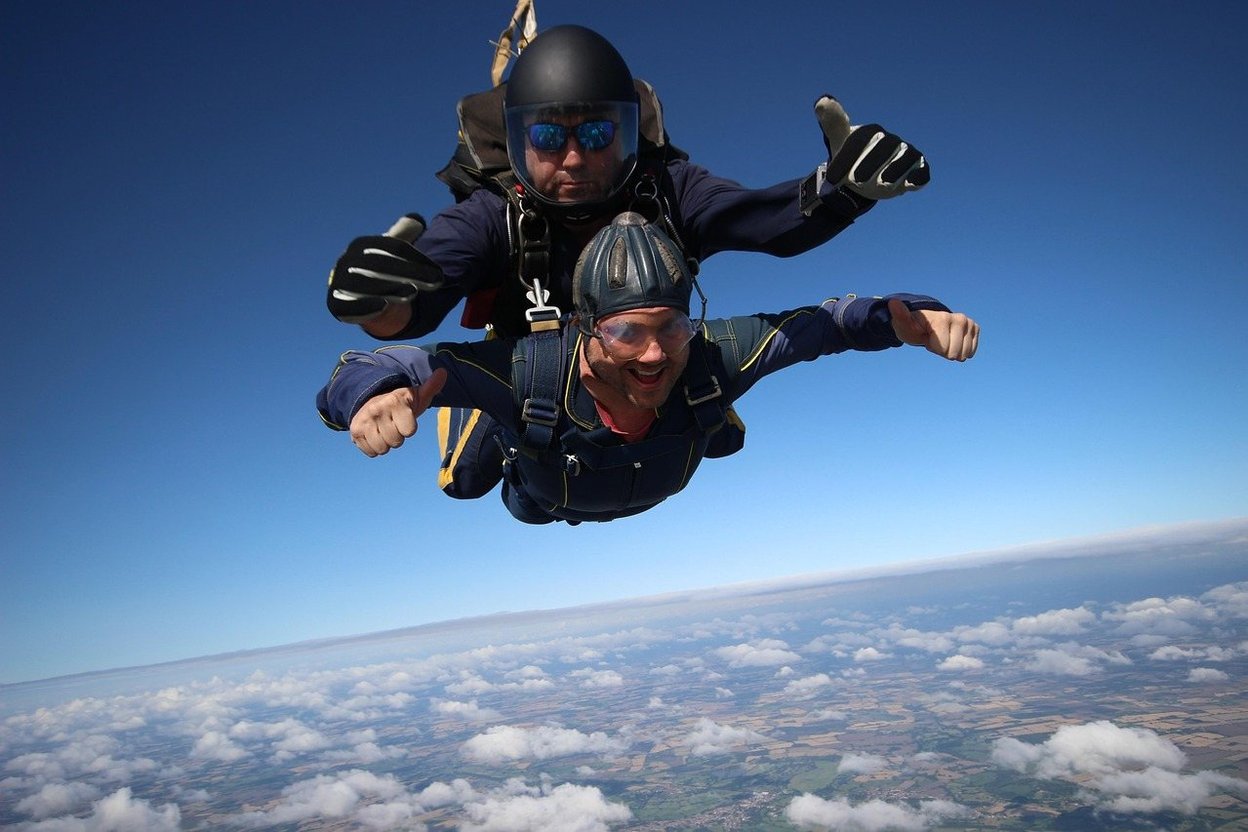
What wind will cancel a first tandem over Thanksgiving weekend?
No single wind limit grounds a tandem. Learn what dropzones check, from gust spread to clouds, and how to plan a Thanksgiving-weekend jump.
You've booked your first tandem for the long weekend. Thanksgiving dinner is on Thursday, and the jump is set for Friday or Saturday. Now you're checking the forecast and wondering how windy is too windy. In the US, no single number grounds a tandem. Each dropzone decides on the day. The closest official figure is the 14 mph ground-wind limit that USPA sets for solo students, and tandems usually get more leeway than that. Gusty, swirling wind and low clouds are more likely to stop your jump than a steady breeze.
The short answer: there is no single number
No published tandem wind limit exists. Skydive Monroe explains that the decision is left to the tandem instructor and the dropzone, because normal wind conditions differ so much from region to region. A breezy day on the plains and a breezy day on the coast aren't the same thing.
The only hard number most people come across is from the United States Parachute Association (USPA). Its Basic Safety Requirements limit ground winds for solo students to 14 mph with a ram-air canopy and 10 mph with a round reserve. That limit applies to solo students, meaning people jumping on their own with a student canopy. It isn't a tandem rule.
Tandems usually get more room. Monroe points out that a tandem pairs you with a professional instructor flying the canopy, on equipment built for two people. You'll see "around 14 mph" quoted online as a tandem limit, and 20-25 mph for experienced skydivers. Treat those as rough benchmarks, not rules.
Dropzones don't publish a cutoff. Skydive Perris, one of the biggest in the country, says only that it can't jump if it's "too cloudy, raining, or if we are experiencing high winds." Expect a judgment call, not a number on a sign.
The steadiness of the wind matters more than its average speed. A steady breeze is predictable, and gusts aren't.
What the dropzone looks at besides average wind
Gust spread. This is the gap between the lulls and the peaks. Monroe gives an example: a gust spread of 5-10 knots may be manageable, but wind that swings from 0 to 14 knots "is another matter entirely." A canopy can handle a steady wind. Sudden changes near the ground are harder, especially when two people are landing together.
Wind direction. The same speed can be fine from one direction and a problem from another, depending on the landing area and what's upwind of it.
Turbulence from obstacles. When wind flows over trees, hangars, and hills, it tumbles and swirls on the downwind side. Monroe lists turbulence as a separate factor from wind speed.
Wind at jump altitude. Skydive the Wasatch notes that winds at altitude can be completely different from what you feel on the ground. A calm parking lot doesn't guarantee calm air at altitude, and the opposite is true too.
Who makes the call. At Monroe, the decision to go on a wind hold rests with the Safety & Training Advisor (S&TA), the tandem instructors, the pilots, and the dropzone owner. Every dropzone sets its own thresholds. These are people who jump in these conditions every week. If they're waiting, it's for a good reason.
Wind isn't the only weather that grounds a jump, and late in the fall it may not even be the most likely.
Clouds, rain, and visibility cancel more jumps than people expect
A sunny, calm day can still be a no-jump day if the sky is socked in. Cloud rules come from federal regulation, not just dropzone preference. Under FAA rule 14 CFR 105.17, below 10,000 feet above sea level, a parachute jump needs:
- 3 statute miles of flight visibility
- 500 feet of clearance below clouds
- 1,000 feet above clouds
- 2,000 feet horizontally from clouds
At or above 10,000 feet, the requirements rise to 5 miles of visibility and 1,000 feet below, 1,000 feet above, and 1 mile horizontally. The same rule says no parachute operation may go "into or through a cloud."
In practice, both Skydive the Wasatch and Long Island Skydiving Center say that if clouds keep instructors from seeing the ground from jump altitude, jumping is delayed or cancelled. A hole in the clouds usually doesn't help. Long Island Skydiving Center explains that the holes move, so a gap overhead now may be closed by the time the plane reaches altitude.
Late November can bring gray, low-ceiling days in much of the country. That's general fall weather, not a forecast. When you check the outlook for your jump day, look at cloud cover as well as wind speed.
Thanksgiving weekend specifics
Thanksgiving 2026 falls on Thursday, November 26. The long weekend runs from Thursday through Sunday, November 29, with Black Friday on the 27th.
Some dropzones close on Thanksgiving Day. Skydive Perris in California is open seven days a week year-round, but it closes on Thanksgiving Day and Christmas Day. On weekends and holidays it runs from 7:30 AM to sunset. If you want to jump on Thursday morning before dinner, check first. Your dropzone may not be open that day.
Some dropzones cut back in November. Skydive Orange in Virginia says that "starting in November we are only open on the weekend," then shuts down for the holidays from mid-December to mid-January. A dropzone with that schedule is open Saturday and Sunday of the long weekend, but probably not Friday. Check your own dropzone's late-fall schedule. Don't assume it's the same as summer.
Other dropzones make a weekend of it. Skydive Arizona in Eloy held a Thanksgiving-weekend boogie (a multi-day gathering of experienced jumpers) in 2018. USPA reported jumping from sunrise to sunset in perfect weather. That was one past event, not a 2026 schedule. Still, it shows the holiday can be a busy, festive time at warm-weather dropzones.
Book early. A four-day weekend with family in town is a likely time for tandem bookings to pile up, especially on Friday and Saturday. If weather pushes back the jumps from one day, those customers need new slots too. Booking early gives you a better choice of time slots and a better chance at a quick rebook.
Days are short. With sunset around late afternoon in late November, a morning hold leaves less time to wait it out than it would in June. An early slot gives you the most room.
What a weather hold means for your wallet and your day
Usually, a weather cancellation costs you nothing except time. Policies vary, but the pattern is consistent:
- Skydive the Wasatch (Utah): If weather cancels your jump, you lose no deposit and the jump is rebooked. If you cancel or reschedule for your own reasons, it needs 24 hours' notice, and the deposit is non-refundable.
- Skydive Perris (California): If weather grounds operations, your deposit stays on file with no penalty. If you make a change with less than 24 hours' notice, it's treated as a cancellation and costs $50 (as of October 2026). Deposits become refundable with 72 or more hours' notice.
- Long Island Skydiving Center (New York): If weather keeps you on the ground, they reschedule you for another day.
Your money is usually safe. Your schedule is what's at risk. Monroe advises setting aside five to six hours for the whole experience in case of weather delays. A hold may be waited out if conditions are expected to improve "within a few hours." Don't plan a jump for 10 AM with a family gathering at 1 PM.
Two more planning tips:
- Build in a backup day. If you're aiming for Friday, keep Saturday or Sunday open. With four days off, this is easy to do.
- Don't book a flight home the same evening. If you're traveling for the holiday, a weather hold on your last day could mean missing the jump or missing your flight.
Quick checklist before you book
- Ask about the weather policy. Find out what happens to your deposit if they cancel, and what happens if you cancel.
- Confirm the November schedule. Are they open on Thanksgiving Day? Are they open weekdays in late fall, or only on weekends?
- Ask about the rebook window. If Saturday gets cancelled, can they move you to Sunday? How far out are they booked?
- Check the weight limit. Every dropzone sets its own, and you'll be weighed or asked to confirm your weight. Find out before you book, not on the day.
- Hold a backup day. Keep at least one other day of the long weekend free.
- Call the morning of the jump. Perris says its forecast is "not always accurate," and Wasatch recommends calling ahead to check conditions. A quick call can save you a drive.
Plan for a hold and be flexible, and wind is unlikely to ruin your weekend.
Sources (12)
- Skydive Monroe: Tandem Skydiving Wind Limits
- Skydive Monroe: Skydiving Weather and Wind Holds
- USPA Skydiver's Information Manual, Section 2 (Basic Safety Requirements)
- Sonuby: How Much Wind Is Too Much for Skydiving
- Skydive Perris: Tandem FAQs
- Skydive the Wasatch: What Do You Consider Inclement Weather?
- Skydive the Wasatch: Rescheduling and Refunds
- Cornell LII: 14 CFR 105.17, Flight Visibility and Clearance from Cloud Requirements
- Long Island Skydiving Center: Skydiving Weather Conditions
- Universal Time Date: Thanksgiving 2026
- Skydive Orange: FAQ
- USPA News: Eloy Throws Busy Thanksgiving Boogie
Photo by dan321132 on Pixabay.