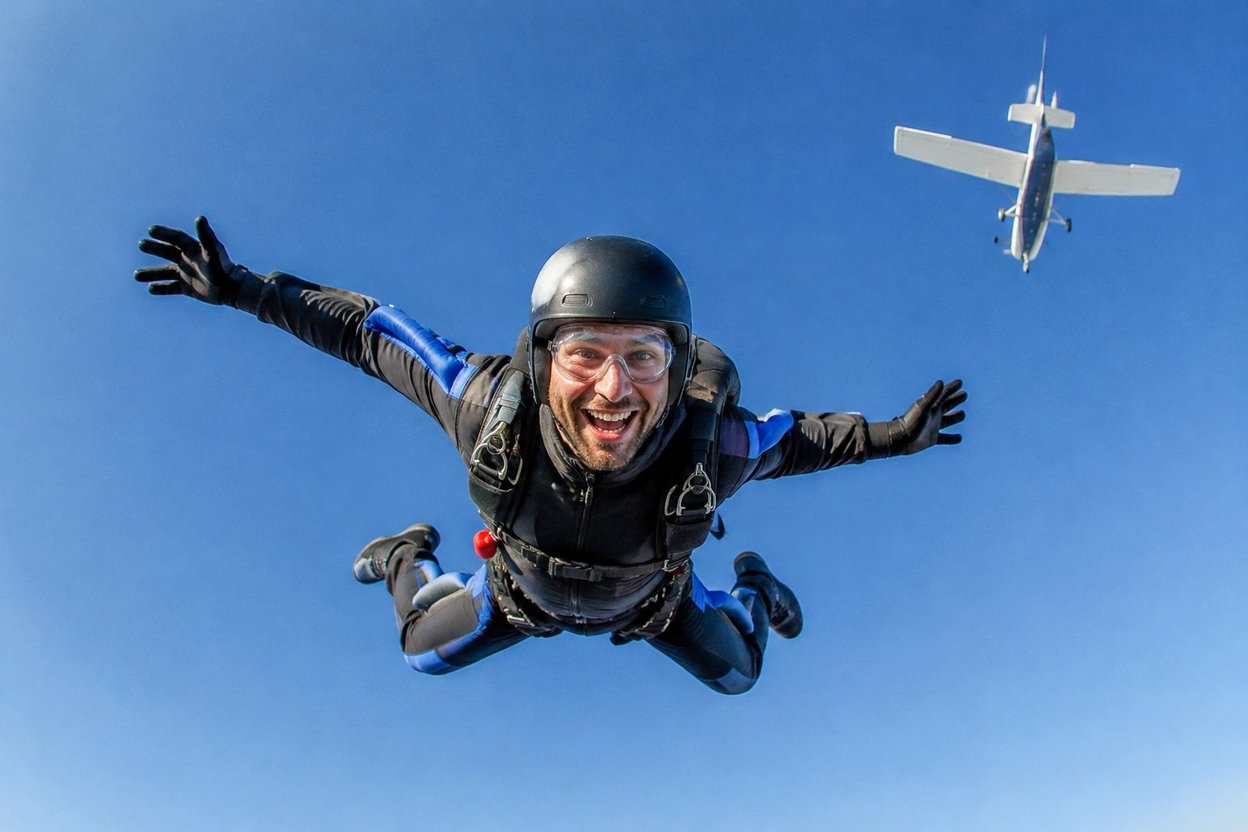
How Much Does a Skydiving License Cost?
US skydiving school prices for the USPA A license, from about $2,100 to $6,000, plus the fees and repeats that change the total.
You've just watched someone's tandem video and caught yourself wondering what it would take to jump without an instructor strapped to your back. The short answer: the USPA A license itself costs $43. Earning it costs much more. US schools advertise prices from about $2,100 to $6,000 for the 25 jumps, instruction and exams, and some of those prices leave out required fees. Below you'll find what the money pays for, how AFF compares with tandem-first and static-line routes, real school prices as of October 2026, and a worksheet for building your own budget.
What you're actually paying for
The United States Parachute Association (USPA) issues the A license, which is the first license in US skydiving. To get one you need:
- 25 jumps
- A completed A-License Progression Card, which lists the skills you must show
- Current USPA membership
- Three exams: a written test (75% to pass), an oral test (100% to pass) and a practical exam, which is a check dive with an instructor watching
The license fee is $43, and you pay it once. The license only stays valid while your membership is current. Since July 1, 2024, new membership costs $98 and renewal costs $83.
That means USPA's share is about $141 in your first year. Everything else goes to the dropzone, for ground school, instructors, aircraft seats, rental gear and pack jobs.
AFF, tandem-first and static line: three ways to start
USPA's Integrated Student Program accepts three starting methods. Each dropzone sets its own prices.
- **Accelerated Freefall (AFF):** You jump your own parachute from your first student jump, with one or two instructors holding on in freefall. Most of the programs priced below are AFF.
- Tandem-first progression: You start strapped to a tandem instructor and learn skills on those jumps. Documented, verified tandems can count toward your 25 jumps, but you still have to complete every skill on the card.
- Instructor-Assisted Deployment (IAD) / static line: The parachute is deployed for you as you leave the plane, and freefall time builds up gradually. This route is often cheaper. Skydive Fargo estimates about $2,800 for static line versus $3,250 for AFF.
Tandems also show up as prerequisites inside AFF programs. Skydive Arizona requires a tandem before its packages. Skydive CSC prices two training tandems separately. Skydive Utah's training tandem is $220 on weekdays and $260 on weekends. So when one school sells a 24-jump package and another sells 25, the first one isn't necessarily short a jump. Count your tandem.
Three different totals that all get called "the license price"
Before comparing schools, make sure each price covers the same thing. Ads mix up three different totals:
- AFF or solo clearance. This is the instructor-led part, usually around seven levels. Monterey Bay's ground school plus seven levels comes to $1,965, plus a 6% fuel surcharge. That price is real, but it covers only part of the 25 jumps.
- A completed A license. All 25 jumps, the coach jumps, solos, packing class, check dive and USPA fees.
- Your first year as a skydiver. The license plus the jumps you make afterward. The r/SkyDiving community wiki estimates $6,000–$10,000 for the first year, depending mostly on how often you jump. That is community guidance, not a quote from any school.
When a school calls seven AFF jumps a "license," it means solo status. A USPA A license still needs all 25 jumps.
US school prices as of October 2026
These are advertised prices from individual operators. They are not state averages. No state has one standard rate.
Lower-cost and club programs
- Lincoln Sport Parachute Club (Nebraska), IAD: $2,130 for a package of 30 student jumps. That's five more than the minimum, which leaves room for repeats. Unused tickets can be refunded after you finish your A license.
- Skydive Fargo (North Dakota): About $2,800 for static line or $3,250 for AFF. Both include instruction, rental and club membership. The estimate assumes 25 jumps with no repeats and leaves out USPA membership.
- Skydive California: $2,970 for a combined 25-jump AFF/A-license package. Repeats are not included, and the package is valid for one year.
Mid-range AFF packages
- East Tennessee: $3,250. Includes ground school, instructional jumps, the extra jumps to reach 25, the check dive and one repeat of a Category A–E level.
- SkyDance (California): $3,275 at the cash/debit price. Includes ground school, 7 AFF jumps, 5 coach jumps, 12 solos, packing instruction and test, check dive, rentals and pack jobs. Tickets expire after 18 months.
- Start Skydiving (Ohio): $3,452 prepaid or $4,315 pay-as-you-go. Ground school ($100), packing class ($80) and USPA membership cost extra.
- Skydive Paraclete XP (North Carolina): $3,836, or $3,400 prepaid, according to its March 2024 article. Includes 15 minutes of wind-tunnel training. Those prices are from 2024, so confirm them before you book.
- Skydive Carolina: August 2026 tuition is $2,119 for Phase 1 and $1,150 for Phase 2, with rental gear and video included. The school's general licensing budget is $3,000–$4,000.
- Skydive CSC (Illinois): The Graduate Program is $3,699. It covers the undergraduate instruction plus nine coach jumps, five solos, two low-altitude jumps and a check dive. Repeats and extra solos can cost more. CSC's blog shows a different breakdown, roughly $3,200 or more for the jumps alone with ground school and tandems priced separately, so go by the current training page.
- WNY Skydiving (New York): $2,320 for seven-jump AFF, then two coach packages at $1,445 each. Repeats are extra.
Higher-priced and destination programs
- Skydive Arizona: The prepaid Economy Package is $4,199. It includes 24 jumps, packing class, the A-license exam and bunkhouse lodging, with completion in as little as nine days. It does not include the prerequisite tandem, the $60 nonrefundable ground-school booking fee, a required $190 tunnel session, or USPA fees.
- Paradise Skydiving (Hawaii): $4,485 program total, with rental and pack jobs included. Ground school ($100), packing class, USPA membership and repeats are extra.
- Skydive Orange (Virginia): The 25-jump package is $5,090 cash or $5,294 credit. The USPA license fee and the packing class (price varies) are extra. Students must buy their own altimeter, goggles and gloves. The school's July 2025 blog estimates $4,790–$5,000 or more, so go by the program page.
- Skydive Perris (California): The June 2026 syllabus recommends budgeting $5,500–$6,000 and setting aside at least two weeks of full days at the dropzone. Perris says it can't guarantee either the timeline or the final cost.
Worked examples, before repeats
These are simple sums of each school's listed prices plus USPA's $98 membership and $43 license fee:
- Ohio, prepaid vs. pay-as-you-go: $3,452 + $100 + $80 + $141 = about $3,773 prepaid. The same math with $4,315 pay-as-you-go gives about $4,636. Prepaying saves $863.
- Arizona, all listed extras added: $4,199 + $60 + $190 + $141 = about $4,590, plus whatever the required tandem costs.
- Fargo, static line vs. AFF: $2,800 + $141 = about $2,941, or $3,250 + $141 = about $3,391.
Where budgets grow
Repeats. If you don't show a skill on a jump, you repeat it at that level's price. Some programs build this in: East Tennessee includes one repeat, and Lincoln's 30-jump package has five spare jumps. Most others charge for each repeat. Treat repeats as a likely cost, not just a possible one.
Breaks in training. USPA recommends at least one jump directly supervised by an instructor if you haven't jumped in 30 days. Some schools add rules on top of that. Skydive Tecumseh in Michigan has students who've been away 31–90 days jump at least one level lower than where they stopped. After 90 days, it also requires a $150 first-jump course. This matters in fall. If you start AFF in late October and your dropzone slows down after Thanksgiving, a winter break can mean paying to repeat skills in spring.
Package deadlines. Start Skydiving's prepaid packages have to be used within one season. They're nonrefundable, and transferring one costs $25. A prepaid discount bought this late in the year can lose value quickly. Check how long the package lasts before you count the savings. SkyDance gives 18 months, and Skydive California gives one year.
Daily rental and weather. After solo status, Perris charges $125 plus tax per day for rental gear and expects two to five jumps per rental day. If wind or clouds limit you to two jumps a day, you pay for more days to finish the same number of jumps.
Schedule and payment method. Skydive Utah takes $20 off each student jump on weekdays. Des Moines Skydivers adds a 3% fee to both credit and debit payments. Orange lists separate cash and credit prices. Monterey Bay adds a 6% fuel surcharge.
Small extras. Examples from Des Moines include $175 ground school, $15 goggles and a $15 logbook.
Your completion-budget worksheet
Add these up for any school you're considering:
- Package or pay-as-you-go total for the full 25 jumps
- \+ Prerequisite tandem(s), unless already included
- \+ Ground school, booking fees, required tunnel time
- \+ Packing class, if separate
- \+ USPA membership ($98) and license ($43)
- \+ Required gear you buy (altimeter, goggles, gloves, logbook)
- \+ Repeat allowance: the price of a few jumps at your school's rates
- \+ Recurrency jump(s), if you expect a break of more than 30 days
- \+ Payment fees or fuel surcharges
- \+ Travel, lodging and time off work (your own numbers)
After the license: renting vs. buying gear
You don't need your own rig to graduate. WNY Skydiving advises against buying gear during training and suggests renting after you're licensed until you know what equipment fits your skills. Paraclete XP's 2024 numbers show what licensed jumping costs: $25 for a low-altitude ticket or $32 for full altitude, plus about $40 for rental gear on each jump. It estimates $6,000–$12,000 for a full personal rig, depending on what you choose and whether it's new or used. That's a separate decision for later, not part of the license price.
Questions to ask before you pay
- What is the total to a completed USPA A license, not just AFF?
- Do my tandem jumps count, and is a tandem required first?
- How much is each repeat, and are any repeats included?
- Are rental gear, pack jobs, packing class and the check dive included?
- Are there booking fees, tunnel requirements or fuel surcharges?
- Is there a fee for paying by card, including debit?
- When does the package expire? Is it refundable or transferable?
- Do you stay open in winter, and what do I have to redo after a break?
- How long do students usually take to finish, given your weather and staff?
For the step-by-step requirements and the exam details, see the UpIsJump guide to USPA A license requirements and cost.
Sources (28)
- USPA: A-License Requirements and Forms
- USPA: License FAQ
- USPA: 2024 Winter Board Meeting (fee changes)
- USPA: Your First Skydive
- USPA SIM 4-2
- Skydive CSC: License cost article
- Skydive CSC: Training program pricing
- Skydive Orange: Cost to become a skydiver
- Skydive Orange: AFF program
- Skydive Paraclete XP: Cost of a skydiving license
- Skydive Carolina: How to get your skydiving certification
- Skydive Perris: PSP Syllabus, June 2026 (PDF)
- Skydive Arizona: Pricing
- Skydive Utah: School prices
- Start Skydiving: AFF prices
- SkyDance Skydiving: Get a skydiving license
- Skydive Fargo: Prices
- Lincoln Sport Parachute Club
- Skydive California: Prices
- Skydive East Tennessee: AFF flyer (PDF)
- Paradise Skydiving: Learn to skydive
- Des Moines Skydivers: Student details
- WNY Skydiving: Info and rates
- WNY Skydiving: How much does it cost to become a skydiver
- Skydive Tecumseh: AFF prices
- Skydive Monterey Bay: Skydive license
- r/SkyDiving wiki: Getting licensed
- UpIsJump: USPA A license requirements and cost