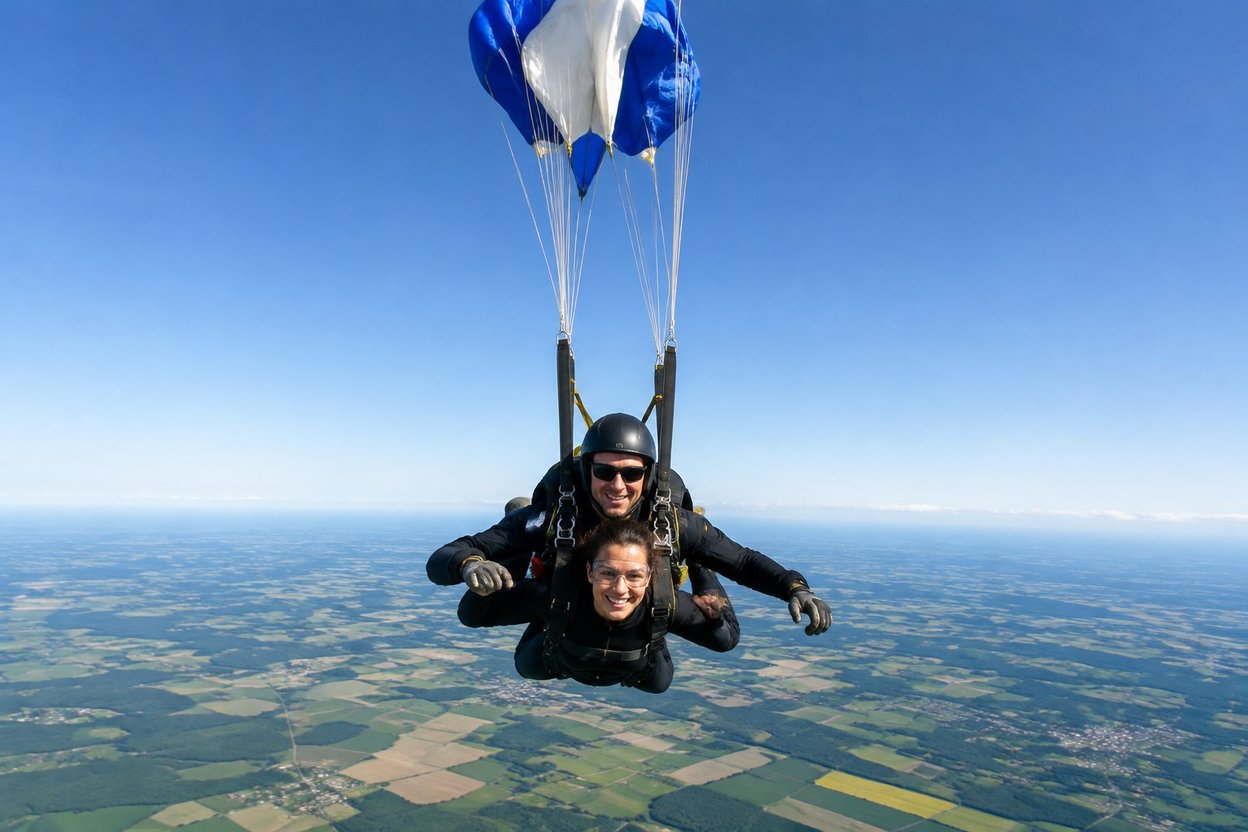
Can You Skydive on ADHD Medication? What the Rules Say and What to Ask Your Doctor
Can you skydive on ADHD medication? Learn what US rules and dropzone screening say, and which questions to bring to your prescriber before booking.
The short answer
As of October 2026, no federal skydiving rule and no part of the United States Parachute Association (USPA) medical requirements bans people with ADHD, or people taking ADHD medication. That doesn't mean a prescription automatically clears you either. Three things decide whether you jump:
- Federal law: you can't be impaired by a drug in a way that's unsafe.
- USPA medical standards: you need one of three accepted forms of proof that you're fit to jump.
- The dropzone's own screening: each operator decides what it needs to know and whether it wants a doctor's note.
What federal law actually says
The FAA rule for parachute jumps is 14 CFR §105.7. It prohibits a parachute operation when a person is, or appears to be, under the influence of a drug that affects their faculties in a way contrary to safety. It doesn't name ADHD medications or any other drug class.
So the rule asks how the medication affects you, not what it's called. Someone whose treatment keeps them focused and steady is in a different position from someone who is drowsy, lightheaded or having side effects. Only you and your prescriber can say which one describes you.
What USPA requires
Most US dropzones are USPA Group Members and follow its Basic Safety Requirements (BSRs). The current online BSR (section 2-1 of the Skydiver's Information Manual, as of October 2026) accepts three ways of showing you're medically fit:
- A recognized medical certificate: an FAA Third-Class Medical, a Form MCSA-5876 medical (the commercial driver's exam form), or a qualifying military medical.
- A physician's statement that you are physically and mentally fit to skydive.
- Agreement with USPA's recommended medical statement. This is the only route that doesn't need a doctor's paperwork.
Two parts of that recommended statement matter here. It allows conditions that are being treated successfully, as long as they pose no foreseeable risk in skydiving. And it addresses prescription and nonprescription substances that would impair your participation as a separate matter. Read together, they say a diagnosis that's under control isn't the problem. Being impaired by a substance is.
USPA also requires the tandem instructor, the person actually flying the parachute, to hold a current USPA-recognized medical certificate. That rule applies to the instructor, not to you as the passenger.
What dropzones actually ask
Dropzones differ in what they ask, but their published policies point the same way:
- Skydive Atlanta (Georgia) says most medications probably won't stop you from skydiving, but recommends a doctor's assessment because of altitude effects.
- Wisconsin Skydiving Center says a medical condition doesn't automatically disqualify you. Talk to your doctor first, then call the dropzone.
- Skydive Perris (California) says some conditions require a doctor's note and asks jumpers to tell their tandem team about relevant conditions before the jump.
- Skydive the Wasatch (Utah) asks you to disclose conditions that could affect your jump and to avoid medications that affect judgment or performance.
- Skydive Skydown (requirements updated in 2025) prohibits jumping after taking medications that impair you.
- Skydive Chicago (guide marked "Updated for 2026") recommends a medical consultation for uncontrolled high blood pressure, heart disease and seizure disorders. It treats ordinary first-jump nerves differently from diagnosed panic disorders or conditions that cause fainting, which it says you should discuss with a doctor.
- Skydive Airtight (Skiatook, Oklahoma) has a published waiver with a field for the medications you currently take.
The pattern is to tell the dropzone, check with your doctor and stay off anything that impairs you. None of these dropzones lists ADHD medication as disqualifying, and none promises that a doctor's note guarantees you a jump.
Tandem, AFF or instructor: the bar changes
What's expected of you depends on the kind of jump:
- Tandem passenger: you're attached to an instructor who handles the parachute. Skydive Atlanta's tandem requirements focus on mobility, such as being able to lift your legs for landing and follow simple instructions. You still go through the dropzone's medical screening and USPA's medical routes.
- **AFF (Accelerated Freefall) student:** you jump on your own parachute from the first jump, with instructors flying beside you in freefall. Atlanta asks AFF students to be in good physical and cognitive health, a higher bar because you make the decisions yourself, including when to open your parachute.
- Tandem instructor: needs a current USPA-recognized medical certificate. Anyone thinking about a skydiving career eventually runs into FAA medical certification, covered below.
If you're moving from a one-time tandem to a license, have a new conversation with your prescriber. Steering your own parachute asks more of your attention and decision-making than riding along does.
Not every ADHD medication works the same way
Prescribing information isn't a skydiving clearance. But it does show why one answer doesn't fit everyone, because different ADHD drugs push your body in opposite directions.
Stimulants (Adderall as the example): - US labeling reports average increases of about 2–4 mmHg in blood pressure and 3–6 beats per minute in heart rate. Some patients see larger increases. - The label advises against use in people with serious heart disease, including cardiomyopathy, serious heart rhythm problems and coronary artery disease. - It tells patients to contact a healthcare provider right away for chest pain during exertion or unexplained fainting.
Nonstimulants (guanfacine extended-release as the example): - The label warns of dose-dependent drops in blood pressure and heart rate, with reports of fainting and of lightheadedness on standing up (orthostatic hypotension). - Sedation and sleepiness are common. The label cautions against driving or operating heavy equipment until you know how you respond. - It advises avoiding dehydration and overheating, which can raise the risk of low blood pressure and fainting.
"Nonstimulant" doesn't mean safer for skydiving. Guanfacine's warnings about fainting and sleepiness bear directly on a day spent in the sun, climbing to altitude and then landing. Because the two types work so differently, your prescriber needs to know which one you take and how it affects you in particular.
"Should I just skip my dose on jump day?"
Don't decide this on your own. No skydiving authority recommends skipping a dose as a workaround. For at least one ADHD drug, stopping carries its own risk: guanfacine's labeling warns against stopping without talking to a healthcare provider, because blood pressure and heart rate can rise after you stop.
Any change to your dose or timing, including a one-day break, is for your prescriber to decide. If they suggest an adjustment, they'll know your history.
What the evidence shows, and what it doesn't
You'll see claims about this online. Here's what the research actually covers:
- Skydiving-specific data: there's no published complication rate for skydivers taking Adderall, Vyvanse, Ritalin or nonstimulants. Anyone who quotes a number for it is guessing.
- Drug labeling: describes cardiovascular and sedating effects in general use. It doesn't give a yes or no on skydiving.
- The MTA cardiovascular study: began with 579 children aged 7–9, randomized to four treatment approaches for 14 months, then followed with naturalistic treatment and observation. Over ten years, investigators found no evidence of increased prehypertension or high blood pressure, though continued stimulant treatment kept its effect on heart rate. That's reassuring for that childhood group over that period. It doesn't prove lifelong safety, and it says nothing about skydiving.
- A 2024 heat-stroke case report: a 17-year-old taking amphetamine/dextroamphetamine 20 mg twice daily fainted during tennis drills in 98°F weather after a two-mile warm-up. His first recorded temperature was 103.2°F. The authors discuss how stimulants can affect heat regulation during exertion. It's one case in a different sport, so it doesn't measure skydiving risk. It's a reasonable reminder to drink water and stay in the shade on a hot jump day.
Fall can help here. A cool October morning at the dropzone is easier on your body than a 98°F afternoon. But southern dropzones can still be warm in late October, and jump days often mean hours of waiting outside.
Questions to bring to your prescriber
The FAA warns that primary-care doctors may not have aviation-medicine training and may miss how a medication or condition affects flight safety. That warning is written for pilots, but the same applies to you: explain what skydiving involves, and don't just ask "is it OK?" Questions worth asking:
- Is my blood pressure and heart rate where you'd want it for a high-adrenaline day?
- Have I ever fainted, or had chest pain during exertion, on this medication?
- Does my medication cause sleepiness or lightheadedness, especially when I stand up quickly?
- Is my dose or medication new or recently changed, and have I been on it long enough to know how I respond?
- How should I handle heat, hydration and a long day outdoors on this medication?
- I'm planning a tandem jump, or AFF training where I'd fly my own parachute. Does that change your answer?
- Should I keep my normal dose and timing? (Let your prescriber make this call. Don't settle it yourself.)
- Would you sign a statement that I'm physically and mentally fit to skydive if the dropzone asks for one?
Prebooking checklist
- Talk with your prescriber about your condition, your medication and the type of jump you're planning.
- Call the dropzone before you book. Ask whether they need a doctor's note for your situation.
- Fill in the medications field on the waiver honestly, and tell your tandem team about anything relevant on the day.
- If the dropzone wants paperwork, bring the physician's statement with you.
- On jump day, don't jump if you feel drowsy, lightheaded or "off." Federal law and dropzone policies both put impairment above everything else.
- Drink water, find shade and eat normally, especially if you're spending the whole day at the dropzone.
Quick myth checks
"The FAA says you have to be off ADHD meds for four years (or 90 days) to skydive." Those numbers are real, but they come from pilot certification. The FAA's ADHD "Fast Track" for pilot medical exams requires four years without ADHD treatment or medication, symptoms or functional instability, and no other current or past psychiatric diagnosis. Its "Standard Track" evaluation requires at least 90 days off ADHD medication and symptom-free. These rules apply to people trying to get a pilot medical, which is relevant if you plan to become a tandem instructor. They don't set jump-day timing for tandem passengers. The FAA also says it keeps no list of acceptable medications and assesses both the condition and the drug individually.
"Stimulants cause oxygen toxicity when you skydive." This comes from scuba diving. Many of the top search results for ADHD medication and extreme sports are diving articles, including the Divers Alert Network's piece, whose examples cover breathing gas, buoyancy, depth and decompression. Any oxygen concern there is a theoretical one tied to breathing high-pressure oxygen at depth. It doesn't apply to skydiving.
"A doctor's note guarantees I can jump." No. A note helps, and some dropzones need one, but each operator does its own screening, and the instructor can still decide on the day.
"Some states ban skydiving on ADHD medication." No state-by-state ban has been documented. Your dropzone's policy is the one that matters, so ask them directly.
The bottom line
An ADHD diagnosis or prescription doesn't automatically ground you. The real tests are whether your treatment is working, whether your medication leaves you impaired, and what your dropzone requires. Take the questions above to your prescriber, call the dropzone, list your medications honestly on the waiver, and leave any dose changes to your doctor.
Sources (18)
- 14 CFR §105.7, Use of alcoholic beverages and drugs (eCFR)
- USPA Skydiver's Information Manual, Section 2-1 (Basic Safety Requirements)
- USPA recommended medical statement
- Skydive Atlanta: Can I skydive if I have a medical condition?
- Skydive the Wasatch: Other health requirements or limitations
- Skydive Chicago: Health and age requirements for skydiving in the US
- Skydive Skydown: Physical requirements for skydiving
- Wisconsin Skydiving Center: Skydiving requirements
- Skydive Perris: Tandem FAQs
- Skydive Airtight waiver (PDF)
- Adderall prescribing information (DailyMed)
- Guanfacine extended-release prescribing information (DailyMed)
- Heat Stroke in a Young Athlete With ADHD on Stimulant Medication (PMC)
- MTA cardiovascular follow-up study (PMC)
- FAA: AME exam requirements with an ADHD diagnosis
- FAA: Does the FAA have a list of drugs pilots can and cannot take?
- FAA: Medications and medical certification
- Divers Alert Network: ADHD and Diving
You're booking a tandem jump, maybe a spring weekend or a gift for someone this Christmas, and the waiver asks you to list your current medications. You take Adderall, Vyvanse, Ritalin or guanfacine every morning. Does that end the plan? Usually not. US parachuting rules don't ban ADHD medication by name. The rules ask whether a drug is affecting you in a way that makes the jump unsafe. Dropzones add their own screening, and your prescriber is the right person to judge how your medication affects you. This guide covers the rules, the dropzone questions and what to ask your doctor. It is not medical advice.