How Ski Jumping Works (and How Far They Fly)
Ski jumpers fly the length of two and a half football fields. How the in-run, takeoff and V-style flight work, how scoring adds up, and the 254.5-meter world record set in Planica in 2025.
Ski jumping looks impossible the first time you see it: a person on two long skis launches off a ramp and flies, not falls, for hundreds of feet. On the biggest hills, jumpers travel farther than two and a half football fields. Here's how it works.
The hill
A ski jump has four parts:
- The in-run: the steep ramp where jumpers crouch and build speed, often reaching around 55 to 65 mph on large hills.
- The takeoff table: the lip at the bottom, angled slightly downward. Jumpers don't get launched up; they push off into the air.
- The landing hill: a long slope shaped to match the jumper's path, so they're never very far above the snow.
- The out-run: the flat area where they stop.
Hills are sized by their hill size (HS), roughly the distance where the landing slope starts to flatten. Normal hills are around 100 meters, large hills around 140, and the giant ski flying hills are 200 meters and more.
The jump
- In-run: a tight, low crouch to cut wind resistance.
- Takeoff: a fast, precise push at the edge of the table. A fraction of a second early or late costs meters.
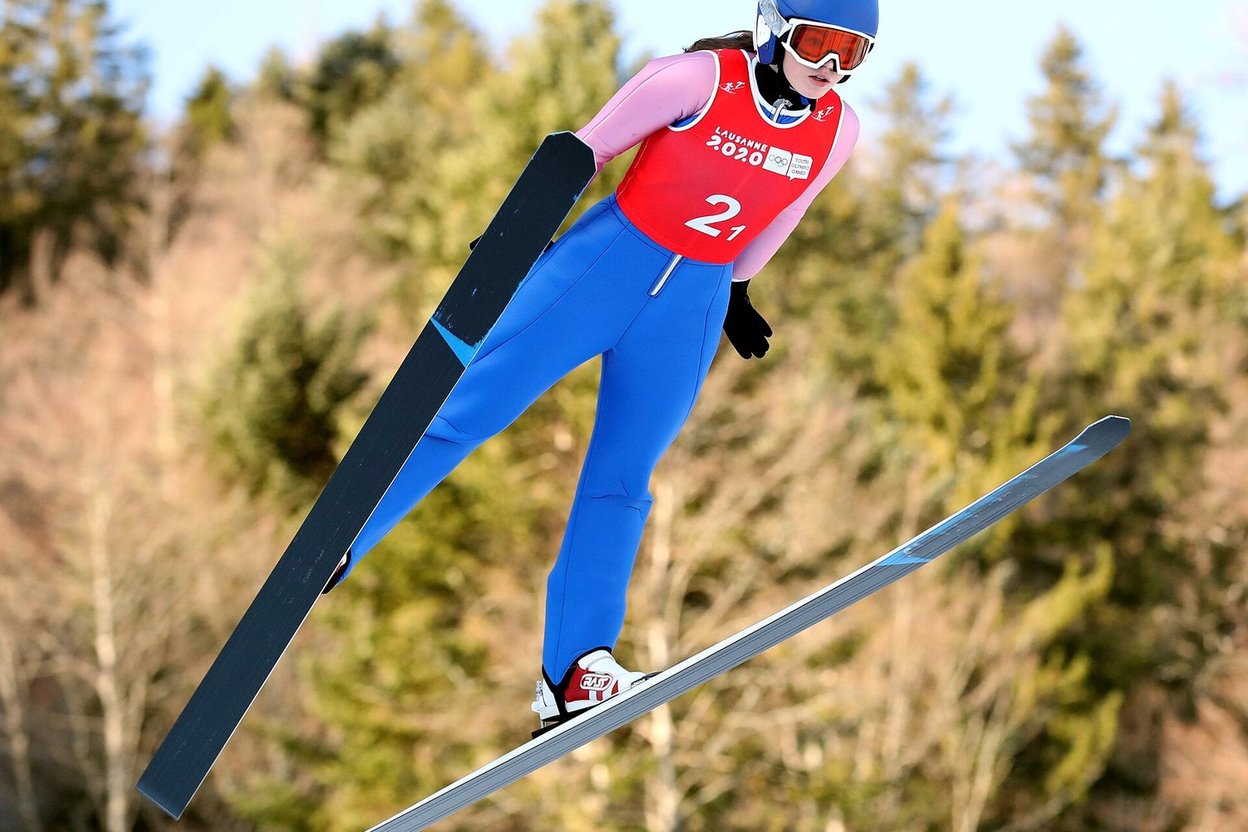
- Flight: jumpers lean far forward over their skis and spread them in a V shape. The V-style, which took over in the early 1990s, works like a wing and gives more lift than holding the skis parallel.
- Landing: in the telemark position, one foot slightly in front of the other with knees bent, like a lunge. Judges look for it.
How it's scored
Scores combine:
- Distance points: more for every meter beyond the hill's target point (the "K-point").
- Style points: five judges score the flight and landing; the highest and lowest scores are dropped.
- Wind and gate adjustments: points are added or taken away for tailwind, headwind and the starting height, to keep things fair when conditions change.
How far they fly
On March 30, 2025, Slovenia's Domen Prevc flew 254.5 meters (about 835 feet) at Planica, Slovenia, on the Letalnica bratov Gorišek ski flying hill. That set the official world record, beating Austrian Stefan Kraft's 253.5 meters from Vikersund, Norway, in 2017 by a meter. Guinness World Records lists it as the longest competitive ski jump.
There have been longer flights on special hills outside of competition, but the official record counts only jumps in sanctioned events.
Can anyone try it?
Yes, in a few places. In the U.S., ski jumping clubs in places like Lake Placid, New York, Park City, Utah, and in the upper Midwest teach kids and adults on small practice hills, starting with jumps of just a few meters. Nobody starts on the big hill.
Watch this winter
The FIS Ski Jumping World Cup usually starts in late November and runs into March, ending with ski flying in Planica, where the longest jumps happen. If you like the idea of flying without an airplane, it's also a cousin of wingsuit flying.
Sources (3)
Planica: New World Record 254.5 m · Guinness World Records: Longest competitive ski jump (male) · Slovenia Times: Ski flying champ sets new world record
Photo: 2020-01-22 Ski Jumping Competition Round Nordic Mixed Team (2020 Winter Youth Ol_by_Sandro_Halank%E2%80%93020.jpg) by Sandro Halank, Wikimedia Commons, CC BY-SA 4.0.