Your First Skydive, Strapped to an Expert: How Tandem Jumping Really Works
A plain guide to your first tandem skydive: your instructor, the safety backups, the step-by-step jump, and what it costs.
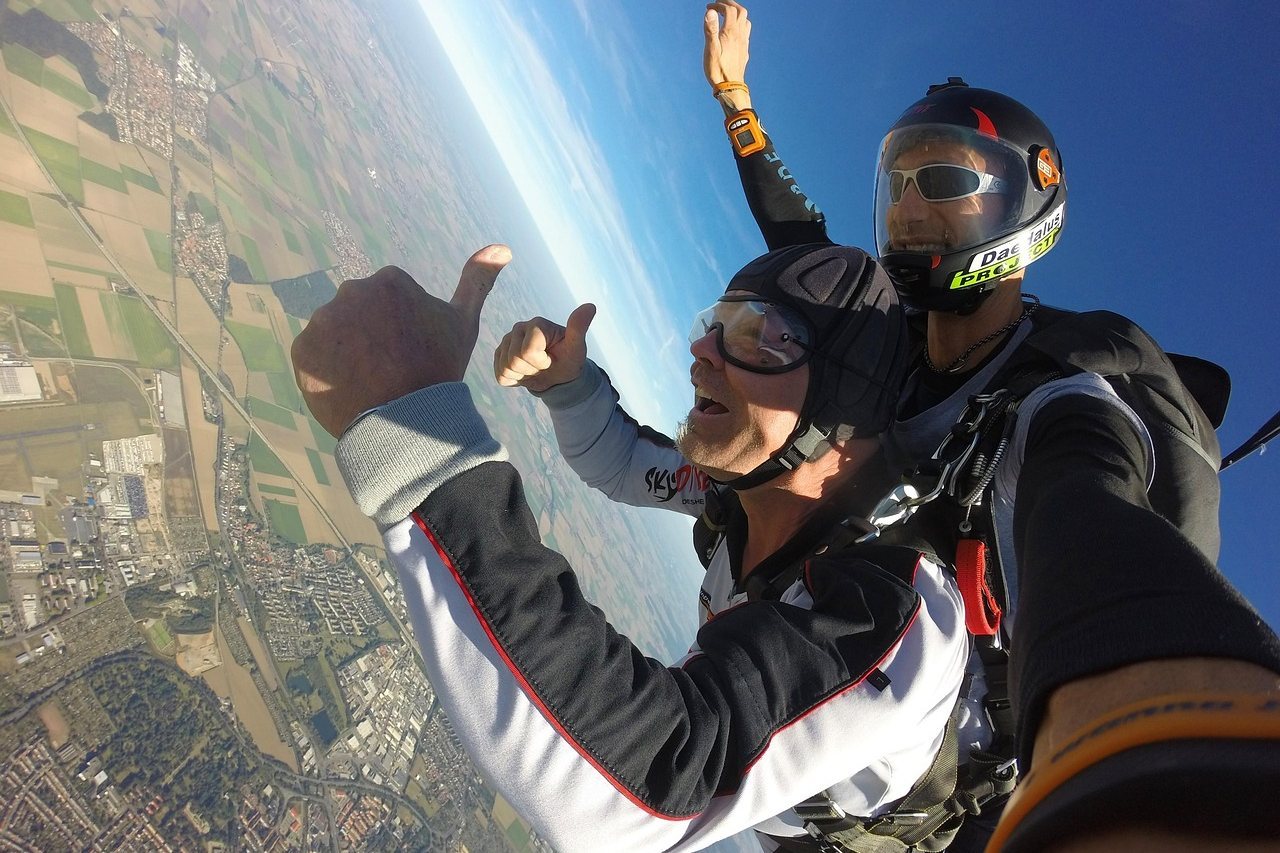
You've probably watched a clip of someone tumbling out of a plane above the clouds, grinning, and thought: I'd love to feel that, but I'd never know what to do. A tandem jump is built for exactly that gap. You're harnessed to a certified instructor who wears the parachute system, makes the deployment decisions, and flies the landing. You get real freefall after a short briefing, not weeks of training. That's why it's the standard first jump. Below is what actually happens, who's on your back, what keeps you safe, and what it costs.
What a Tandem Jump Is
In a tandem skydive, you wear a passenger harness that clips to the front of your instructor's harness and container system. It connects at four points, two at the shoulders and two at the hips. According to Skydive Monterey Bay, each piece of load-bearing hardware is typically rated for 2,500 to 5,000-plus pounds of force.
The system carries a main parachute, a reserve parachute, and a small drogue parachute that solo rigs don't have. The instructor handles all three. Your part is smaller but real, and we'll get to it.
Who's Strapped to Your Back
Federal rules set the bar for your instructor. Under the FAA's regulation 14 CFR § 105.45, the person in command of a tandem jump must have:
- at least three years of parachuting experience
- at least 500 freefall jumps on a ram-air (square) parachute
- a master parachute license from an FAA-recognized organization
- a completed tandem instructor certification course
The United States Parachute Association (USPA) adds a medical requirement. Tandem instructors must hold a valid recognized medical certificate, such as an FAA Third-Class Medical Certificate, a Department of Transportation medical exam form, or a military equivalent.
Before You Board
That same federal rule requires your instructor to brief you before the flight. The briefing has to cover aircraft emergencies, how you'll exit, what to do in freefall, how the parachute works, and the landing approach.
You also have to qualify. USPA rules set the minimum age at 18, which matches the rules of the equipment manufacturers.
Weight is the other hard limit. Tandem systems are certified under FAA Technical Standard Orders for a maximum suspended weight of 500 pounds. That total has to cover you, your instructor, and roughly 50 to 60 pounds of gear. As a rough illustration, a 190-pound instructor wearing 55 pounds of gear leaves about 255 pounds for the passenger.
Because of that math, and because the instructor has to physically control the landing, individual dropzones set their own passenger limits. These generally fall between 220 and 260 pounds. Check with your dropzone before you book.
The Jump, Step by Step
Exit and the drogue. Shortly after you leave the plane, your instructor throws out the drogue, a small parachute that trails above you. Two people falling together would build up far more speed than one. Dropzones put that speed somewhere near 200 mph without a drogue. The drogue's drag holds you to roughly 120 mph, about what a solo skydiver falls at, and it keeps the pair stable.
Freefall. This is the part people come for. Your job is to hold the position you practiced on the ground: belly toward the earth, back arched. A good arch helps keep the two of you stable.
Deployment. USPA safety requirements say tandem instructors must start main parachute deployment by pulling the drogue release no lower than 5,000 feet above the ground. The drogue then pulls the main canopy out, and the noise and speed of freefall give way to a much slower ride under the parachute.
Landing. As you come in, you'll be asked to lift both legs out in front of you, close to horizontal. This keeps your feet out of your instructor's way and stops them from hitting the ground first, which is how passengers break ankles. It's the most important thing you'll do all day, so practice it during the briefing.
What's Keeping You Safe
Several layers of backup sit behind every tandem jump:
- A second parachute. The reserve is a separate canopy for when the main has a problem.
- A professional packer for the reserve. Under 14 CFR § 105.43, a reserve parachute must have been inspected and repacked by an FAA-certificated parachute rigger within the previous 180 days.
- An automatic activation device (AAD). Tandem systems are required to carry one. If the jumpers are still falling too fast below a preset altitude, the AAD cuts the reserve's closing loop and releases the reserve. It does not deploy the main parachute. It exists for the case where something has gone badly wrong.
How Safe Is It, Really?
Skydiving is not risk-free, but the numbers are lower than most people guess. USPA records show 9 civilian skydiving fatalities in 2024 across about 3.88 million jumps, or 0.23 deaths per 100,000 jumps. That was down from 10 fatalities across 3.65 million jumps (0.27 per 100,000) in 2023. Those totals cover all skydiving, not only tandems.
Tandem jumps, with their mandatory instructor standards, are generally considered the safest form of the sport. Dropzones citing decades of data estimate the tandem fatality rate at roughly 1 per 500,000 jumps. Treat that as an industry estimate rather than an official count.
The Waiver You'll Sign
Before you jump, you'll sign a liability waiver, and you should read it. In the U.S., courts have generally upheld clear, conspicuous skydiving waivers as releasing the operator from claims of ordinary negligence. They typically do not protect a provider from gross negligence or willful misconduct. If the details matter to you, ask the dropzone questions or talk to a lawyer.
What It Costs
Skydive California puts the base price of a standalone tandem jump at typically $169 to $300. The price depends on things like exit altitude and whether you jump on a weekday. Professional video and photos usually add $100 to $199. Prices vary by dropzone and region, so compare a few nearby and ask what's included.
How Tandem Became Everyone's First Jump
Tandem jumping is younger than many people assume. Before it existed, new skydivers trained through static-line jumps or the Accelerated Freefall (AFF) program. The USPA Board approved AFF in September 1981 and put it into use in 1982.
In January 1983, Ted Strong of Strong Enterprises made the first dual-adult tandem jump on purpose-built equipment, with Ricky Meadows, in Eustis, Florida. That same year, Bill Booth of The Relative Workshop developed his own tandem harness system and coined the word "tandem." The FAA allowed tandem jumping under experimental waivers starting in 1984. It wrote formal tandem rules into Part 105 of its regulations in 2001.
After Your First Jump
A tandem jump gives you the real thing: the exit, the fall, the canopy ride, and the landing. You get it with a qualified instructor and a regulated stack of backups behind you. If you land wanting more, the training paths that existed before tandem are still there. AFF and static-line programs are how you work toward jumping on your own.
Sources (30)
- 14 CFR § 105.45 – Use of tandem parachute systems (Cornell LII)
- 14 CFR § 105.45 (eCFR)
- 14 CFR § 105.43 – Use of single-harness, dual-parachute systems (Cornell LII)
- 14 CFR Part 105 (eCFR)
- USPA Skydiver's Information Manual, Section 2-1
- USPA Skydiver's Information Manual, Section 2
- USPA Skydiver's Information Manual, Section 4-3
- USPA Skydiver's Information Manual, Section 9
- USPA – Minimum Age to Skydive
- USPA – Next Step: Earning a Tandem Rating
- USPA – The Long and Sometimes Crazy History of Skydiving Instructional Methods
- USPA – Instructional Rating Manual, page 190
- USPA – A Milestone in Safety: The 2024 Fatality Summary
- USPA – A Widespread Improvement: The 2023 Fatality Summary
- Skydive Monterey Bay – Your Tandem Skydive
- Skydive Paraclete XP – How Fast Do You Fall When Skydiving?
- Skydive Raleigh – How Fast Do You Fall When Skydiving?
- Skydive Orange – Skydiving Overweight
- Skydive Midwest – Tandem Skydiving Weight Limit
- Skydive Midwest – Is Skydiving Safe?
- Skydive California – Are There Weight Limits for Skydiving?
- Skydive California – Skydiving Common Questions Answered
- Skydive California – How Much Does Skydiving Cost for the First Time?
- Skydive Cross Keys – Tandem Skydiving Safety Statistics
- Skydive Key West – The History of Tandem Skydiving
- Skydive Perris – Skydiving History: Important Moments
- Skydive Seneca Lake – FAQ
- UPT Vector – Vector II Tandem Manual (PDF)
- LawInfo – Are Liability Waivers Enforceable in a Personal Injury Case?
- FindLaw – Skydiving Liability Waivers: 3 Legal Clauses Explained