Skydiving on Screen: The Movie Jumps That Were Real, and the Ones That Weren't
Which movie skydiving scenes were real, which were faked on ground rigs, and what it takes to make a real jump.
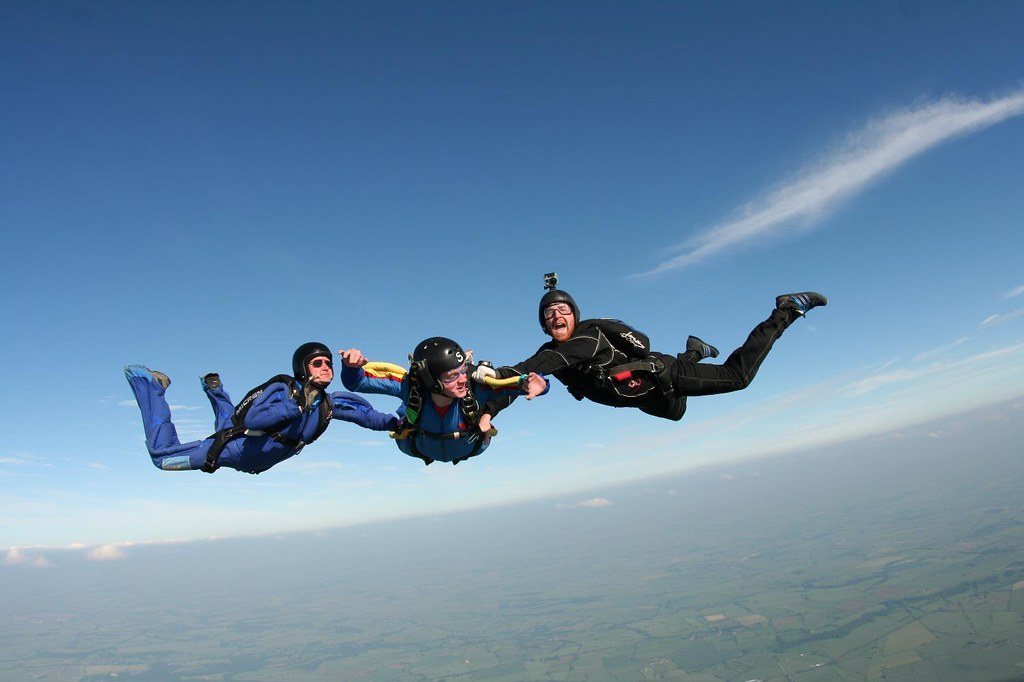
You've probably felt it in a dark theater: your hands tighten on the armrest as someone steps out of an open aircraft door, and you know you're about to fall with them. Two sequences have earned that feeling more than any others: the freefall in Point Break (1991) and Tom Cruise's HALO jump in Mission: Impossible – Fallout (2018). A third film, the documentary Sunshine Superman (2014), shows where much of that daring began. Below is what actually happened in front of the cameras, what was faked, and what it takes to jump for real.
Where the Fall Began
Skydiving scenes depend on a stunt that is more than two centuries old. On October 22, 1797, André-Jacques Garnerin made the world's first successful high-altitude parachute descent over Parc Monceau in Paris. His craft looked nothing like a modern rig. He rose in a hydrogen balloon, not a hot-air balloon, to about 3,000 feet (roughly 900 to 1,000 meters). Then he released a frameless silk canopy and rode it down in a basket slung beneath it.
No backpack harness or steerable wing was involved. Even so, a person dropping from the sky under fabric is the image every skydiving scene since has built on, and filmmakers have spent decades finding ways to put a camera right beside that person.
Point Break (1991): The Freefall That Made the Genre
Point Break is the film most people picture when skydiving and movies come up together, and its aerial sequences still feel physical. That's because much of what you see in the sky was really happening.
Patrick Swayze was a licensed skydiver, and he made 55 jumps during production. When his character falls through open air, you are often watching the actor himself.
Keanu Reeves did not make real jumps for the film. His close-up dialogue shots in freefall were filmed on the ground, using a custom 10-foot simulation rig with wind machines blasting him to recreate the rush of air. The trick works because it is cut together with genuine aerial footage.
That footage came from Tom Sanders, the aerial camera operator who led the film's freefall cinematography. Sanders was inducted into the International Skydiving Hall of Fame in 2019. His work is a big part of why the sequences feel so convincing: you are watching real skydivers filmed by another skydiver falling alongside them.
Mission: Impossible – Fallout (2018): Raising the Altitude
Point Break blended real jumps with ground rigs. Nearly three decades later, Fallout set out to show its lead actor doing the jump himself, from far higher.
Tom Cruise became the first actor to perform a High Altitude, Low Opening (HALO) jump on screen. He leapt from a Boeing C-17 Globemaster III military transport at 25,000 feet. In freefall he passed 200 mph, and he had to fly within three feet of cameraman Craig O'Brien so the shot would hold his face in frame.
One jump was nowhere near enough. Director Christopher McQuarrie wanted the scene shot at dusk, and the natural light he needed lasted only about three minutes each day. As a result, the sequence took more than 100 jumps to capture.
The sequence also has a precise ending that people often misremember. Ethan Hunt does not crash into a city street. He opens his parachute over Paris and lands on the glass roof of the Grand Palais, which makes a neat echo of Garnerin's descent over the same city in 1797.
Sunshine Superman (2014): The Man Behind the Camera and the Jump
Both of those Hollywood films depend on jumpers who could fly and film at the same time. Sunshine Superman tells the story of a man who did both before Hollywood caught on: Carl Boenish.
Boenish is widely regarded as the father of modern BASE jumping. In 1978 he coined the acronym "B.A.S.E.," which stands for the four kinds of fixed objects people jump from: Building, Antenna, Span (a bridge), and Earth (a cliff). The documentary draws on his own footage of those jumps.
His story ends in Norway. On July 7, 1984, Boenish died during a cliff jump from the Stabben pinnacle near the Troll Wall (Trollveggen). Only one day earlier, he and his wife, Jean Boenish, had completed a Guinness World Record jump.
Sunshine Superman is sometimes grouped with Free Solo (2018) as an "extreme sports documentary," but the two cover different worlds. Free Solo follows Alex Honnold climbing El Capitan without ropes. It is a climbing film and involves no skydiving or BASE jumping.
What It Takes to Jump for Real
The films make freefall look like pure instinct. In practice, every real jump in the United States, whether for a movie or a weekend at a drop zone, happens inside a tightly regulated system.
The Federal Aviation Administration governs civilian parachute operations under Title 14 of the Code of Federal Regulations, Part 105. A few of its rules shape every jump:
- Two parachutes. Under 14 CFR § 105.43, sport jumps using a single-harness system require both an approved main parachute and an approved reserve.
- Clear air. Under 14 CFR § 105.17, jumping into or through clouds is prohibited, and jumpers must meet set minimums for visibility and distance from clouds.
- Detailed guidance. The FAA's Advisory Circular AC 105-2E, "Sport Parachuting," covers compliance procedures, jump aircraft operations, and standards for parachute riggers.
On top of the federal rules, the United States Parachute Association (USPA) sets mandatory Basic Safety Requirements and publishes operating guidance in its Skydiver's Information Manual.
The safety record shows the effect. In 2024, USPA recorded an all-time low of 9 civilian skydiving fatalities out of 3.88 million jumps in the United States. That works out to 0.23 deaths per 100,000 jumps. USPA's 2025 figures, drawn from its member survey, estimate about 3.47 million jumps and 16 civilian fatalities. The sport still carries real risk, but it is far more controlled than the movies suggest.
Why These Scenes Last
The iconic scenes share one thing: somebody really fell. Swayze's 55 jumps, Sanders's camera work, Cruise's more than 100 trips out of a C-17, and Boenish's own footage give these films a weight that a wind machine alone can't fake. Even Reeves's ground-rig close-ups land because they are stitched into real sky.
The next time your grip tightens on the armrest, watch for the cuts. Notice which shots were filmed falling and which were filmed standing still. The real ones are usually the shots you remember.
Sources (14)
- History.com: history.com
- Guinness World Records: guinnessworldrecords.com
- Smithsonian Magazine: smithsonianmag.com
- eCFR, 14 CFR Part 105: ecfr.gov
- Federal Aviation Administration: faa.gov
- USPA, Safety FAQs: uspa.org
- USPA, Skydiver's Information Manual: uspa.org
- /Film: slashfilm.com
- Wisconsin Skydiving Center: wisconsinskydivingcenter.com
- Long Island Skydiving Center: longislandskydiving.com
- National Skydiving Museum: skydivingmuseum.org
- Business Insider: businessinsider.com
- CBR: cbr.com
- Wikipedia: wikipedia.org