Take the Leap: How to Choose the Perfect Skydiving Gear for a Safe and Thrilling Adventure
This article will guide you through the process of selecting the right skydiving gear for a safe and exhilarating experience. Learn more now!
Don’t buy a parachute while you’re learning. Your drop zone supplies student gear until you earn your USPA A license (25 jumps minimum). After that, rent a rig for $30 to $40 a jump, buy the small personal gear first (altimeter, audible, helmet, jumpsuit), and buy a rig, used or new, once you know what size canopy you land well. Plan on roughly $2,500 for a decent used rig and $9,500 or more for a new one.
Here’s the full gear list, what each piece costs, and the order to buy it in.
The full gear list
The rig (the big-ticket part)
A “rig” is four things working as one system:
- Harness and container: straps you in and holds both parachutes. New: about $4,000.
- Main canopy: the parachute you open on every jump. New: about $3,000 to $3,500.
- Reserve canopy: the backup, packed by a certificated rigger. New: about $1,500 to $2,400.
- AAD (automatic activation device): fires the reserve if you’re still falling fast at a set altitude. New: about $1,100 to $1,400.
Most containers also carry a reserve static line (RSL), which pulls the reserve automatically when you cut away a bad main. Choosing the canopies, sizing the container and checking an AAD’s age is its own topic; this post sticks to what to buy and when.
Personal gear (buy this first)
Prices below are from SkydiveShop’s fall 2026 listings unless noted.
- Visual altimeter: required for students and worn by everyone. An analog Alti-2 Galaxy is $199; a digital L&B Viso II+ is $299.
- Audible altimeter: beeps in your helmet at altitudes you set. An L&B Optima 3 or Quattro 3 is $299.
- Helmet: a rigid helmet is required for students. Cookie’s open-face Fuel is $294; the full-face G4 is $570.
- Goggles: $25 to $35. Cheap, and worth having your own pair that fits.
- Jumpsuit: Tonfly suits run about $470 to $600. Ask your drop zone what they expect before you buy one; a suit matters more once you’re flying with other people and need to match their fall rate.
- Hook knife: $40 to $75. It cuts a line or strap if you get tangled.
The buying path, step by step
1. During training: buy nothing big
USPA’s Basic Safety Requirements have every student jump drop-zone gear until the A license: a rigid helmet, a visible altimeter, a container with an RSL and a single-point riser release, a working AAD, a ram-air main suited to students and a steerable reserve. The drop zone picks the canopy size for you, usually large and slow. Your training price covers it.
If you want to buy one thing, make it goggles or your own altimeter. Ask your instructor before you buy a helmet; the drop zone may want you in theirs.
2. Right after the A license: rent and buy the small stuff
Many drop zones rent rigs to licensed jumpers. Skydive Spaceland Dallas charges $30 plus tax a jump, pack job included; Skydive Paraclete XP charges $40. Renting lets you try canopy sizes before you commit $3,000 to one.
This is the time to buy your altimeter, audible and helmet. They move with you to every rig you’ll ever own, so they’re never wasted money.
Do the rental math. At $30 to $40 a jump, 60 to 85 jumps of rentals costs about what a $2,500 used rig does. If you’re jumping every weekend, you’ll get there fast. If you jump a few times a year, keep renting.
3. Your first rig: used or new
Skydive Orange puts a used rig at “as little as $2,500” and a new setup at “about $10,000.” Skydive Danielson’s breakdown says $8,000 to $14,000 or more for everything new. Full new rig packages at SkydiveShop (container, main, reserve, AAD) were listed at $9,480 to $10,180 in fall 2026.
Used makes sense when:
- You aren’t sure you’ll stay on the same canopy size for long.
- You can find a container that fits you and holds the canopy size you land well now.
- A certificated rigger inspects it before you pay. Every component has a date of manufacture; the AAD especially has a hard end of life.
New makes sense when:
- You’re an unusual size and used containers don’t fit.
- You know what canopy you want and you’re jumping often.
- You can wait. SkydiveShop’s 2023 guide put stock containers at one to two months and custom Vector and Javelin builds at up to six months.
You can also mix: a used container that fits, a new or lightly used main, and a reserve and AAD with plenty of life left.
4. Buying used without getting burned
- Buy local when you can. SkydiveShop’s guide makes the point: locally you can try the container on, sometimes jump it first, and avoid scammers.
- Get the paperwork. Serial numbers, dates of manufacture, the reserve data card with its last repack, and the AAD’s manufacture date.
- Check the AAD’s life. A CYPRES 2 made in 2017 or later lasts 15.5 years; older units, 12.5. A Vigil lasts 20 years but needs a mandatory battery swap between 8 and 12 years. An AAD near its end is a $1,100 to $1,400 bill waiting for you.
- Don’t let price pick your canopy. A cheap rig with a main two sizes smaller than you’ve been landing is not a deal.
Brands you’ll hear at the drop zone
You don’t need to memorize a catalog. A few names cover most of what you’ll see:
- Containers: UPT (Vector), Sun Path (Javelin), Mirage, Aerodyne (Icon).
- Canopies: Performance Designs (Navigator, Sabre3, Optimum reserve), Aerodyne, JYRO.
- AADs: Airtec (CYPRES), Vigil, MarS.
- Helmets and altimeters: Cookie, Alti-2, L&B.
The brand matters less than the fit, the size and the condition. Talk to your rigger and instructors; they see which gear holds up on your drop zone.
What it costs to keep jumping your own rig
- Reserve repack: required within every 180 days by an FAA-certificated rigger (14 CFR 105.43). Skydive Paraclete XP charges $95; Skydive Danielson puts it around $100.
- Main packing: free if you pack yourself (your A license lets you). Paying a packer runs about $10 at Paraclete XP.
- AAD replacement: plan for it when the unit reaches end of life.
- Jump tickets: separate from gear. Paraclete XP lists $38 to full altitude.
The short version
- Training: use the drop zone’s gear.
- A license: rent at $30 to $40 a jump; buy altimeter, audible, helmet, goggles.
- Once you’ve settled on a canopy size and you’re jumping regularly: buy a rig, used ($2,500 and up) or new ($9,500 and up).
- Before your first jump on it: rigger inspection, every time, no exceptions.
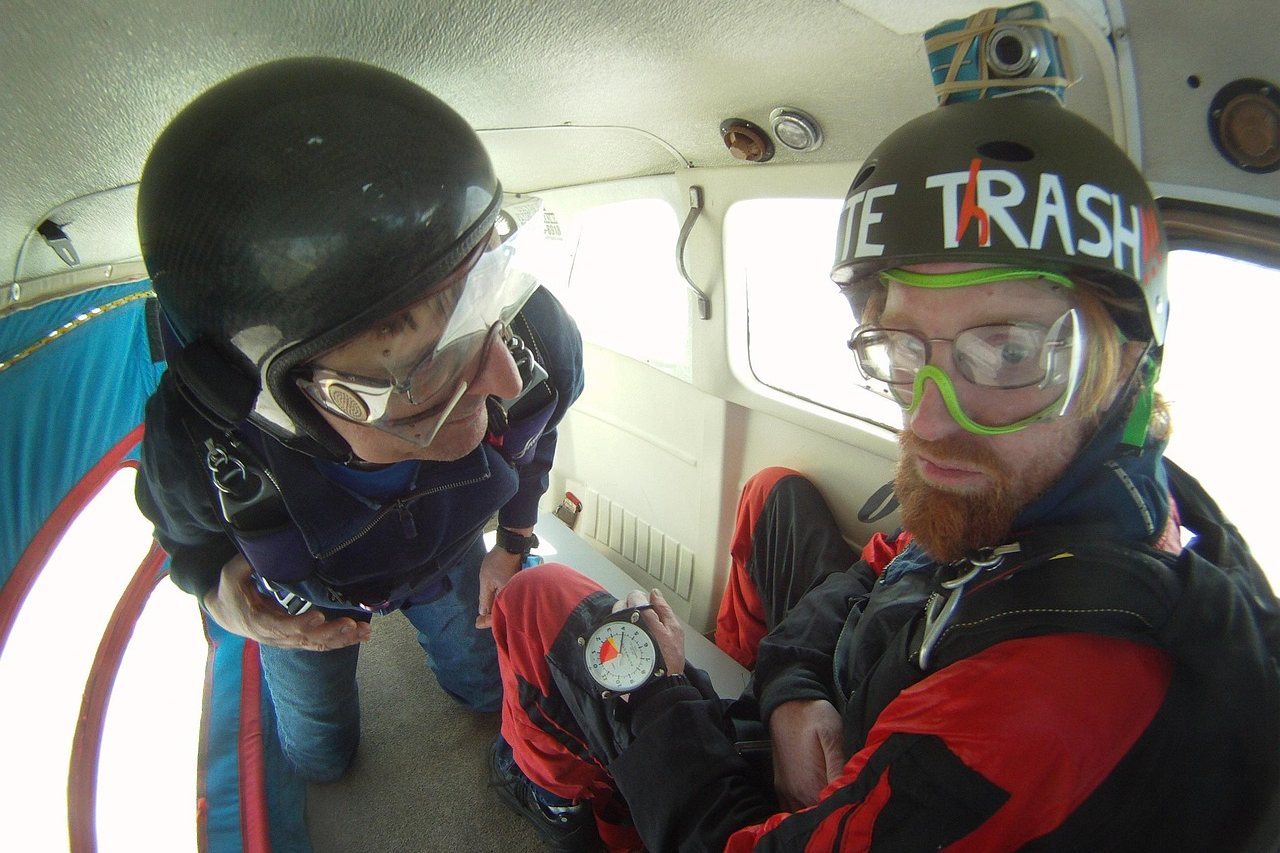
Photo by wesleyjharrison on Pixabay.