Navigating the Sky: A Comprehensive Guide to Choosing the Perfect Parachute and Harness for Your Next Jump
Discover how to choose the right parachute and harness for safe skydiving. Our expert guide covers everything from gear selection to maintenance.
Pick your main canopy first, at a size you already land well. Then pick a reserve that you could land safely on your worst day, a harness and container built around those two canopies and your body, and an AAD with plenty of service life left. Buying in the other order (a sleek small container first, canopies to fit it later) is how new jumpers end up under parachutes they can’t handle.
This post goes piece by piece through the four parts that keep you alive: main, reserve, harness and container, and AAD. If you’re still on student gear, none of this is your call yet. USPA’s Basic Safety Requirements have the drop zone put every student on gear it supplies until the A license.
The main canopy: wing loading decides almost everything
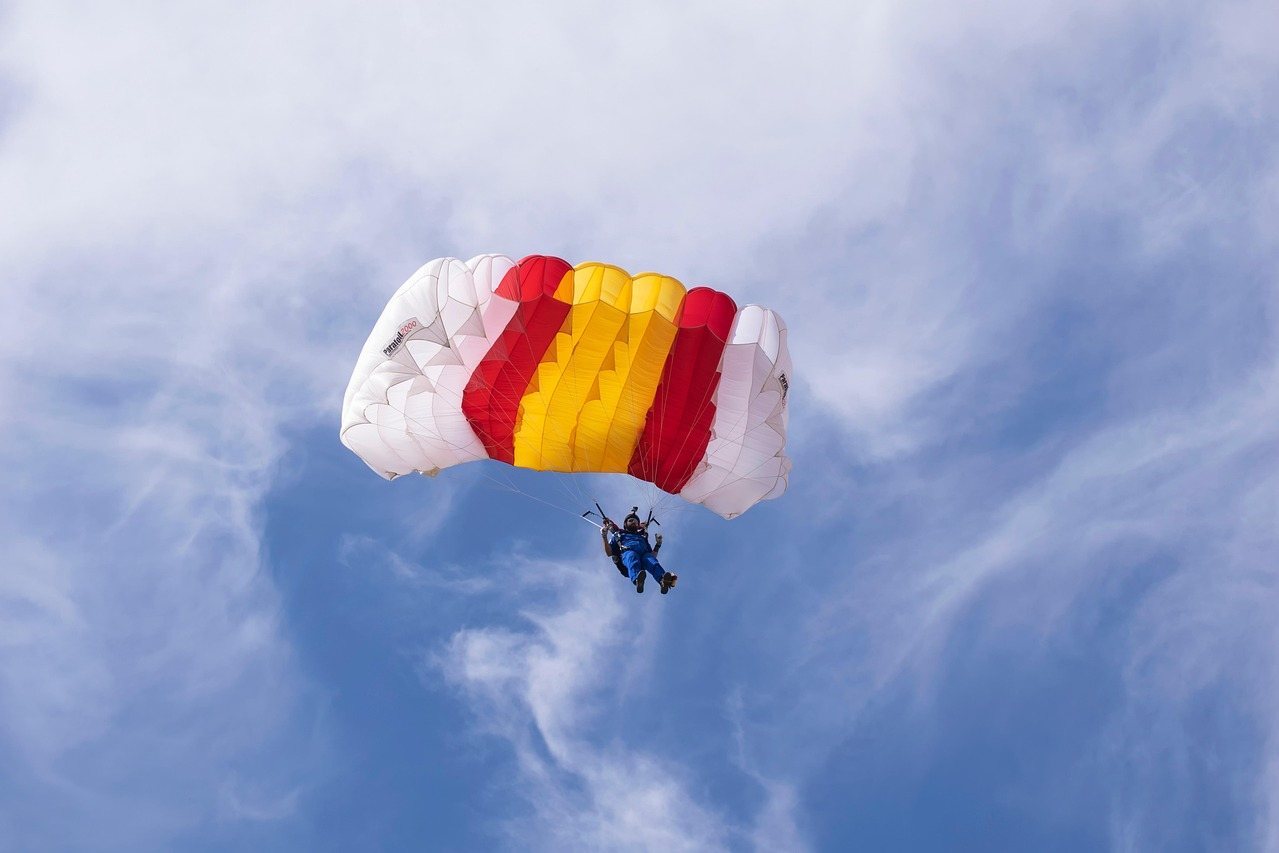
Every sport parachute you’ll jump is a ram-air canopy: a rectangular or elliptical fabric wing with cells that inflate and give it an airfoil shape. “Rectangular” and “ram-air” aren’t two different choices. Round canopies belong to the military and to history, not to your first rig.
The number that matters most is wing loading: your exit weight divided by the canopy’s size in square feet. Exit weight means everything you jump with: you, clothes, helmet, rig, both canopies. Performance Designs’ own example: a 190-pound exit weight under a 190-square-foot canopy is 1.0 pound per square foot. Put that same jumper under a 95 and it’s 2.0.
Weigh yourself fully geared up on the drop zone scale. Don’t guess. Higher wing loading means the canopy flies faster, turns harder, dives farther in a turn and gives you less time to fix a mistake near the ground.
How to pick the size
- Start from what you jump now. If you’re landing a 220 well on rental or student gear, your first canopy should be a 220 or close to it. Your first rig is not the time to downsize.
- Follow USPA’s downsizing advice. USPA’s Downsizing Best Practices sheet says to go down one size at a time, and to change size or canopy type, not both at once. If you have doubts, it says to make 50 or 100 more jumps on your current canopy first. “There is no penalty for waiting!”
- Know the gap between student and sport canopies. PD’s Navigator, a common student main, comes in 200 to 300 square feet and is built to forgive late or early flares. A sport main like the Sabre3 is a step up in responsiveness.
- Dacron lines for now. Dacron is the normal student and novice line choice, and PD doesn’t recommend microline for student use on the Navigator.
A new main runs around $3,000. In fall 2026 a Sabre3 was listed at $2,990 at ChutingStar and $3,490 at SkydiveShop, and a Navigator at $3,060. Used mains cost far less, but have a rigger check the fabric, the line set and the jump count before you pay.
The reserve: the canopy you hope you never meet
Your reserve has to be an FAA-approved parachute, which in practice means built under the Technical Standard Order C-23 series. It has a placard with its maximum certified exit weight. Stay well under that number, not just under it.
Size the reserve for a bad day. You’ll be opening it after a malfunction, possibly low, possibly into an unfamiliar landing area, maybe hurt. A reserve much smaller than your main means a faster landing at the worst possible time. Check how your reserve size compares with your main and ask your rigger and an instructor before you order.
Modern reserves fly better than the old ones. PD’s Optimum is a 7-cell reserve rated for maximum exit weights from 220 up to 290 pounds depending on size, and PD says it packs about one size smaller than traditional reserves. Rough new prices at SkydiveShop in fall 2026:
- MarS WP reserve: $1,540
- Aerodyne Smart: $1,760
- PD Reserve: $2,080
- PD Optimum: $2,360
Under federal rules (14 CFR 105.43), a synthetic-fabric reserve must be repacked by an FAA-certificated rigger within 180 days before you jump it. Budget for that twice a year. Skydive Paraclete XP lists a standard reserve repack at $95.
The harness and container: built around the canopies and you
The harness and container is the backpack that holds both canopies and straps you in. The harness is the part that carries your weight on opening: main lift webs, chest strap, leg straps, and the three-ring release that lets you cut away a bad main. Like the reserve, the harness and container must be FAA-approved.
Size it to your canopies
Each container size is built to hold a range of main and reserve sizes, and every maker publishes a sizing chart. Pick your canopies first, then the container that fits them. SkydiveShop’s first-rig guide calls the opposite mistake the “double-downsize trap”: buying a small container and being forced into a smaller main and reserve than your skill level allows.
Size it to your body
A new custom container is made to your measurements, usually taken by a dealer or rigger. Used containers are where fit goes wrong. Before you buy one, put it on, tighten it and hang in a harness or lie on a creeper in an arch. Check that:
- The leg straps sit on your thighs and don’t creep toward your knees or crotch when you arch.
- The chest strap lands across your chest, not up near your throat.
- Your hands find the main pilot chute, the cutaway handle and the reserve handle without hunting, in an arch and sitting up.
- The container doesn’t flop away from your back when you move.
Features that matter
A reserve static line (RSL) pulls your reserve ripcord automatically when you cut away a main. USPA requires one on student gear. Some containers offer a main-assisted reserve deployment (MARD), such as UPT’s Skyhook, which uses the departing main as a giant pilot chute to pull the reserve out faster. UPT lists it as an option on the Vector 3.
Expect roughly $4,000 for a new container. SkydiveShop listed the UPT Vector 3 at $4,090 and the Sun Path Javelin Odyssey at $4,000 in fall 2026. Lead time is the catch. SkydiveShop’s 2023 guide put stock containers from Javelin, Mirage and Infinity at one to two months and custom Vector and Javelin builds at up to six months. Order early.
The AAD: your backup’s backup
An automatic activation device fires your reserve if you’re still falling fast at a set altitude. USPA’s BSRs require a working AAD for every student, maintained on the manufacturer’s schedule. They don’t require one for licensed jumpers, but your drop zone may, so ask. If one is installed, federal rules (14 CFR 105.43) say it must be maintained to the maker’s instructions.
The three common sport AADs, with what you’d pay new and how long they last:
- CYPRES 2 (Airtec): $1,290 to $1,400 depending on the seller. Units made in January 2017 or later have a 15.5-year life; older units, 12.5 years. Factory maintenance is now optional.
- Vigil Cuatro: about $1,280 to $1,290. Vigil rates it for 20 years from date of manufacture with no scheduled maintenance, but the battery is a mandatory replacement between 8 and 12 years.
- MarS m² multi: $1,090 at SkydiveShop.
On used gear, the AAD’s date of manufacture matters as much as its price. A CYPRES made before 2017 has a 12.5-year life, so a 2014 unit is at or near the end of it now. A “complete used rig” with an AAD that expires next year is really a rig plus a $1,300 bill.
Keep it all airworthy
Your main has to be packed within 180 days before use, by you, a rigger, or someone working under a rigger’s supervision. In practice you’ll pack it every jump. The reserve gets its 180-day rigger repack, which is also when your rigger should inspect the whole system. Between those, look at your gear every time you gear up: closing loops, pins, three-ring assembly, handles, and the bridle. Bring anything frayed or worn to a rigger. Don’t fix it yourself.
Before you pay for any rig
- Main size matches what you land well now, at a wing loading your instructors agree with.
- Reserve is TSO-approved, you’re well under its placarded max weight, and it isn’t much smaller than your main.
- Container is sized for both canopies and fits you in an arch.
- AAD has years of life left, not months.
- A certificated rigger has inspected the whole thing before your first jump on it.
Photo by ELG21 on Pixabay.