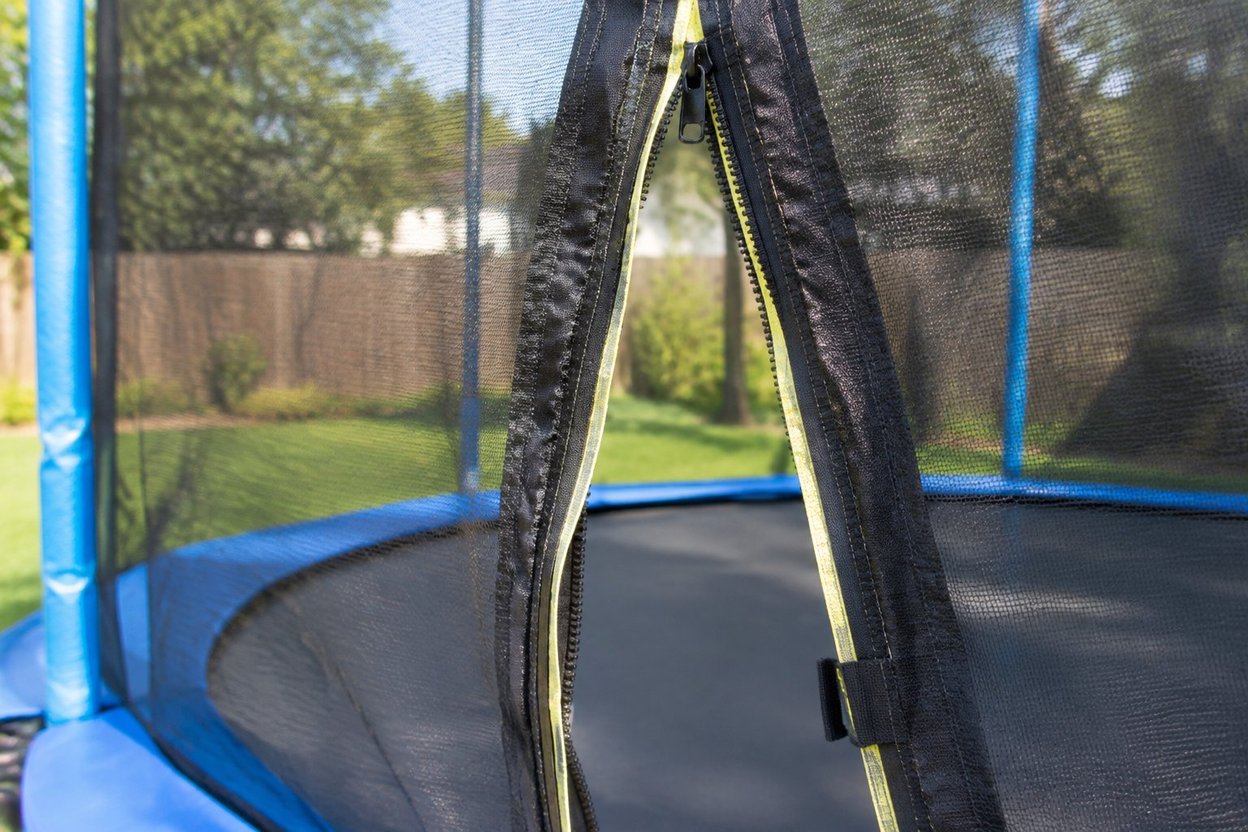
Can a Trampoline Be Used Safely With a Net That Has a Zipper Gap?
A gap in the trampoline net zipper means no jumping until it's fixed. Here's how to check the net, and when to repair or replace it.
You walk out to the trampoline on a windy fall afternoon and spot it: a gap where the zipper won't close, a split along the door seam, or a stretch of loose net near the entrance that sags when you push on it. The kids are already pulling their shoes off. Can they jump if they stay away from that side? No. Keep everyone off until it's fixed. Below you'll find what the net actually does, why the zipper matters so much, how to check the net and how to choose between a repair and a replacement.
Short answer: no, not until it's fixed
The enclosure net has one job: to keep jumpers on the trampoline. The zipper door is the one part of the net that is built to open. A gap there is an opening in your fall protection, right at the spot where kids go in and out most often.
Trampoline makers are clear about this. One manual for a 12 ft trampoline sold at Argos tells owners to make sure "the zipper and buckles located at the entrance are fully closed before use." The same manual says that if the net or mat shows any sign of weakness, stop using the trampoline right away and keep people off it until an authorized replacement net or pad is installed.
People often ask how big a gap can be before it matters. No safety standard, regulator or manufacturer gives a "safe gap size" for an enclosure zipper. Nobody has published a number that's small enough to ignore. The only gap the instructions allow is no gap: the zipper fully closed and the net undamaged. A small opening also tends to grow, because every bounce pulls on the fabric around it.
What the net is for, and what it isn't
Knowing what the net does helps you see what a gap takes away. The manual quoted above says the enclosure is "ONLY intended to be used to reduce the risk of injury from falling off the trampoline." That's a real benefit. The U.S. Consumer Product Safety Commission (CPSC) says enclosures "can help prevent injuries from falls off trampolines."
Falling off is only one way kids get hurt, though. CPSC lists four main causes:
- colliding with another person on the trampoline
- landing badly
- falling or jumping off
- falling on the springs or frame
A net only helps with the third one. CPSC estimated 104,691 emergency room-treated trampoline injuries in 2014, and it knew of 22 trampoline deaths from 2000 to 2009.
Doctors say the same thing. In a 2020 University Hospitals Rainbow Babies & Children's article, pediatric sports medicine doctor Susannah Briskin said: "Injuries can happen even when a trampoline has padding and a net enclosure, and even when an adult is supervising." The same article notes that the American Academy of Pediatrics advises parents not to buy a home trampoline at all, and that children under 6 are at greatest risk.
So a net doesn't make a trampoline safe. It removes one risk. A gap puts that risk back.
Why the zipper and entrance matter
The entrance is the weakest point of any enclosure. It's the one place where the net isn't a single piece of mesh. It depends on a zipper, and often buckles or clips too, and those get opened and closed many times a week. They take a lot of wear, kids pull on them, and they're easy to leave half-done.
That's why manuals focus on the door. The Argos manual says to close the zipper and buckles fully before use. It also says to enter and exit only through the zipper door, never through the gap between the net and the mat. It warns that crawling through that gap poses a strangulation risk, especially for young children. If the zipper is broken, kids tend to find another way in, and that gap is usually the one they use.
There's a real example of what happens when a net opens at the bottom. On December 7, 1999, CPSC announced a recall of about 2,300 JumpSport safety net enclosures. The bottom straps could break and let children fall out from under the net. Two incidents were reported, with no injuries. The lesson still holds: an opening low on the net, where a jumper's body actually lands, lets a child out of the enclosure.
Consumer trampoline enclosures in the U.S. are covered by a voluntary standard, ASTM F2225, last updated in July 2024. A net that's torn or won't zip shut is no longer working the way it was designed and tested.
Check it before every jump
The Argos manual says the net "must be inspected prior to each use." It also says the net "must be immediately replaced" if it shows wear, damage, stretching, cracking, looseness or brittleness. A Virtufit trampoline manual gives the same advice: inspect the net before each use and use only the net door to get on and off.
A pre-jump check takes about a minute:
- Zipper fully closed. Run it from end to end. It shouldn't leave gaps, skip teeth or slide back open when you push on the door.
- Buckles and clips fastened. Every strap at the entrance should be done up and snug.
- No tears near the zipper. Look closely at the fabric along both sides of the zipper and at the corners of the door, where tears usually start.
- Net attached at every point. Check the top of each pole and every place the net connects at the bottom, all the way around. Gaps between the net and the mat are a warning sign.
- Net the right size for the frame. It should hang evenly with no slack bunches. A net that sags or barely reaches the mat may be stretched out or the wrong size.
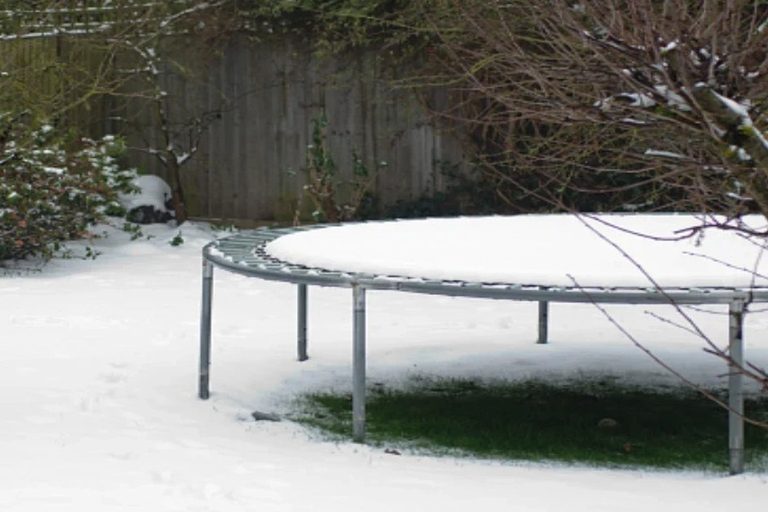
The manual also recommends regular deeper checks at 1–3, 3–6 and 6–12 month intervals, covering the whole enclosure and every connection. It says nets and pads wear out "like tires on a car," and that UV, pollution, rain and wind speed up the wear. That makes fall a good time for a full check, after a summer of sun and before winter storms. It's also a good time to remind kids of the manual's other rules: no kicking, bouncing against, climbing, hanging from or crawling under the net.
Fix, replace, or retire
What you do next depends on the damage.
A small tear near the zipper. Some owners sew small rips shut by hand. One home-repair blogger stitched a tear by the zipper and found that a rip there showed up within a year. She suggests reinforcing that area before it tears. Treat a sewn repair as a stopgap, not a fix. A hand-sewn seam hasn't been tested the way the original net was. The manufacturer's instructions still call for replacing a damaged net. If you patch it, check the repair before every use and plan to replace the net soon.
A broken zipper, a stretched net or several tears. Replace the net. The Argos manual says to stop using the trampoline and keep people off it until an authorized replacement is installed. If fabric has gone brittle, cracked or baggy, more stitching won't fix it. The whole net has aged.
Getting the right replacement. Enclosure nets are made for a specific frame size and pole setup. A net that's too big will sag and leave gaps, and one that's too small will strain at the attachment points. Before you order:
- Check your manual for the model number and approved replacement parts.
- Measure the frame diameter and count the enclosure poles.
- Contact the maker if you're unsure which net fits. A "universal" net may not attach the way your enclosure needs.
Retiring it. If the frame is rusted, the pads are falling apart and the net is torn, the trampoline may not be worth saving. Since the AAP advises against home trampolines in the first place, an old, worn-out one is a reasonable thing to take down.
Quick rules while you wait
Until the new net is on:
- No jumping. Not "carefully," not "away from the door."
- Keep kids off. Tell visiting kids too. Halloween parties and Thanksgiving visits bring cousins and friends into the yard.
- Remove or block the ladder. CPSC already advises against leaving a ladder in place, because it gives small children unsupervised access.

When the trampoline is back in use, follow the CPSC basics: one jumper at a time, no somersaults, pads covering the springs, hooks and frame, the trampoline set away from structures and trees, no children under 6 on a full-size trampoline, and an adult supervising at all times. The manual adds that children should never be left alone inside the enclosure.
Sources (7)
- Trampoline and enclosure manual (12 ft, Argos), hosted by Lowe's
- Virtufit trampoline with net manual
- CPSC: Trampoline Safety Alert
- University Hospitals: Home Trampoline Safety: What Parents Should Know (Sept 8, 2020)
- CPSC: JumpSport safety net enclosure recall (Dec 7, 1999)
- ASTM F2225-24, Standard Consumer Safety Specification for Trampoline Enclosures
- DIY Danielle: How to Fix a Ripped Trampoline Net