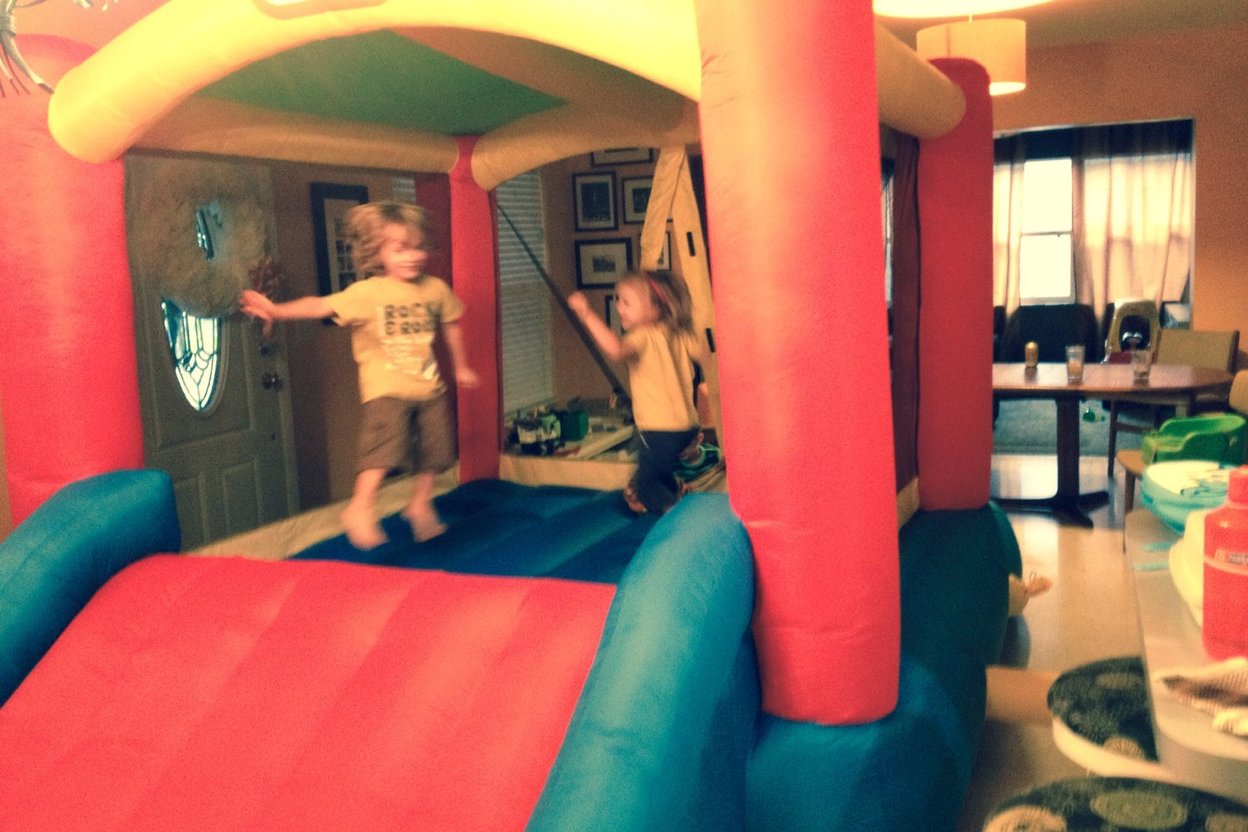
Winter Income for a Bounce House Business: Indoor Event Rentals
In cold-weather states, outdoor inflatable rentals stop when the season ends. How rental businesses keep money coming in over the winter: indoor events, schools, churches, and the holiday party season.
It's late October, the last backyard booking is packed away, and your calendar for the next few months is nearly empty. Indoor rentals are the way to fill it. Schools, churches, community centers, event planners and parents still book parties in winter, and they need units that fit inside a building. Outdoor revenue typically falls to 30-50% of summer levels, so the goal is to win back part of that gap, not to match July.
The winter slump is real
One operator resource puts winter revenue at 30-50% of summer revenue and advises saving cash during peak season and diversifying into indoor units or complementary services. That figure comes from a single source, so treat it as a benchmark, not a promise for your market.
Pricing makes the dip worse. One industry analysis reports that peak-season rental rates run 40% higher than off-peak rates. In winter you have fewer bookings and a lower price per booking.
The market itself is not shrinking. One analysis puts the bounce house rental market at $4 billion in 2024, with North America holding a 42% share. It also reports that the post-pandemic celebration surge lifted demand by 25%. Another source projects the inflatable rental market growing from $2 billion in 2023 to $3.5 billion by 2030. Those are projections, and sources measure the market differently, so the numbers don't line up exactly. The direction is what matters: people still want to celebrate, and in winter they have to do it indoors.
What an indoor winter month needs to look like
Start with the target. One discussion of inflatable rental income says netting $5,000 a month after expenses likely takes 10 to 50 clients a month, with castles renting for $200 to $1,000 a day. The range is wide because it depends on what each booking leaves you after expenses. By simple arithmetic, 10 clients means about $500 net per booking, and 50 clients means about $100 each.
Published price benchmarks:
- Standard bounce houses average $200 to $300 per day.
- Obstacle courses run $400 to $1,000 per day.
Obstacle courses are the higher-ticket item, and indoor events are a natural place to offer them.
Published profit margins for the business range from 20% to 40%, and another source puts them at 30% to 40%. Many operators report annual revenues between $50,000 and $100,000. These are sourced benchmarks, not guarantees. The same discussion that lays out the $5,000 math also notes that the work involves booking, delivery, setup, teardown and payment collection, and that the US industry is mature with established competition. Winter bookings are earned, not handed out.
Find your indoor customers within 75 miles
One business-planning guide suggests estimating your market by counting the parents who live within a 75-mile radius. That is a useful way to size demand before you commit to winter marketing.
The business-plan template lists these as primary customers, and each is a winter indoor prospect:
- Parents, for birthday parties in rented halls and homes
- Event planners
- Schools
- Churches
- Community centers
The same sources don't say which events each group books. As a practical matter (this is our suggestion, not a sourced finding), think of school gyms for winter carnivals, church fellowship halls for youth events, and community center rooms for local holiday events. Make your pitch to each group specific to the space it has.
Then raise the order size. One startup guide describes a starter bundle of a basic bounce house plus 6 tables and 40 folding chairs for around $3,000 in equipment. Adding tables and chairs to a bounce house booking gives an indoor client one vendor for the whole party, and gives you a bigger ticket.
Indoor safety, insurance and equipment
The safety basics in the business-plan template apply indoors as much as out: proper anchoring, weight limits, liability insurance and local compliance.
Anchoring is where indoor jobs differ. Ground stakes are usually not an option on a gym or hall floor, so our advice (not a sourced rule) is to ask your unit's manufacturer how it should be secured indoors, and to ask the venue what it allows, before you quote the job.
Insurance is the other thing to settle early. Annual liability insurance is estimated at $500 to $1,000 for this kind of business. Before you take indoor bookings, confirm with your insurer that your policy covers indoor events, and ask what proof of coverage a venue will want. That is advice, not a sourced requirement.
Equipment risk goes up when you're working fast in unfamiliar buildings. One operator resource lists tears and blower failures as moderate equipment damage risks to budget and prepare for. Check blowers and seams before every indoor job, because you can't easily swap a unit in a booked hall.
Startup costs are not a settled number
If winter income is part of a plan to start or expand, don't rely on one cost figure. Published estimates for initial investment include $5,000 to $20,000 in one source and $10,000 to $50,000 in another, and some guides say a lean start costs far less. The gaps depend on how many units you buy, whether they are commercial grade, and what insurance, registration and transport you include. Price your own list instead of borrowing a number.
A winter checklist for operators
Work through this list before the season turns:
- Set aside part of peak-summer revenue to cover winter operating costs, since winter revenue may fall to 30-50% of summer.
- Count the parents within 75 miles and list the schools, churches and community centers in that area.
- Pitch indoor institutions before winter, not during it. Our suggestion is September and October, when many plan their winter events.
- Offer obstacle courses at $400 to $1,000 alongside standard units at $200 to $300.
- Build a bundle with tables and chairs to raise the order total.
- Confirm indoor coverage with your insurer and ask the venue what documentation it requires.
- Get anchoring instructions for indoor use from the manufacturer.
- Test blowers and inspect seams before every job.
- Plan the day itself: scheduling, transport, setup, teardown, maintenance and payment collection.
Bottom line
Indoor rentals won't erase the winter dip, and the figures above suggest you shouldn't expect them to. They can turn an empty calendar into steady bookings. Pick the institutions near you, price your units and bundles, sort out the insurance and anchoring questions, and start booking before the first cold weekend.
Sources (7)
- Is an Inflatable Business the Right Opportunity for You? (Bounce Horizon)
- Bounce House Rental Market Share: Complete Industry Analysis 2024 (Bounce Horizon)
- Bounce House Business Plan Template (Bounce Horizon)
- Business Plan Tips for Your Bounce House Rental Business (Jungle Jumps)
- Can I earn $5000 USD per month if I start my own rental business with inflatable castles? (Quora)
- Bounce House Event Rentals (Nikonomics toolkit)
- How to Start a Party Rental Business (Event Rental Systems)