Parachute: The Lifesaving Equipment that Makes Skydiving Possible
Discover the science behind parachutes, types of canopies, safety measures, and famous skydiving records in this article by an expert writer.
A sport skydiving rig is two parachutes in one container, plus, on most rigs, a small computer that can open the second one for you. You fly the main on almost every jump. The reserve is packed by an FAA-certificated rigger, sealed, and repacked every 180 days whether it’s used or not. The AAD (automatic activation device) fires the reserve if you’re still falling at freefall speed close to the ground. Most skydiving deaths today don’t come from gear failing. They come from people making mistakes under a parachute that was working fine.
Here’s how each piece works, what the rules say, and what to ask before you jump.
What’s inside a skydiving rig
From the outside it looks like a slim backpack. Inside, the parts are:
- Harness and container. The harness straps around your legs and chest. The container on your back has two compartments: main on the bottom, reserve on top.
- Pilot chute and bridle. A small parachute, about the size of a beach umbrella canopy, that you throw into the wind. It drags the main out of the container on a strap called the bridle.
- Slider. A square of fabric with a grommet in each corner that the lines run through. It slows the opening so the canopy doesn’t slam open at full speed.
- Canopy and suspension lines. The wing itself, and the lines that hang you under it.
- Risers. Four straps that connect the lines to the harness. On a sport rig they attach with a three-ring release, which is what lets you drop the main in an emergency.
- Steering toggles. Handles on the rear risers attached to the brake lines. Pull one to turn, pull both to slow down and flare for landing.
- Handles. A cutaway handle (usually red or orange, on the right) and a reserve handle (usually silver, on the left).
How a modern canopy flies
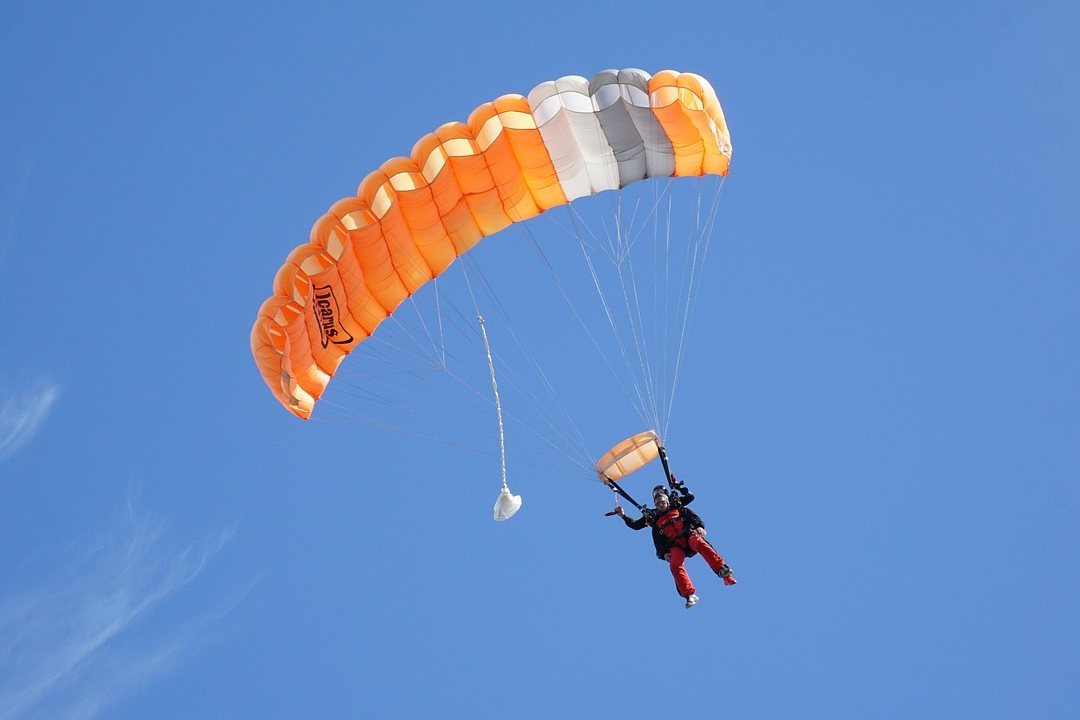
Almost every sport parachute today, main and reserve, is a ram-air canopy. It’s two layers of fabric sewn into cells, open at the front. Air rams into the front, inflates the cells, and the canopy takes the shape of a wing. It glides forward instead of just dropping, and you can steer it.
Students learn on ram-air canopies too, just big, docile ones. The round parachute you picture from war movies is mostly a military static-line design now. Rounds can’t be steered much and they can’t flare, so you land however the wind puts you down.
Landing a ram-air comes down to the flare. You come in with the canopy flying forward, then pull both toggles down smoothly a few feet over the ground. That trades forward speed for lift, and on a good flare you step onto the ground at a walk.
The dangerous part is turning. A canopy dives when it turns, and the smaller and more heavily loaded it is, the harder it dives. In the USPA’s 2025 fatality summary, intentional low turns under small, fast canopies caused a quarter of the deaths (4 of 16). Turning low is the mistake that kills experienced jumpers.
What canopies are made of
Canopies are nylon. Most modern mains use zero-porosity (ZP) fabric, a coated nylon that’s airtight. Performance Designs brought ZP into the sport in 1989 and it became the standard. The older alternative, F-111, lets a little air through and is still used on some canopies, mostly student and reserve designs, because it tends to open softer.
Lines are where most of the material choice happens. Spectra (Microline), Vectran, HMA and Dacron are the common types. Thin lines mean less drag; Dacron is thicker and stretches a bit, which some people prefer for softer openings.
Nylon’s weak point is sunlight. Lightweight parachute fabric loses strength fast under UV, so the gear lives in its container, out of the sun, in a cool, dry place. If you see someone leave a canopy spread out on the lawn all afternoon, that’s not a good sign.
The reserve: your second parachute
If the main has a problem, you deal with it by a set altitude. Students are commonly trained to a decision altitude of 2,500 feet above the ground; experienced jumpers often use around 1,800 feet. Below that, there’s no time to keep fixing things.
The usual sequence for a main that’s out but not flyable: look at the cutaway handle, pull it to release the main, then pull the reserve handle. Students practice this on the ground until it’s automatic. The exact procedure depends on the type of malfunction and the gear you jump, and it’s taught by your instructor. Don’t learn emergency procedures from a blog post.
How often does it happen? The USPA reports that in 2025, about 11.8% of its members used a reserve, roughly one reserve ride per 726 jumps. Main malfunctions aren’t rare, which is exactly why the reserve exists.
Who packs it and how often
Under 14 CFR 105.43, the reserve must be packed by a certificated parachute rigger within 180 days before it’s used (60 days if any part is silk or another natural fiber, which you won’t find on modern sport gear). The rigger opens it, inspects the canopy, lines, container and harness, repacks it, and seals it.
You may see an older figure of 120 days on some websites. That’s the old rule. The current interval is 180 days.
The main can be packed by a rigger, by the person who’s going to jump it, or by someone working under a rigger’s direct supervision. That’s why you see skydivers packing their own mains on the hangar floor between loads. Tandem and student mains are usually packed by the drop zone’s staff.
The AAD: the backup for when you can’t act
An AAD is a small computer in the container that tracks altitude and how fast you’re falling. If you’re still falling fast below its set altitude, it fires a cutter that opens the reserve container.
The common Expert CYPRES 2, for example, fires if you’re falling faster than about 78 mph (35 m/s) at around 750 feet. The Student version adds a second trigger: about 29 mph below about 1,000 feet, which catches some situations where a student is under a bad canopy.
AADs are for when the skydiver can’t act: knocked out in a collision, lost track of altitude, frozen. They aren’t a plan. Of the three 2025 deaths the USPA counted as no-pulls, it noted one jumper had no AAD.
The rules:
- The USPA requires every student rig to have a working AAD, serviced on the maker’s schedule.
- The FAA requires an AAD on the reserve of every tandem system (14 CFR 105.45).
- For licensed solo jumpers, the FAA says an AAD is optional, but if one is installed it must be maintained per the manufacturer. The USPA says at least 90% of experienced skydivers use one anyway.
Tandem rigs
A tandem rig is built for two people: a bigger main, a bigger reserve, a harness for the passenger that clips to the instructor’s, and an AAD on the reserve. It also has a drogue, a small parachute the instructor throws right after exit. Two people falling together would reach close to 200 mph. The drogue holds the pair to about 120 mph, the same as a solo skydiver, and later pulls the main out when the instructor opens the container.
The USPA’s minimum opening altitude for tandems is 5,000 feet above the ground, higher than for solo jumpers. For comparison: students and A-license holders must open by 3,000 feet, and B, C and D license holders by 2,500 feet.
Weather and the canopy ride
Wind matters more under canopy than in freefall. A strong headwind can hold you nearly in place or push you backward on final approach. Gusty, turbulent air can partially collapse a canopy near the ground, where there’s no altitude to recover. Drop zones set wind limits for students and tandems and hold loads when the wind is up. If they put you on a weather hold, that’s the system working.
Clouds are the other limit. FAA rules require jumpers to stay clear of clouds and have minimum visibility, so on low, overcast days the planes stay on the ground.
The record jumps, briefly
Parachutes have a longer history than most people expect. André-Jacques Garnerin made the first recorded parachute descent on October 22, 1797, cutting loose from a hydrogen balloon over Parc Monceau in Paris. His canopy was silk, and the basket swung so hard on the way down that he reportedly got sick.
The famous high jumps, with the figures checked:
- Joe Kittinger, August 16, 1960 (Project Excelsior III, U.S. Air Force): stepped off a balloon gondola at 102,800 feet, fell for 4 minutes 36 seconds under a small stabilizing drogue, and hit about 614 mph. His main opened at 17,500 feet.
- Felix Baumgartner, October 14, 2012 (Red Bull Stratos): jumped from 127,852 feet (38,969 m), fell for about 4 minutes 19 seconds without a drogue, and reached 843.6 mph (1,357.6 km/h), faster than sound.
- Alan Eustace, October 24, 2014: rose under a helium balloon to 135,890 feet (41,422 m), the current FAI exit-altitude record, and fell 37,623 m with a drogue before opening.
- Luke Aikins, July 30, 2016: jumped from 25,000 feet with no parachute at all and landed in a 100-by-100-foot net in Simi Valley, California.
Every one of those jumps leaned on the same basic gear you’d use at a local drop zone, just pushed a long way further.
Before your jump: what to ask
You don’t need to know how to pack a reserve to make a tandem jump. But it’s fair to ask, and a good drop zone will answer without blinking:
- Is it a USPA Group Member drop zone?
- Does every rig I’ll use have an AAD? (For tandems and students, it has to.)
- When was the reserve last packed? The date is on the data card in the reserve container, and it should be within 180 days.
- What are your wind limits for tandems and students?
- If you’re learning solo: how much time do you spend on emergency procedures before the first jump?
The one thing to remember: the gear is very good, and it’s checked on a legal schedule. What keeps you safe on top of that is pulling on time and landing without turning low.
Photo by Mylene2401 on Pixabay.