When Should You Assemble a Trampoline for Christmas Morning?
Plan when to build a backyard trampoline before Christmas, with build times by size, hiding tips, winter ground checks, and first-bounce safety rules.
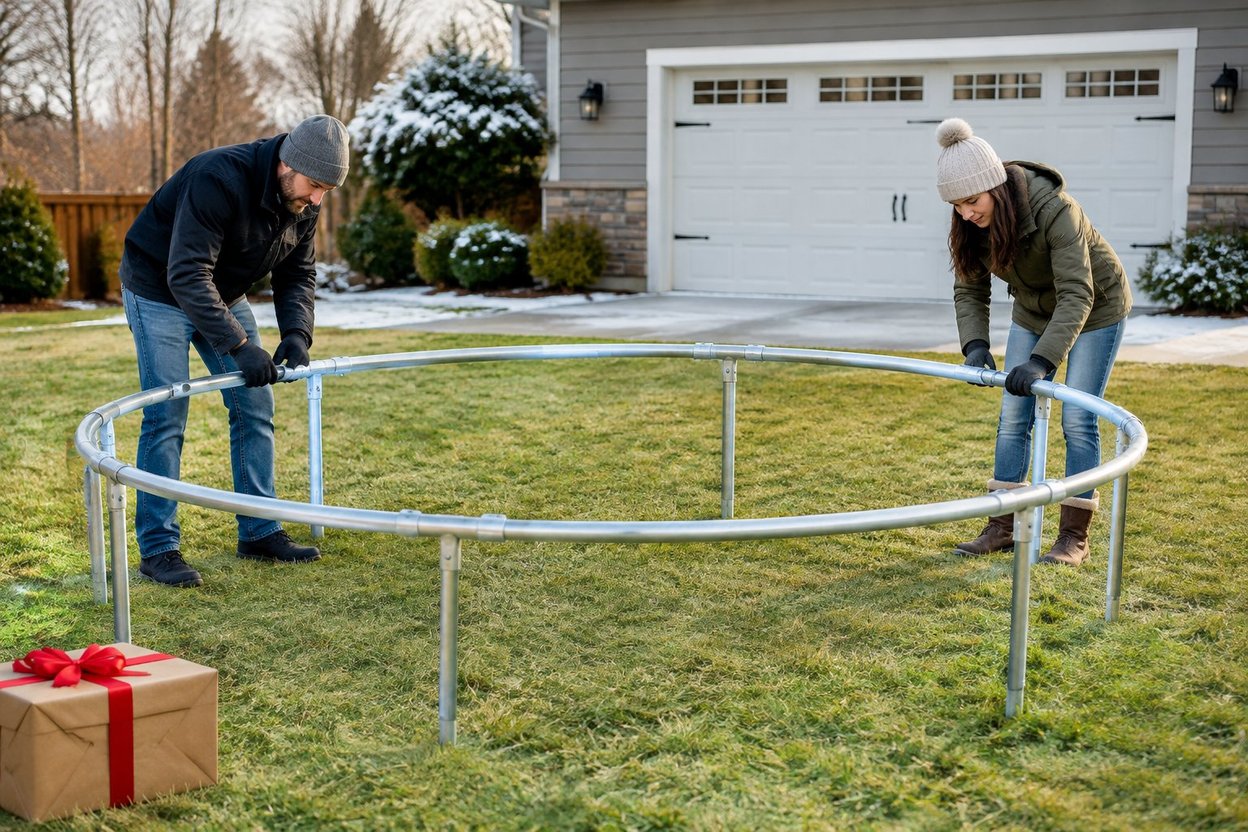
The boxes arrived, they're heavier than you expected, and now they're hidden behind the holiday decorations in the garage. Sooner or later you have to ask yourself: when do I actually put this thing together? Build it before Christmas Eve, not that night. Depending on size, a backyard trampoline takes about 1.5 to 6 hours with two people, plus extra time for the net. Below is a build-date plan, realistic build times, ways to hide a finished trampoline, and a cold-weather and safety checklist for the first bounce.
The short answer: build it before Christmas Eve, not that night
Springfree's own estimates run from about 1.5 hours for a small 8 ft trampoline to about 6 hours for a 15 ft one. A safety net adds roughly 30 to 60 more minutes. Springfree says one person can technically do the build but recommends two.
Now picture that work on Christmas Eve. The kids go to bed late. It's dark by late afternoon in December, it's cold, and you're reading a step-by-step manual with a flashlight. A job the box calls "three hours" can easily take five, and you're still tightening the last fittings at 2 a.m. If a part is missing, the stores are closed.
That's why the UpIsJump team recommends building early. No manufacturer names a "right" build date, so treat this as our planning advice. You have three good options:
- Build it days ahead and hide it. A dry weekend in early to mid December works well. If the weather cooperates, Thanksgiving weekend (November 26 this year) works too, while the relatives who help with heavy lifting are already in town.
- Build it at a friend's or relative's place. This only works if you can move it afterward. A built trampoline is big, so check that it will fit through gates and that you have helpers to carry it.
- Keep the boxes stored and plan a daytime build. Pick a daylight morning before Christmas Eve, with time to spare if something goes wrong.
Whichever you choose, the first thing to know is how long your particular model takes.
How long the build really takes
Springfree's estimates by size, for two people:
- 8 ft: about 1.5 to 3 hours
- 12 ft: about 2.5 to 4 hours
- 14 ft: about 2.5 to 5 hours
- 15 ft: about 3 to 6 hours
Add 30 to 60 minutes for the safety net. For a two-person team, Springfree's general rule is about 2 to 3 hours. These are one manufacturer's figures for its own trampolines. Other brands, including budget round-frame models with springs, may take more or less time, so read your own manual's estimate before you pick a date.
Doing it alone usually takes longer. Some steps, like lifting frame sections or attaching the mat, are much easier with a second pair of hands, which is why two people are the recommended crew.
It also helps to look at the instructions before build day. BILT, a free instruction app, has step-by-step guides for some models. Its listing for the Springfree Medium/Large Square says 2 people, about 2 hours 30 minutes, and 57 steps, and the tools list shows up inside the app. If you open it a week ahead, you won't find out on build day that you need a tool you don't own.
Once the trampoline is built, you have a new problem: where to hide something that's 12 feet across.
Hide it, store it, or surprise them
Retailers have a few practical ideas. Acon suggests keeping a built trampoline out of sight behind a shed or garage, or under a large tarp, until Christmas Eve. Springfree also suggests hiding it under tarps or sheets until gift time. If you haven't built it yet, Acon recommends storing it in a garage or shed and keeping the boxed parts secure and dry. Wet cardboard falls apart, and loose parts go missing.
On Christmas Eve, move the trampoline into its final spot (another job for two people) so the kids find it there in the morning. A big bow or a sheet over the top makes for a better reveal.
Before anyone jumps, check all parts, which Acon also stresses. Moving a built trampoline can loosen fittings or shift the net. Walk around the whole frame, press on the padding, and confirm every piece is where the manual says. Where you put it matters too, and in December the ground and weather are part of the decision.
December weather and ground
Pick the spot first. Springfree advises a level, flat spot, because a slope makes assembly harder and affects stability. Leave 3 to 5 ft of clearance on every side. CPSC also advises setting a trampoline up away from structures and other play areas. Hiding it behind the shed is fine. Jumping next to the shed is not.
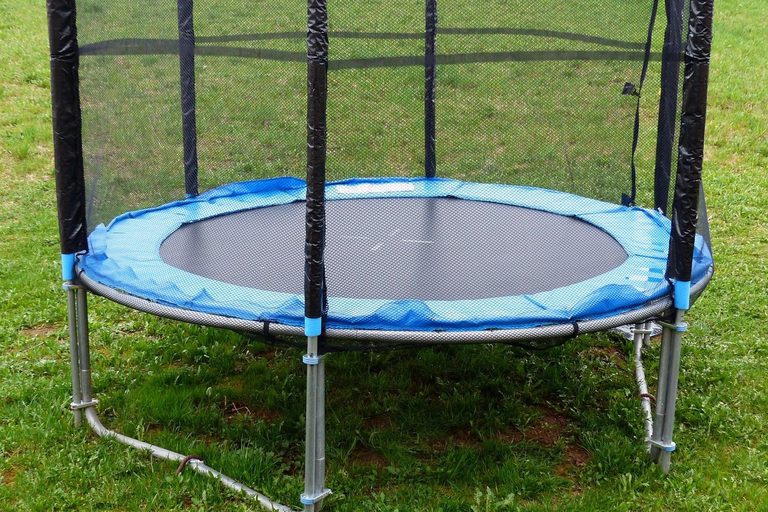
**Anchor it if wind is a concern.** Trampolines.com describes a typical anchor kit as four metal corkscrews that twist into the ground, with straps to the frame. It says these kits handle moderate wind, but for very high winds you should move the trampoline or remove the mat. Corkscrews need ground you can screw them into, so if you live where the ground freezes hard by late December, putting anchors in during an earlier, milder build window is another good reason to build early.
Check the mat for ice. Springfree says it plainly: "Bouncing on an icy trampoline can be dangerous." A cold Christmas morning can leave frost or a thin glaze on the mat that's hard to see. Run a hand over it before the first jump.
**Clear snow before it piles up.** Springfree warns that heavy snow can tear the mat and recommends a soft brush or broom, never a shovel.
Read your brand's winter rules. According to Springfree, some brands, such as Skywalker and Machrus, advise taking the trampoline down in colder climates. If your manual says that, a Christmas setup may need to be short-lived, or you may want to hold the reveal and the full setup until spring.
Safety check before the first jump
Christmas morning brings a crowd: excited kids, visiting cousins, everyone wanting a turn at once. That is exactly when the rules matter most.
The numbers are serious. CPSC reported that ER-treated trampoline injuries nearly tripled during the 1990s, from an estimated 37,500 in 1991 to almost 100,000 in 1999, and nearly two-thirds of those injured were children ages 6 to 14. A 2019 AAOS release, citing CPSC, put the 2018 total at 313,850 trampoline-related injuries treated in emergency departments, doctors' offices and clinics.
Any family buying a trampoline should know the American Academy of Pediatrics' position. Its 2012 policy statement tells pediatricians to counsel families against recreational trampoline use and says safety measures have not significantly reduced injury rates. HealthDay's report on the statement adds that most injuries happen when several people jump at once, and that falls and attempted flips can cause neck (cervical spine) injuries.
If the trampoline stays, set these rules on day one, before the first jump:
- One jumper at a time. CPSC lists collisions between jumpers as a main cause of injury.
- No flips or somersaults. CPSC says to prohibit them.
- An adult watching every session. CPSC says to supervise children whenever they're on it.
- Springs, hooks and frame fully padded. This is a CPSC recommendation.
- No ladder left in place. CPSC says a ladder lets small children climb on unsupervised. AAOS recommends removing it after each use.
- No children under 6, per AAOS.
- Treat the net as one layer of protection, not the whole plan. CPSC says an enclosure can prevent falls off the trampoline, but AAOS notes that most injuries happen on the jumping surface itself.
Post the rules where everyone can see them, sweep off any frost, and let the first jumper go.
Sources (9)
- Springfree: How long does it take to put together a trampoline?
- BILT: Springfree Large Square Trampoline instructions
- Acon: How to wrap a trampoline for the perfect Christmas surprise
- Springfree: How to create the perfect Christmas Day reveal
- Springfree: Winter maintenance tips for your Springfree
- Trampolines.com: Buy a trampoline anchor kit
- HealthDay: AAP strongly discourages home trampolines
- CPSC: CPSC Reports Sharp Rise in Trampoline Injuries
- AAOS: Trampoline safety press release