Can You Hang Christmas Lights on a Backyard Trampoline?
Where Christmas lights can go on a backyard trampoline, which types to buy, how to attach them safely, and the electrical rules to follow.
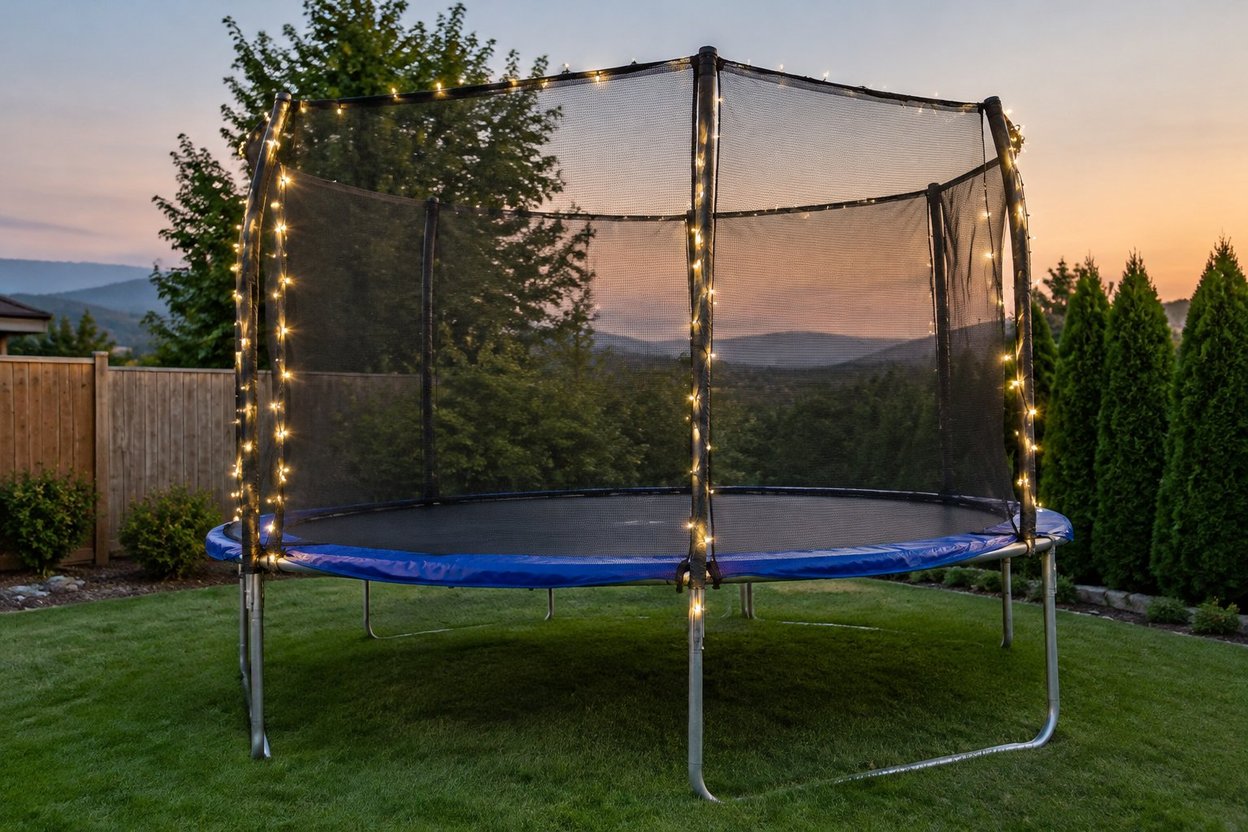
You look out at the backyard on a December evening and think the trampoline would look great glowing with the rest of the house. You can hang Christmas lights on it if you attach them to the frame or enclosure poles and keep them clear of the jumping area. Choose lightweight, outdoor-rated lights, and keep every cord and decoration away from jumpers.
The short answer
Use the frame and enclosure poles for lightweight, battery-powered, outdoor-rated lights. Keep the jumping mat and springs clear. Check your trampoline manual before decorating, because no official standard or manufacturer warning on holiday lights turned up. The trampoline's own safety rules still apply.
Battery-powered LED strings or fairy lights spare you from running a power cord out to the trampoline. Trampoline seller Zupapa says the same: "Stick to battery-powered LED options to avoid hazards." Keep the battery pack protected from moisture.
Think of the lights as decoration on the trampoline's structure, not on its bouncing surface. If you cannot attach a strand securely without putting it where someone could strike or trip over it, leave that area undecorated.
Where lights go and where they don't
The frame and enclosure poles give you the clearest attachment points. Trampoline seller Acon24 says lights should never interfere with the bounce area and should stay away from the springs and the spring-to-frame connections.
The net is the riskiest place for lights. Acon24 advises attaching lights to the frame and poles rather than directly to the net, because the net may be damaged. If you do put lights on it, it suggests lightweight LED or fairy lights secured at several pole points to spread the weight. Sources disagree here: trampoline maker Springfree lists the netting as a placement option. Keeping lights on the poles is the more cautious choice. Zupapa suggests garlands and ribbons around the outside of the safety net, and says not to hang hard decorations inside the trampoline where a jumper could hit them.
For an in-ground trampoline, Springfree lists lights under the mat as an option, as long as they are fastened so they "won't interfere with jumping." Keep loose wiring beneath the trampoline out of the way, too. Before anyone jumps, check that nothing hangs into the enclosure or bounce area.
Which lights to buy
Battery-powered LED strings and fairy lights are practical because no cord has to run from the trampoline to an outlet. Put battery packs in waterproof pouches.
Solar lights and waterproof, outdoor-rated LED rim strips are other options. Check the product's outdoor rating before using it outside. Plug-in sets work too: they go into a nearby outlet, often through an extension cord, which should be outdoor-rated and routed away from walkways.
Whatever you choose, pick lightweight lights you can fasten securely to the frame or poles.
Skip:
- heavy decorations
- hooks
- hard pieces that could strike a jumper or catch on the trampoline
Keep the setup simple enough that you can inspect the lights and their attachments without shifting the net or mat.
How to attach them
Springfree's list of supplies is short: zip ties or Velcro straps, a ladder for work around the netting, and a tape measure. Space the ties evenly along the frame or enclosure poles. Keep each strand snug, but not so tight that it damages the wire or the trampoline's coating, which Acon24 warns about.
Test the lights before you fasten everything down. Then use the ladder to reach attachment points around the net, and check that each tie or strap holds firmly.
Keep the strand clear of:
- sharp edges
- moving parts
- the jumping area
Do not thread lights through the net. Attach them to the poles instead. Once the lights are up, walk the full perimeter to check for loose sections and confirm that no cord crosses a path people use.
Electrical and holiday-fire safety
Use lights tested by a recognized laboratory and labeled for outdoor use. The U.S. Consumer Product Safety Commission (CPSC), in a 2002 holiday-decoration release, says to plug outdoor lights into GFCI-protected circuits.
The same release says to connect no more than three standard-size light sets to one extension cord, and a 1998 release repeats that limit. Turn the lights off when you go to bed or leave the house.
For context, the National Fire Protection Association (NFPA) data for 2017–2021, as reported by the NKyTribune, counts about 790 home fires a year started by decorations other than Christmas trees. They caused an average of 4 civilian deaths and 33 civilian injuries a year.
Inspect the strands every few weeks for:
- frayed wires
- loose ties
- damaged bulbs
Unplug or switch off lights when you are not using them.
Keep the jumping safe
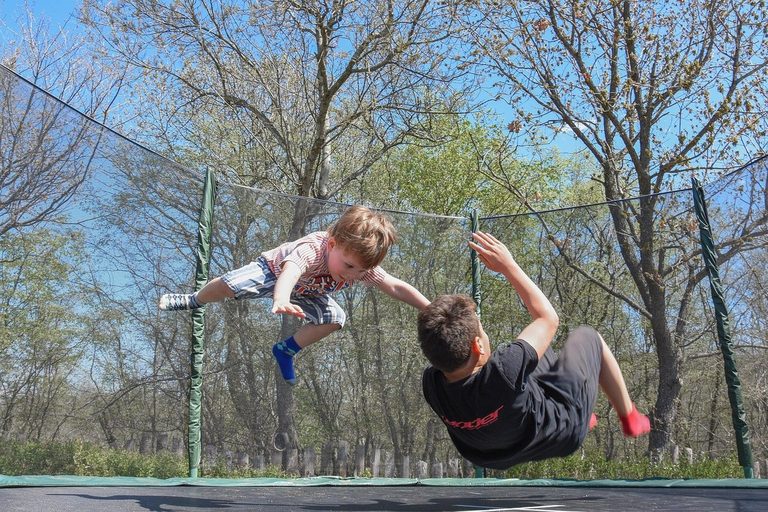
The trampoline's normal safety rules stay in force while the lights are up. The American Academy of Orthopaedic Surgeons (AAOS) advises one jumper at a time, says children under six should not use trampolines, and warns against relying on enclosure nets alone, because most injuries happen on the mat. Zupapa adds that an adult should supervise children and the weight limit should not be exceeded. Keep anyone off a trampoline with a damaged net.
The AAOS, citing the CPSC, reports 313,850 trampoline injuries treated in emergency departments, doctors' offices, and clinics in 2018. Lights are a small addition next to numbers like that, so they should never make the trampoline harder to use safely.
For nighttime jumping, make sure the jumping area has enough light. Decorative strands should stay outside the bounce area and must not block the light needed to see it.
Inspect the lights and attachments every few weeks, and take the decorations down when the holiday season ends.