Is Rebounding Easy on the Knees?
How a mini-trampoline changes knee impact, what studies show, who should be careful, and how to set up and bounce so your knees stay happy.
Yes, for most people rebounding is easier on the knees than running or jumping on a hard floor. The mat stretches when you land, so each landing hits more slowly and less sharply. That only holds if you bounce low, keep your knees soft and use a rebounder that doesn't bottom out. Jump high, land stiff-legged or overload a cheap frame, and you give a lot of that advantage back.
Below is what the research supports, where the claims get stretched, and how to set up so your knees get the benefit.
What the mat does for your knees
Run on pavement and your foot stops dead in a split second. That sudden stop sends a sharp jolt up through your ankle, shin and knee. On a rebounder the mat and springs (or bungee cords) give, so your body slows down over a longer distance. Same body weight, gentler hit.
The study people quote most is a 1980 NASA Ames paper in the Journal of Applied Physiology (Bhattacharya and colleagues). Eight young men ran on a treadmill at four speeds and jumped on a trampoline at four heights while sensors on the ankle, lower back and forehead recorded acceleration.
- Running: the ankle always took the biggest jolts, from about 3 G at the slowest speed to about 12 G at the fastest. The back and head took much less.
- Trampoline: the forces were spread more evenly across ankle, back and head as jump height went up.
The paper also found that at the same heart rate and oxygen use, the trampoline gave the body a bigger overall training stimulus than running. That was the point for NASA, which wanted ways to keep astronauts from deconditioning. The study did not measure knee joints and did not include anyone with knee problems. It's good evidence that bouncing spreads impact differently than running. It is not proof that rebounding fixes knees.
You still get a real workout
A gentler bounce doesn't mean an easy session. In a study sponsored by the American Council on Exercise, 24 college students did a 19-minute mini-trampoline routine. They averaged 79% of max heart rate, and the men burned about 12.4 calories a minute and the women about 9.4. ACE compared that to running 6 mph on flat ground.
The interesting part: the students rated the effort as light to moderate (11.7 on the exertion scale) when the numbers showed moderate to vigorous. The researchers put that down to the trampoline being "less jarring." For someone whose knees complain after a jog, that gap is the whole appeal.
What the research says about knee problems
The research here is thin, so keep expectations reasonable.
- A 12-week trial of adults aged 56 to 83, published in Clinical Interventions in Aging, had people bounce on mini-trampolines twice a week. Compared with a control group, they improved balance, leg and arm strength, walking speed and fear of falling. Bone density barely changed.
- An 8-week study of 20 sedentary adults found knee strength went up in the trampoline group, but not by enough to beat the control group.
Neither study focused on knee arthritis. The Arthritis Foundation says mini-trampolines can give people with arthritis a low-impact workout, while big backyard trampolines are "generally off-limits" because of injury risk. If you have arthritis, that's the sensible reading of the evidence: probably a better choice than running, not a treatment.
When rebounding can still bother your knees
These are the usual reasons people say a mini-trampoline "hurt my knees":
- Bouncing too high. The higher you go, the faster you come down and the harder the mat has to work. A health bounce where your feet barely leave the mat, or don't leave it at all, is where the gentleness is.
- Locked or caving knees. Landing with straight legs pushes the load into the joint. Knees that fold inward (toward each other) twist the kneecap. Land with knees slightly bent and tracking over your second toe.
- Bottoming out. If you hear or feel the mat hit the floor, you've lost the cushion, and that's a hard landing on a hard surface. Heavier users on light-duty rebounders run into this most.
- Unstable mat for unstable knees. A soft, bouncy surface asks your knee to steady itself on every landing. That's good training for most people. After a recent ACL tear, knee surgery or a kneecap that slips, it can be too much too soon.
- Doing too much on day one. It feels easy, so people go 30 minutes the first time and pay for it the next morning.
If your knee is swollen, recently injured or recently operated on, ask your doctor or physical therapist first and get a specific green light.
Picking a rebounder that's kind to knees
The frame matters more than most people think.
- Bungee cords vs. steel springs. Bungee rebounders give a softer, quieter, rounder bounce. The Arthritis Foundation notes that most experts recommend bungee cords for the smoothest ride. Cheap steel-spring models often feel stiff with a harsh "thunk" at the bottom.
- Weight rating. Ratings vary a lot. The Arthritis Foundation notes some are rated around 400 pounds and others half that. Pick one rated well above your weight so you don't bottom out.
- A handle bar. A stability bar lets you hold on while you get used to the bounce. If your balance or knees are shaky, it's worth having.
- Price, as of October 2026: budget bungee rebounders with a bar run roughly $80 to $130. Mid-range JumpSport models run about $300 to $450. A bellicon runs about $700 to $900. You don't need the top end, but the $30 steel-spring specials are where most knee complaints start.
Put it on a flat floor with a few feet of clear space all around and nothing low overhead. A thin rubber mat under the legs keeps it from walking across hardwood.
A first week that won't wreck your knees
Start smaller than you think you need.
- Days 1 to 2: 5 to 8 minutes total. Health bounce (heels lifting, feet staying on the mat) and marching in place. Hold the bar.
- Days 3 to 4: 10 minutes. Add a light jog in place and small side-to-side steps. Feet just clear the mat.
- Days 5 to 7: 10 to 15 minutes with short breaks. Add jumping jacks if your knees feel fine the next morning.
The Arthritis Foundation points to a beginner pattern of about eight minutes of bouncing broken up with two-minute breaks. That's a good model if you're coming off a long layoff.
The rule that matters most is the next-morning check. A little muscle soreness in your thighs and calves is normal. Knee pain, swelling or stiffness that's worse than before means you went too high or too long, so drop back a step. For full routines once you're comfortable, see Rebounding: Mini-Trampoline Workouts for Beginners. If cold mornings are pushing your training indoors this fall, Winter Jump Workouts You Can Do Indoors has more ideas.
Keep the rest of your training
Rebounding spreads impact, but your bones and the muscles around your knees still need load. The Arthritis Foundation's advice to keep walking and doing some strength work alongside it holds up. Squats to a chair, step-ups and glute bridges two or three times a week build the thigh and hip strength that protects knees on any surface. Once your knees are solid, Plyometrics for Beginners: Start Safe shows how to add harder jumping a step at a time.
Your checklist before the first bounce
- Bungee or quality spring rebounder, rated well above your body weight
- Stability bar if your balance or knees are uncertain
- Low bounce, soft knees, knees over toes
- 5 to 10 minutes to start, then build
- Next-morning knee check before adding time or height
- Doctor or PT sign-off if you have a recent injury, surgery or a swollen knee
Sources (6)
- Bhattacharya et al., "Body acceleration distribution and O2 uptake in humans during running and jumping," Journal of Applied Physiology, 1980 (NASA record)
- ACE-Sponsored Research: Putting Mini-trampolines to the Test
- Arthritis Foundation: Are Trampoline Workouts Safe With Arthritis?
- Effectiveness of a Mini-Trampoline Training Program on Balance (Clinical Interventions in Aging)
- Effects of mini-trampoline exercise in sedentary adults (Journal of Human Sport and Exercise)
- Rebounder price comparison, 2026 (bellicon, JumpSport, BCAN)
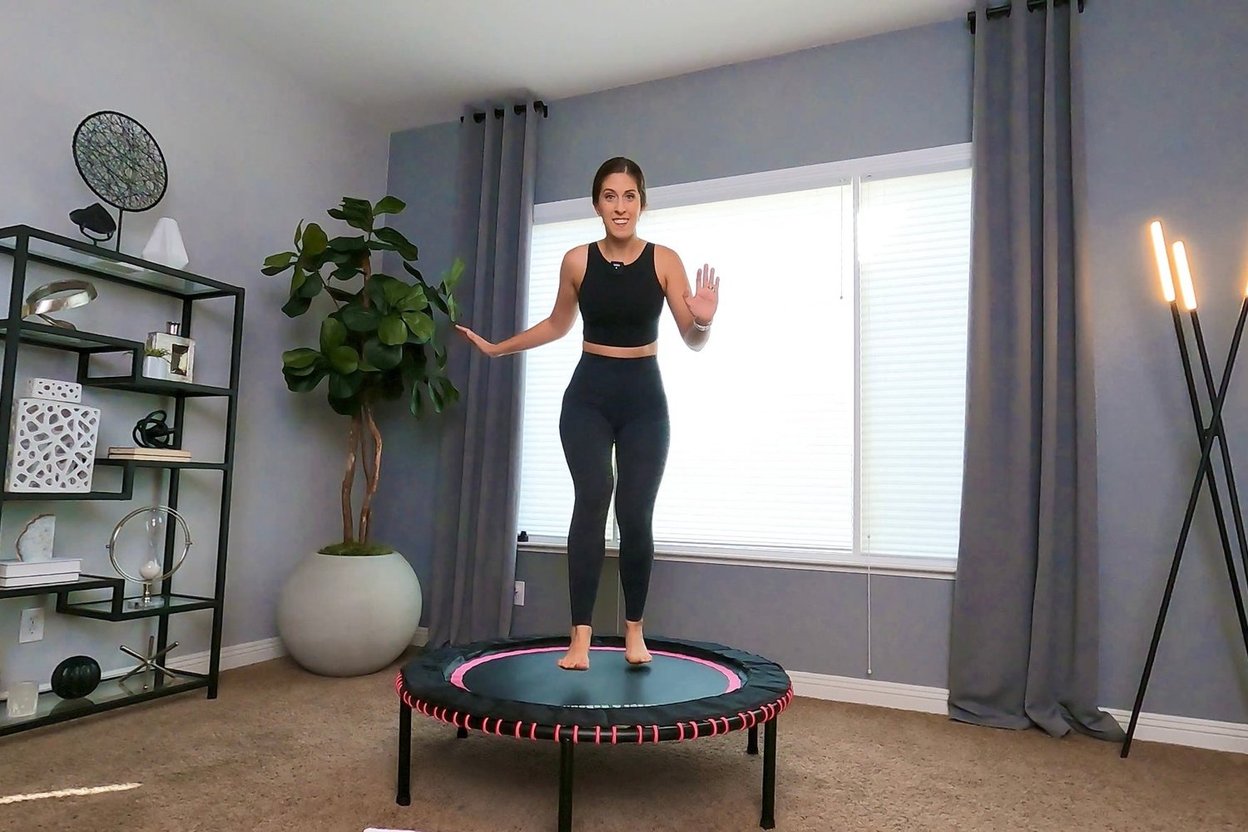
Photo: Woman standing on a Leaps & Rebounds rebounder by Leaps & Rebounds, used with credit.