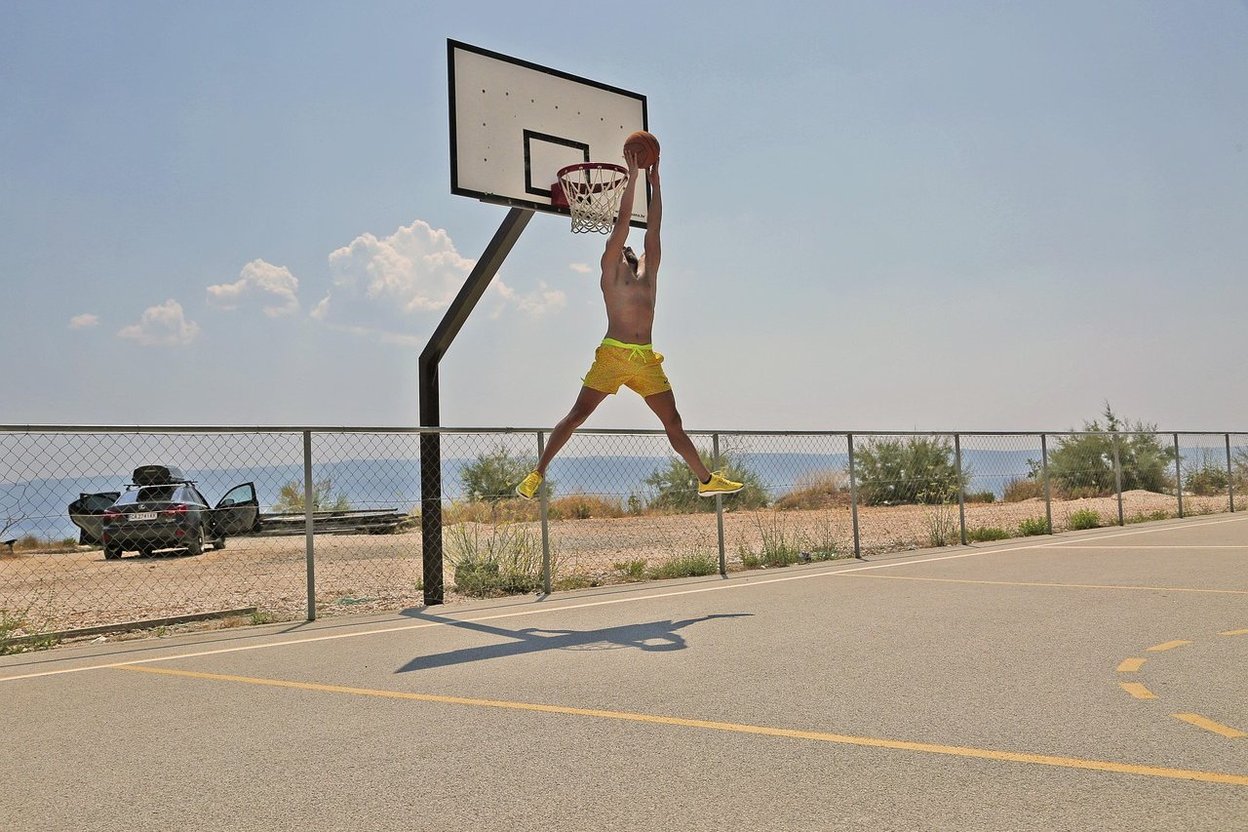
How Much Vertical Do You Need to Dunk? The Formula, by Height
Find how much vertical jump you need to dunk, using your standing reach and a 120-inch rim. Includes a height chart and how to measure yourself.
You're under the hoop at the park, or out on the driveway after the Thanksgiving dishes, and you jump to see how close you get to the rim. Maybe you slap the net. Maybe you graze the metal. So how much higher would you have to go to dunk? Most people need roughly 30 to 35 inches of vertical. Your own number could be lower or higher, and it depends mostly on one measurement: how high you can reach while standing flat on the floor.
The short answer and the formula
A regulation rim is 10 feet off the floor. That's 120 inches, and it's 18 inches across on the inside. Your hand needs to get a little above it to dunk the ball, so the math is:
Vertical needed = 120 in − your standing reach + clearance
Clearance is how far your hand has to rise above the rim. For a one-handed dunk, the common rule of thumb is about 6 inches. That figure is a convention used by dunk calculators, not a lab-tested number. People with big hands, who can palm the ball easily, often need less.
Here's how it works out:
- A 92 in standing reach (7'8"): You need 28 in just to touch the rim (120 − 92). To dunk, you need about 34 in (28 + 6).
- A 5'9" player with average arms: Standing reach is about 91 in (7'7"). That means about 29 in to touch the rim and about 35 in to dunk.
The most important point is that reach matters more than height. Two people who are both 5'11" can have very different standing reaches because arm length and shoulder width vary. The one with longer arms might need several fewer inches of jump. So measure your reach before you worry about your height.
How to measure your own numbers
You need a wall, some chalk or sticky notes, and a helper if you can get one.
- Standing reach: Stand sideways to the wall with your feet flat. Reach one arm straight up as high as it goes and mark where your fingertips touch. Keep your heels down. Going up on your toes makes your reach look bigger, which then makes your jump look smaller.
- Jump reach: From a standstill, jump and touch the wall as high as you can. Mark that spot.
- Vertical: Subtract your standing reach from your jump reach. The difference is your vertical jump.
If you can't measure, here's a rough estimate: standing reach is about 1.33 times your height. A 6'0" person (72 in) would land near 96 in. Arm length varies a lot, though, so a real measurement always beats the estimate.
It also matters which kind of jump you test:
- Standing vertical: Two feet, no steps, arms swinging. This is the number most fitness charts use.
- Running (approach) vertical: A few steps before you take off. This usually adds about 3 to 8 inches. Nearly every dunk happens off a run, so your approach jump is the one that counts at the rim.
What you'd need at different heights
These estimates use the formula with an average reach (height × 1.33, rounded) and 6 inches of clearance. Measure your own reach and you could move a few inches either way.
- 5'3" (reach about 84 in / 7'0"): About 36 in to touch the rim, about 42 in to dunk
- 5'6" (reach about 88 in / 7'4"): About 32 in to touch, about 38 in to dunk
- 5'9" (reach about 91–92 in / 7'7"–7'8"): About 28–29 in to touch, about 34–35 in to dunk
- 6'0" (reach about 96 in / 8'0"): About 24 in to touch, about 30 in to dunk
- 6'3" (reach about 100 in / 8'4"): About 20 in to touch, about 26 in to dunk
- 6'6" (reach about 104 in / 8'8"): About 16 in to touch, about 22 in to dunk
There's always a 6-inch gap between touching the rim and dunking. A lot of people reach the rim and then stall there for a long time. Holding and controlling the ball on the way up is a separate skill from jumping.
Basketball guides that sort dunking by height reach about the same place. One rates 5'7" to 5'9" as "difficult," at roughly 35 inches to dunk. It rates 5'10" to 6'0" as "challenging," at roughly 30 inches. At 6'1" to 6'3" it calls dunking normal, and from 6'4" up it calls it easy once you've done some explosive training. Treat all of these as ballparks, because your arms can move you a full category up or down.
How your jump compares
Here's how the numbers above compare with a typical jump.
Common fitness ratings for a standing, two-foot jump with arm swing put average men at about 16 to 20 inches and average women at about 12 to 16 inches. "Excellent" is over 28 inches for men and over 24 inches for women. These ratings are a general guide, not a strict standard. One small study of 116 adults found similar averages: about 17.7 inches for men and 11.8 inches for women.
At the top of the sport, the NBA Draft Combine measures max verticals with a running start. At the 2024 combine, the best jumpers reached 42 inches, and the top 11 averaged about 40.8. The 2025 combine's best was 43 inches, from Drake Powell. The lowest listed that year was 28 inches, and several big men jumped 30 or less. That didn't matter much for them, because standing reaches at that combine ran from 7'10" all the way to 9'6". If your reach is over 9 feet, you barely have to jump to dunk. (Combine measurements have been questioned for accuracy, so treat individual numbers as close, not exact.)
Here's the honest takeaway:
- Under about 6'0", dunking takes a vertical well above "excellent," often 35 inches or more. For many people that's out of reach, even with training.
- Around 6'0" to 6'3", a strong, trained athlete has a real chance.
- Tall athletes with long arms dunk regularly, sometimes with a jump that's barely above average.
- Most women need about 40 inches of vertical at average height. That's why dunking is rare in the women's game.
Can you add inches?
Yes, though probably not as many as the ads promise. A meta-analysis of 26 studies found that plyometric (jump) training raised vertical jump by about 4.7% to 8.7%, depending on the type of jump tested. For someone starting at 20 inches, an 8.7% gain is about 1.7 inches. That's real progress, but it won't turn a 20-inch jumper into a 35-inch jumper.
Another review found what produces the biggest gains:
- Programs longer than 10 weeks, with more than 20 sessions
- More than 50 jumps per session
- A mix of jump types (squat jumps, countermovement jumps and drop jumps) instead of just one
- Adding weight to the jumps didn't help
Height and reach are mostly genetic, so you can't train them. Your jump is the one part you can improve. Strength training, sprinting and practicing your approach can also help you get more out of the vertical you already have.
If fall tryouts have you starting a jump program now, build up gradually. Begin with low jumps on a forgiving surface, keep the number of jumps reasonable, and rest between sessions. Jump training is hard on knees, ankles and Achilles tendons, especially for growing teens. For younger kids, an adjustable hoop lowered to 8 or 9 feet is a great way to feel what a dunk is like, and it's a lot safer than hanging off a regulation rim.
Sources (12)
- NBA Rule No. 1: Court Dimensions
- WNBA Rule One (archive)
- Dunk Calculator write-up, Simple Decision Maker
- OVR Performance: What Vertical Jump Is Needed to Dunk
- HoopsBeast: How Tall Do You Have to Be to Dunk
- Top End Sports: Vertical Jump Norms
- Marathon Handbook: Average Vertical Jump
- Top End Sports: 2024 NBA Draft Combine Results
- NBADraft.net: 2025 Combine Measurements
- Markovic 2007, British Journal of Sports Medicine / PubMed
- de Villarreal et al. 2009, PubMed
Photo by ludiaoposum on Pixabay.