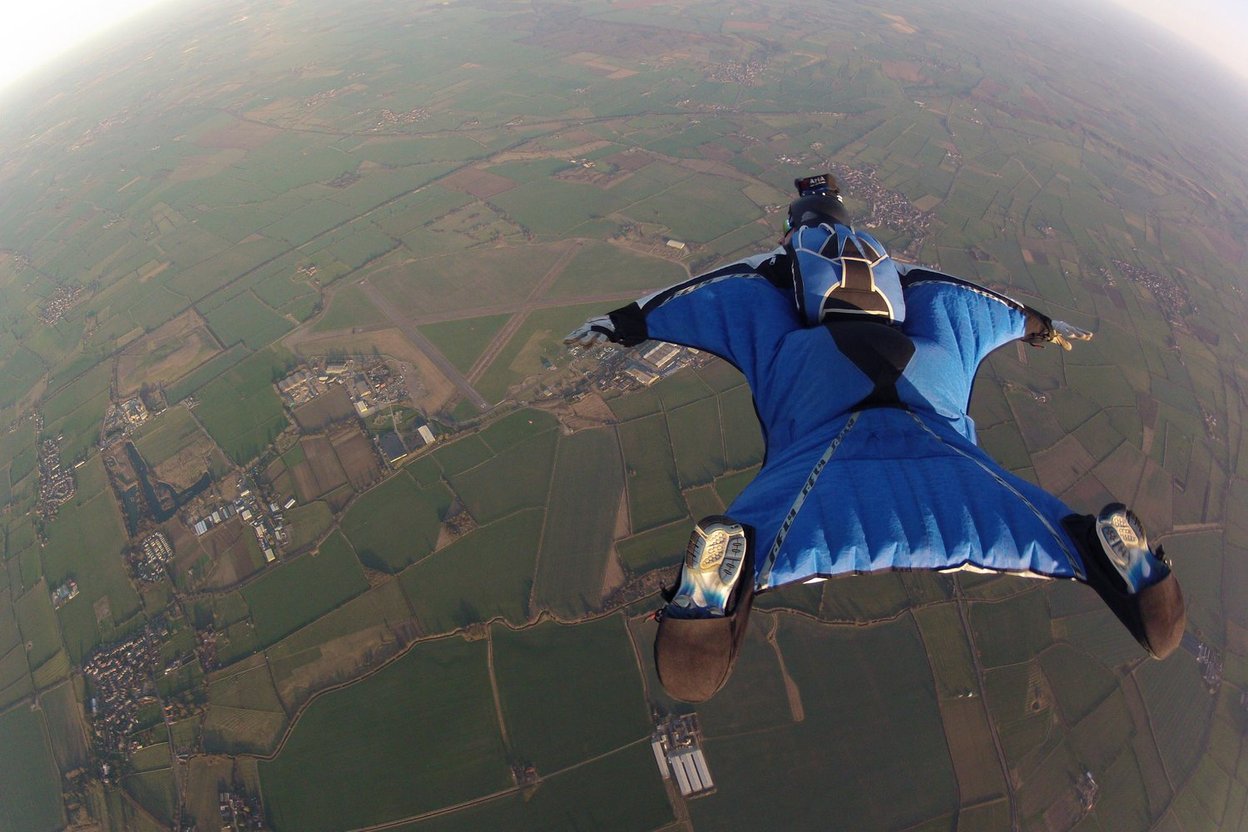
How Much Height Does a Wingsuit BASE Jump Need?
Experienced jumpers suggest about 500 m of total height for a wingsuit BASE jump, but experience matters more. Here's why, and what the rules say.
You've seen the clip: a figure in a wingsuit steps off a cliff, drops for a beat, then skims down a valley like a flying squirrel. The obvious question is how tall that cliff has to be. No official minimum exists. Jumpers often say you want roughly 500 m (about 1,650 ft) of total height between the exit and the landing. Experience, though, matters more than any height figure, and the rest of this article explains why.
The short answer
No agency publishes a minimum height for wingsuit BASE jumping. General references on wingsuit flying and BASE jumping give no number, and no regulator sets one. What you'll find instead are rules of thumb from people who do it.
One UK wingsuit BASE jumper, quoted in the Scottish Daily Mail in 2020, put it in two parts:
- Initial vertical drop: at least 100 m (330 ft) of clean fall off the rock, and usually closer to 150 m (490 ft). The suit needs this much room to start flying.
- Total altitude: more than 500 m (1,650 ft) from exit to landing, so the flight lasts more than a few seconds.
Spanish-language guidance gives similar figures: about 100–150 m of rock drop and roughly 500 m overall. Treat these as experienced jumpers' estimates, not a standard. At the other end of the scale, the classic European flights cover thousands of feet. In practice, cliffs that are fine for a regular BASE jump are often considered too short for a wingsuit.
Why height matters: time and room to recover
A wingsuit doesn't fly the moment you leave the edge. At first you're falling like a rock, and the suit only starts to glide once you've built airspeed. That speed has to carry you forward and away from the wall before you can think about a parachute.
The clock runs fast. National Geographic notes that a 300-ft fall with no parachute takes only about 4.32 seconds. That's all the time there is to fall, fly clear and open the canopy.
You can see the effect in flight times. National Geographic reports that wingsuit flights in Moab, Utah, last 20–30 seconds at most, and one pilot there said "the margin for error is extremely thin." In Europe, flights with about 5,000 ft of descent last more than three minutes.
Compare that with skydiving. Skydivers must open their main parachute above 2,000 ft, which leaves room to deal with a problem. A wingsuit BASE jump has no buffer like that. Every foot of height spent building speed is a foot you can't use later for a bad opening or a wrong heading.
Real-world sites compared
How does that play out at actual cliffs?
- Ordinary BASE sites: Many BASE jumps are made from below about 486 ft (148 m). The lowest are under 200 ft (60 m), and some go as low as about 30 m. Those are jumps where the parachute opens almost right away, with no flying at all.
- Moab, Utah: Most exits sit on sandstone cliffs of about 300–400 ft, and the cliffs there rarely top 500 ft. National Geographic calls that height "barely adequate" for BASE and "widely considered much too short for wingsuit flights." A few pilots fly wingsuits there anyway, and that's where the 20–30-second, thin-margin flights come from.
- The big European walls: These are the long flights, with about 5,000 ft of descent and three-plus minutes in the air.
So a wingsuit jump from the lowest BASE sites isn't realistic. Moab-height cliffs are at the extreme edge of what anyone tries. The jumps that look graceful on video usually start from much bigger terrain.
Experience comes before height
Height is only half of the picture. Every height figure above assumes a pilot who already knows exactly how their suit behaves, and that's why the experience requirements are so strict.
Wingsuit skydiving first. The US Parachute Association's Basic Safety Requirements say a wingsuit jump requires at least 200 skydives and a current license. USPA also advises taking a first-flight course with an experienced wingsuit coach. British Skydiving is stricter. It requires a C Licence, its TR1 qualification, and either 500 total jumps or 200 jumps in the previous 18 months. Wingsuit makers set their own floors too. Squirrel's beginner suits are listed for jumpers with around 200 skydives.
BASE comes next. BASE courses have their own prerequisites. One adventure-travel operator gives these rough guidelines, which are unofficial:
- 150–300 skydives before a BASE course
- 60–100 wingsuit skydives before a first wingsuit BASE jump
- 6 months to 3 years in total to get there
Those numbers come from one company, not a governing body, but they show the order of things. You learn to fly the suit where there's plenty of altitude and a reserve parachute. Then you learn BASE without a wingsuit. Only after both do you combine them. Nobody's first wingsuit flight should be off a cliff.
Risk and the proximity-flying problem
Wingsuits carry a large and growing share of BASE deaths:
- 1981–2011: Of 180 recorded BASE fatalities, 39 involved wingsuits (Mei-Dan et al., 2013).
- 2007–2017: Of 223 BASE fatalities, 137 involved wingsuit jumps. Hitting the ground or an object played a part in 96% of the fatal events (Bouchat and Brymer, 2019).
That 96% figure matters. Most deaths weren't equipment failures in open sky. The jumper struck terrain, which is what happens when there isn't enough room or a pilot flies too close to it on purpose. Flying close to terrain on purpose is called proximity flying. Fixed-object jumps add more risk on top of that: low exits, terrain close by, and only one parachute, with no reserve.
What nobody can tell you is the risk per jump. Both studies count deaths but don't have reliable totals for how many wingsuit BASE jumps were made, so there's no true per-jump fatality rate for wingsuits. The closest figure covers all BASE jumping at one site. At Kjerag, Norway, from 1995 to 2005, nine people died in 20,850 BASE jumps, about one death for every 2,317 jumps. That number includes jumps without wingsuits, so it shouldn't be read as the wingsuit rate.
What to do if you're curious
If watching those videos this fall made you curious, the route is long but clear:
- Start skydiving. A tandem jump is a fine first taste. A licence is the actual starting point.
- Build up to around 200 jumps. That meets USPA's minimum for wingsuit flying.
- Take a first-flight wingsuit course with an experienced coach, then log plenty of wingsuit skydives.
- Talk to a BASE school about its own prerequisites before you plan anything off a cliff.
Rules for specific sites vary, so check what's allowed at any cliff before you go near it. There's no shortcut, and no cliff is tall enough to make up for missing experience.
Sources (8)
- National Geographic: Watch: Pilot Pioneers Harrowing, Low-Level Wingsuit Flights
- Wikipedia: Wingsuit flying
- Wikipedia: BASE jumping
- USPA Skydiver's Information Manual, Section 5-8
- Scottish Daily Mail via PressReader: "On a Wing and a Dare" (2020)
- Yumping: How to get started in the wingsuit
- Squirrel: Suits
- Adventure Driven Vacations: Wingsuit BASE jumping
Photo: Wingsuit Flying over Langar Airfield UK by Wingsuiting, BY-SA 4.0.