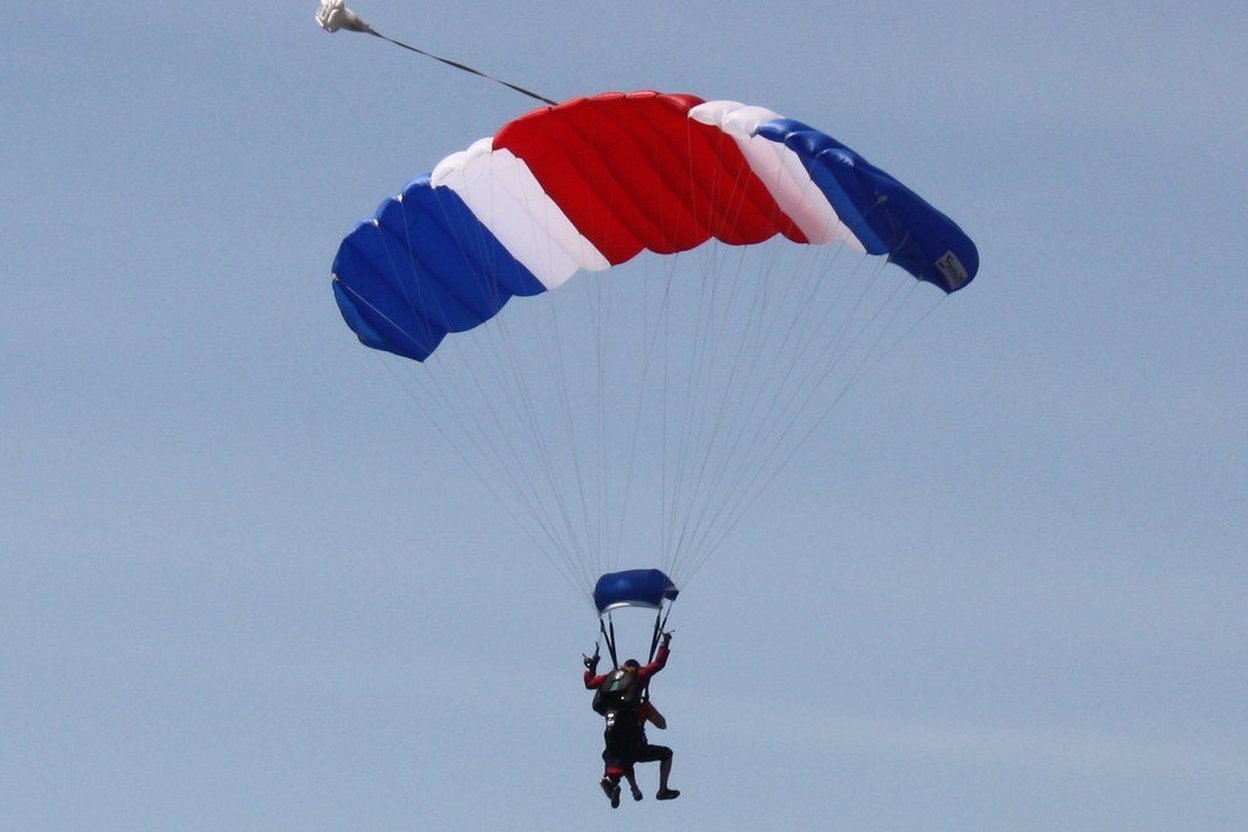
Can You Skydive If You Are Afraid of Heights?
A fear of heights usually won't stop you from skydiving. Here's why it often fades at altitude and how to prep if you're nervous.
You get halfway up a ladder to hang the Halloween lights and your legs lock. Or you step onto a hotel balcony and back up until you feel the wall behind you. Then a friend suggests a tandem skydive and you think, not me. Usually, though, the answer is that you can. A fear of heights doesn't disqualify you, and plenty of people who feel it still make the jump. Here's why the fear often acts differently at jump altitude, how common it is, and how to get ready if you're nervous.
The Short Answer: Yes, Usually
No rule stops someone who is afraid of heights from doing a tandem skydive. Dropzones also say the fear itself often doesn't show up once you're at altitude. Skydive Midwest says most people with a fear of heights find it isn't triggered during a jump. Skydive Perris says that "for most people, the answer is yes."
Skydivers admit to it too. Skydive Monroe says fear of heights is the most common fear skydivers own up to, and that experienced jumpers still get nervous. Long Island Skydiving says many experienced skydivers are afraid of heights.
Keep one thing in mind. These claims come from skydiving businesses, which earn money from bookings. They aren't based on clinical research, and no peer-reviewed study has measured how skydiving feels to people with acrophobia. Some people with a real phobia say the jump didn't feel any easier for them, and the experience may differ between someone with a diagnosed phobia and someone who just dislikes heights. So treat "it won't bother you" as a common pattern, not a promise.
Expect some fear either way. Skydive Midwest says everyone who jumps feels some fear or anxiety, and that jumping while scared is part of the experience. The goal isn't to feel no fear. It's to know what's coming so the fear is easier to handle.
How Common the Fear Is
If heights make you uneasy, you're in large company. Researchers separate two things:
- Acrophobia (a clinical phobia): A German telephone survey of 2,012 people found a lifetime prevalence of 6.4%: 8.6% of women and 4.1% of men. This is the intense, life-limiting kind.
- Visual height intolerance (milder discomfort): This is the woozy, grip-the-railing feeling without a full phobia. Its lifetime prevalence is about 28.5%, or roughly 3 in 10 people (32.4% of women, 24.5% of men).
Skydive Midwest gives a similar figure from the industry side: about 1 in 3 people express discomfort or distress around heights. Since so many people feel this way, many of the people on any jump plane probably feel it too.
Why Skydiving Feels Different from a Balcony
The fear you feel on a ladder or a bridge has specific triggers. Most of them are missing at jump altitude.
There's no nearby ground to judge the distance. Skydive Perris says fear of heights "is usually associated with visual reference and proximity," like standing on a ledge. Tandem jumps usually leave the plane at around 12,500 to 14,500 feet. At 14,500 feet you're almost 3 miles up, which is too far for your brain's usual sense of scale. Skydive Monroe calls it a height "beyond what your brain can calculate as 'dizzying.'"
The view looks flat. Long Island Skydiving says the ground looks "like a toy or a map." Skydive Perris says it's "as if you're looking at a map, which isn't a threatening feeling at all."
You don't get the roller-coaster stomach drop. That feeling comes from sudden acceleration. A jump plane is already moving fast when you leave it, so the forward speed carries you into freefall and you aren't yanked downward. Skydive Perris says the classic stomach drop is more likely when jumping from a hot air balloon or a helicopter, which barely move forward.
The size of the plane matters. Skydive Midwest says small planes that carry 4 to 6 jumpers, such as a Cessna 182 or 206, can still cause some of that roller-coaster feeling. Large planes that carry 14 or more jumpers generally don't.
Freefall feels like being held up. You speed up to about 120 mph and then stop accelerating. Long Island Skydiving says you feel cushioned by the wind rather than falling. Skydive Perris calls it "more like being supported by a column of air."
Waiting is the hardest part. Skydive Perris says "the fear usually peaks before the skydive itself even begins," during the drive, the briefing and the climb. Once you're out of the plane, "almost immediately, the fear disappears," according to the dropzone. That matches what operators report in general. It isn't a guarantee for every jumper.
Tips If You're Nervous
Once you know the waiting is often worse than the jump, you can plan for it.
- Tell the dropzone when you book, and tell your instructor on the day. Instructors work with nervous first-timers all the time. If they know, they can explain each step before it happens.
- Bring a friend. Skydive Midwest recommends jumping with friends. Someone you know in the hangar or on the plane makes the wait easier, and going as a group can be a good plan for a long Thanksgiving weekend.
- Choose a larger plane if the stomach drop worries you. Ask what aircraft the dropzone flies. One that carries 14 or more jumpers is the better choice for avoiding that roller-coaster feeling.
- Research the center. Skydive Midwest also suggests looking into how to choose a dropzone before you book. Read reviews, check credentials, and ask how they handle nervous first-timers.
- Expect to feel scared. Nervousness on the climb doesn't mean something is wrong. It's normal, and almost everyone on the plane feels it.
- Know what your instructor does. On a tandem, you're attached to a USPA-rated instructor who handles the exit, the parachute and the landing. Skydive Monroe says only USPA-certified instructors and jumpmasters assist with skydives, and they guide you through each step. Your job is to listen and follow simple body-position instructions.
If your fear is severe enough to limit daily life, treatment exists. A 2017 meta-analysis of 16 studies found that exposure-based therapies for acrophobia helped in the short term. The long-term benefit wasn't clear, and the authors called the evidence tentative. A mental health professional is the right person to ask, not a dropzone.
Basics Before You Book
Nerves aren't the only thing to sort out. Check these before you book:
- Age: You must be at least 18 to tandem skydive in the US, and you'll need a photo ID. Parents can't sign for minors. The only exception is a USPA-approved medical waiver program such as Make-A-Wish.
- Weight: Each dropzone sets its own limit. At Skydive the Wasatch in Utah, most instructors can take jumpers up to 230 lb, and customers over 200 lb pay a small extra fee. Other dropzones list limits from about 230 to 275 lb, so check before you book.
- Health timing: Skydive the Wasatch asks you to wait at least 24 hours after SCUBA diving or donating blood. Waiting periods after drinking alcohol vary by dropzone, so ask yours.
- Cost: One industry guide puts a US tandem jump at about $200 to $350 as of October 2026. Video and photos usually add about $80 to $150. Prices vary by region and aircraft, so compare a few dropzones' own price pages.
- Safety record: According to Parachutist, the USPA's magazine, 9 people died in civilian skydives in the US in 2024, a record low. In 2023 there were 10 deaths in about 3.65 million jumps, or 0.27 per 100,000 jumps. Skydiving isn't risk-free, but serious accidents are rare.
If you're still unsure, call a dropzone, tell them heights make you nervous, and ask about their aircraft and their first-timer briefing. For many people, the climb ends up being the scariest part of the day.
Sources (12)
- Skydive Midwest: Fear of Heights
- Skydive Monroe: Can You Skydive If You're Afraid of Heights?
- Long Island Skydiving: Why a Fear of Heights Means Nothing in Skydiving
- Skydive Perris: Is Skydiving Scary?
- Teggi et al. 2019, PMC
- European Psychiatry (Cambridge): Visual Height Intolerance and Acrophobia
- Frontiers in Neurology 2017
- Arroll et al. 2017, Medical Journal of Australia
- Skydive the Wasatch: Tandem Skydiving Eligibility Requirements
- Skydive Cross Keys: Tandem Skydiving FAQ
- Skydive Magazine: Tandem skydiving cost
- Parachutist, January 2, 2025: 2024 fatality summary