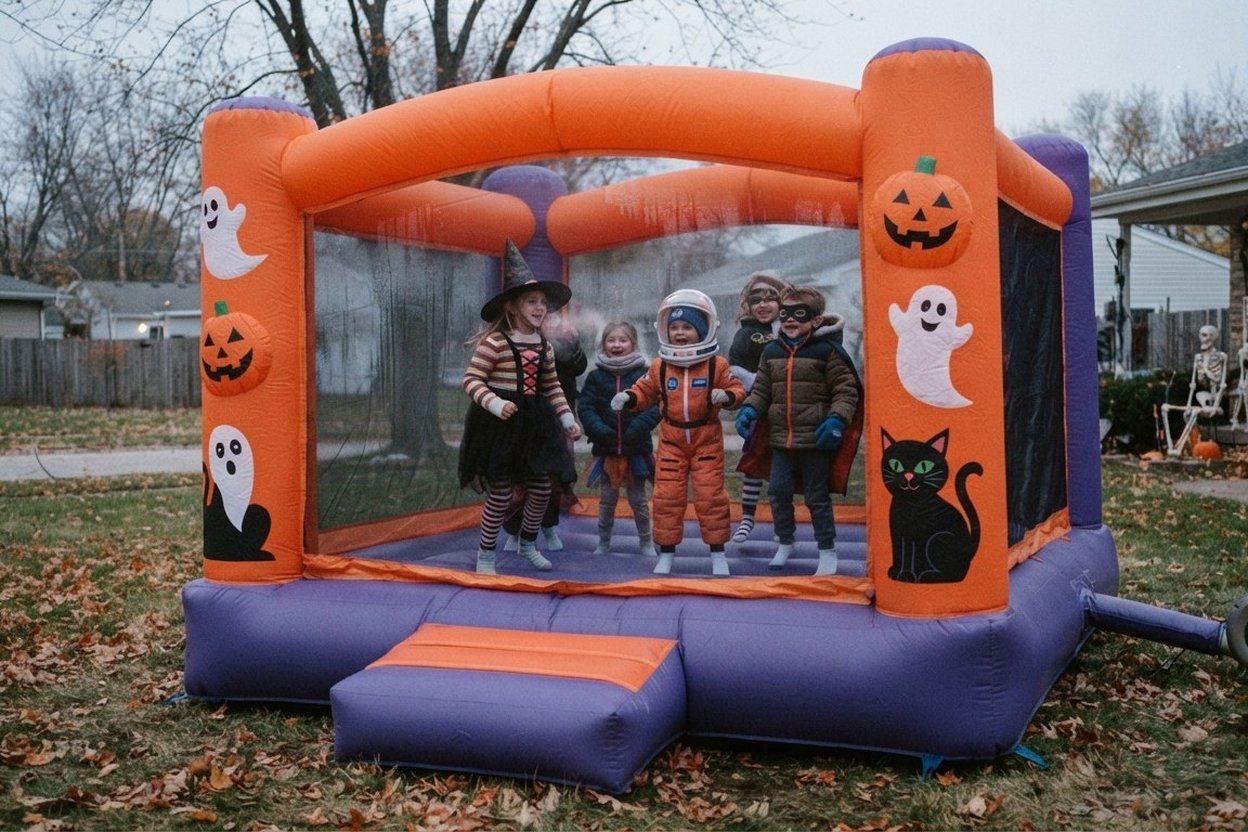
How cold is too cold for an outdoor bounce house on Halloween?
Most bounce house manuals set 40°F as the minimum. Learn the cold, wind, and wet-weather limits to check before your Halloween party.
When you’re planning an outdoor Halloween party, the forecast can turn a fun yard setup into a safety decision. For most bounce houses, 40°F is the manufacturer’s minimum operating temperature; follow the manual for your specific unit.
A 50-degree afternoon can still work if the unit’s instructions allow it and conditions stay dry and calm. Check the evening forecast as well as the daytime high, since temperatures can drop during trick-or-treat hours.
The short answer: 40°F is the line most manuals draw
Three manufacturer manuals set 40°F as the minimum operating temperature for their units. Pogo, EZ Inflatables, and MoonwalkUSA also direct operators to stop use in rain or when winds reach 15 mph. The 40°F threshold comes from manufacturers, not a nationwide temperature rule: no federal standard or state rule sets a cutoff. The Consumer Product Safety Commission (CPSC) advises commercial operators to follow the “use temperature range” in the owner’s manual without specifying a temperature of its own.
Some rental companies set their own minimum a little higher. Kicks and Giggles uses 42°F, while Jumping J’s sets its floor at 45°F. Those policies can affect whether your rental goes ahead, even when the temperature is above 40°F.
Check the manual or safety placard for the exact unit you plan to use, then confirm the rental company’s cancellation and operating rules. If the forecast drops below the unit’s stated minimum, follow that limit.
Why cold matters to the vinyl
As vinyl cools, it stiffens, and very low temperatures raise the risk of brittle material and cracked seams. Patriot Jumps in Louisiana and Jumping J’s in Virginia describe similar temperature bands: around 60°F and above, vinyl feels normal; in the 50s, it feels firmer; in the 40s, it feels stiff; and below about 40°F, it can turn brittle.
That change affects how the surface responds to movement. A party at 50°F can still be fun, with a firmer bounce than you might expect on a warmer day. Check the manufacturer’s minimum before inflating, and follow the rental company’s directions about setup and operation in cool weather.
What Halloween usually feels like where you live
Halloween temperatures vary widely across the United States, with normal October 31 lows ranging from about 30°F in Denver to 60°F in Phoenix. The National Centers for Environmental Information (NCEI) 1991–2020 daily normals show lows near 35°F in Minneapolis, 40°F in Chicago, 43°F in Boston, 44°F in Seattle, 49°F in Atlanta, and 51°F in Dallas. You can check the NCEI station normals for those locations.
Normal highs range from about 50°F in Minneapolis to 83°F in Phoenix. These are full-day climate normals, not an evening forecast for your party or a prediction for Halloween 2026. Check your local forecast during the week of the event, paying attention to the temperature expected at the hours children will use the bounce house.
Wind and wet are the bigger Halloween risks
Wind and wet conditions can rule out use even when the temperature meets the manual’s limit. The manuals cited above set a 15 mph wind limit and prohibit operation in rain; snow or a wet unit also means no jumping under those instructions.
The CPSC’s Beaufort-style guide describes conditions at 13–18 mph as winds that lift dust and loose paper and move small branches. A unit not built for winds above 15 mph should be evacuated and deflated when wind reaches that range. For residential backyard bounce houses, CPSC gives a separate 20 mph line in its inflatable amusement safety bulletin. Follow the limit for your specific unit, and take it down if wind reaches the applicable threshold.
Rain, snow, or a wet jumping surface calls for a pause under the manuals, even if the air temperature remains within range. Check conditions during the party and stop use when the surface becomes wet.
Keeping kids warm without breaking the rules
Warm layers help children stay comfortable while preserving the inflatable’s footwear rules. CPSC and MoonwalkUSA say shoes and glasses should come off before kids enter, leaving socks as the layer between their feet and the vinyl.
The American Academy of Pediatrics recommends several thin layers, plus a hat and mittens, for cold-weather play. Change wet clothes right away. The National Weather Service notes that wind-chill research was conducted on adults, so use extra caution when judging outdoor conditions for children.
A Louisiana rental company also suggests starting later in the day, choosing a sunny spot, and keeping an indoor home base available. Use those options to make breaks and warm-ups easy, while still following the unit’s temperature, wind, and wet-weather limits.
Why the rules exist
Inflatable safety rules address injuries linked to setup, operation, and supervision. CPSC estimated about 113,272 emergency-department-treated injuries involving inflatable amusements from 2003 to 2013, along with 12 reported deaths. CPSC staff said the incidents they reviewed were mostly associated with improper operation, supervision, and setup; the CPSC injury report provides the agency’s figures.
Use this quick go/no-go check before kids jump:
- Go only when the temperature meets the unit’s manual, conditions are dry, and wind stays below the applicable limit.
- No-go below the unit’s 40°F minimum, in rain, snow, or on a wet unit, or at 15 mph wind for units with that limit.
- For residential units, follow the CPSC 20 mph line and the specific manual’s directions.