Can You Put Christmas Lights on a Backyard Trampoline? Yes, If You Keep Them Off the Mat
Yes, a backyard trampoline can glow for the holidays. Learn where lights are safe on the frame and poles, which to buy, and how to attach them.
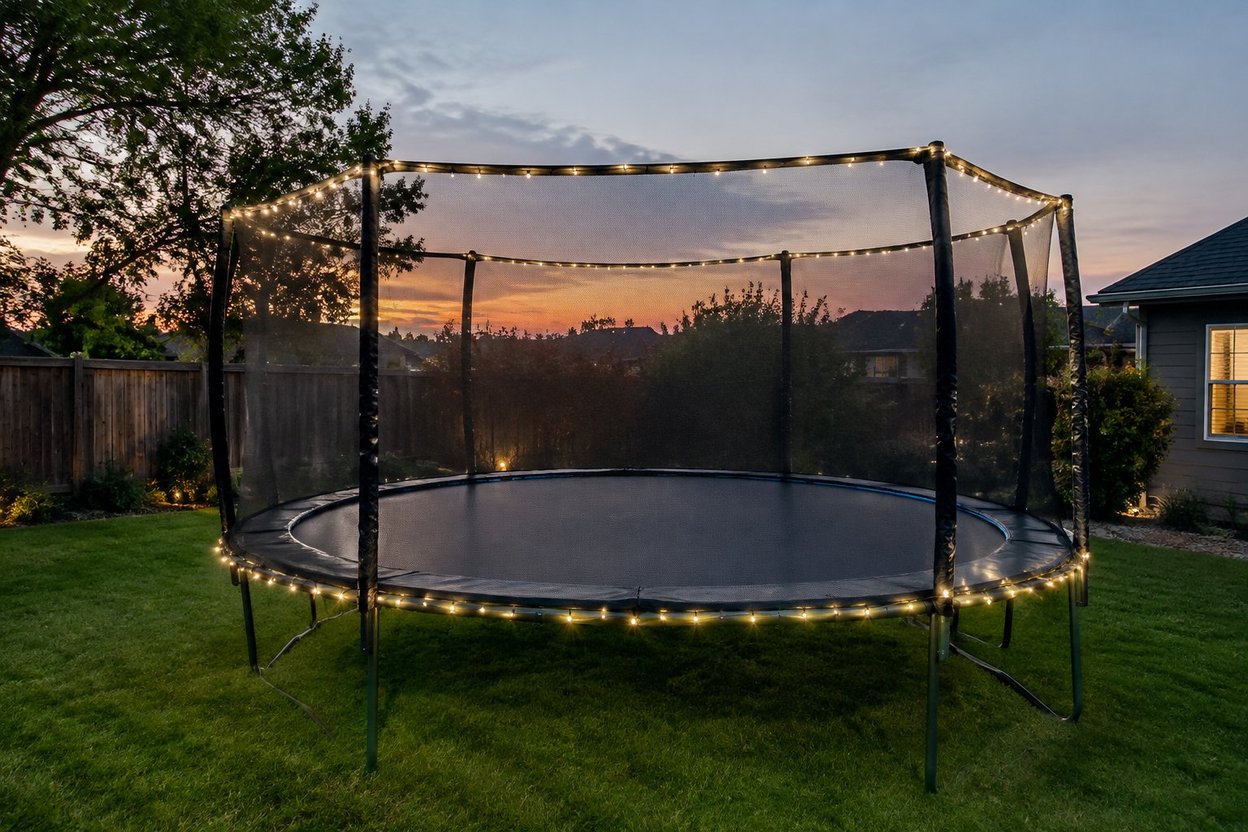
You're up on the ladder after Thanksgiving, clipping the last string of lights along the gutter, and you look down at the trampoline. It's the biggest thing in the yard and the only one still dark. Can it glow too? Yes, as long as you set some limits. Lights belong on the frame and the enclosure poles. They don't belong on the jumping mat or the springs. Pick lightweight strings rated for outdoor use, attach them with soft ties, and keep the usual trampoline safety rules in place while the yard is lit up.
The short answer
Lights on a trampoline are fine if they stay on the parts that don't move. That means the steel frame and the enclosure poles. The jumping mat, the springs and the joints where the springs hook into the frame flex hard on every bounce, so keep all lights and wiring away from them.
The light itself matters too. Trampoline seller Zupapa puts it simply: "Stick to battery-powered LED options to avoid hazards." Battery LEDs are light, they stay cool, and they keep you from running a cord across the lawn. Whatever you buy, it should be rated for outdoor use. Your trampoline will be sitting in rain, frost and possibly snow from late November into January.
Read your own trampoline's manual before you start. No safety standard or manufacturer rule covers holiday lights on trampolines, and most of the advice out there comes from trampoline sellers' guides. Your manual knows your net, poles and coating better than any general guide. Weight limits, supervision and one jumper at a time all still apply, lights or no lights.
Where lights go and where they don't
Good spots:
- The frame. Wrapping lights around the outer frame rail outlines the trampoline in a ring of light without getting near jumpers. Springfree, a trampoline maker, lists the frame as one of its main placement options.
- The enclosure poles. Acon24, a trampoline seller, recommends attaching lights to the frame and enclosure poles instead of directly to the net. Spiraling a string up each pole looks great from the house.
- Outside the net. Zupapa says garlands and ribbons can go around the outside of the safety net.
The risky spot: the net. The sources disagree here. Springfree lists the netting as an option. Acon24 warns against attaching lights directly to the net because they can damage it. A net is there to catch a jumper, and added weight can make it sag or tear it. That makes the net the riskiest place on the trampoline. If you decorate it anyway, Acon24 suggests using only lightweight LED or fairy lights and securing them at several pole points to spread the weight.
Never:
- The bounce area, springs and spring-to-frame connections. Acon24 says lights "should never interfere with the trampoline's bounce area." Springs stretch and snap back with every jump, and they will pinch and fray a wire.
- Hard decorations inside the enclosure. Zupapa advises against hanging hard decorations inside the trampoline. Anything a jumper can hit, kick or land on shouldn't be there.
Under the mat. Springfree mentions lights under the mat for in-ground trampolines and says they must be fastened so they "won't interfere with jumping." On an above-ground trampoline the mat drops low under a jumper's weight, so anything placed underneath has to sit well clear of that dip.
Which lights to buy
Once you know where the lights will go, choose strings that are light, waterproof and easy to power. The common options:
- Battery-powered LED strings and fairy lights. These are the first choice for the poles and frame. Acon24 lists battery fairy lights among its top options. Keep the battery packs in a waterproof pouch so rain doesn't reach the contacts.
- Solar lights. Springfree names LED and solar as the most common types. With solar there's no cord and no batteries to swap. Put the panel somewhere that gets daytime sun, which can be hard in December when the days are short.
- Waterproof LED strips. Acon24 suggests outdoor-rated, waterproof LED strips. They run neatly along a frame rail.
- Plug-in lights. Springfree notes that corded lights plug into a nearby outlet, often through an extension cord. If you go this way, Acon24 says to use an outdoor-rated extension cord and route it away from walkways. Kids running out to the trampoline after dark shouldn't have to step over a cable.
What to skip: heavy decorations, inflatables tied to the frame, glass ornaments, and anything with metal hooks or hard plastic parts that could end up near jumpers. Light and soft is the rule.
How to attach them
You don't need much gear. Springfree's list is zip ties or Velcro straps, a ladder for working around the netting, and a tape measure to figure out how many feet of lights you need.
- Test first. Turn the lights on while they're still on the ground. It's much easier to find a dead string before it's tied down. Springfree recommends testing the lights and checking that everything is secure.
- Fasten at even spacing. Space the ties evenly along each pole and the frame so the string doesn't droop in loops a hand could catch.
- Snug, not tight. Acon24 warns that wrapping lights too tightly can damage both the wire and the trampoline's protective coating. Velcro straps are gentler than zip ties if you're worried about that. If you do use zip ties, trim the tails flush so no sharp ends stick out.
- Mind the edges. Acon24 also says to avoid sharp edges, which can cut through wire insulation over a season of wind and freezing temperatures.
- Use the ladder for high spots. Don't climb the enclosure or lean on the net to reach the top of a pole.
- Don't weave lights through the net. Threading strings in and out of the mesh puts weight and wear on the net, and you'll have a hard time getting them out in January.
Electrical and holiday-fire safety
Battery LEDs carry little risk. Plug-in lights need the same care as any outdoor display. The U.S. Consumer Product Safety Commission's standard holiday advice covers the basics:
- Use lights that have been tested by a recognized testing laboratory and are labeled for outdoor use.
- Plug outdoor lights into GFCI-protected (ground-fault circuit interrupter) circuits.
- Connect no more than three standard-size light sets to one extension cord.
- Turn the lights off when you go to bed or leave the house. A timer makes this easy.
Decoration fires are rare, but they do happen. According to National Fire Protection Association data for 2017–2021, as reported by the NKyTribune, U.S. fire departments responded to an estimated average of 790 home fires a year that started with decorations other than Christmas trees. Those fires caused an average of 4 civilian deaths and 33 injuries a year. In 48 percent of them, the decoration was too close to a heat source. A trampoline in the middle of the yard is usually far from heat sources, which is one more reason cool-running LEDs are a good fit.
Keep the jumping safe
A lit-up trampoline invites people to jump on it, so the usual rules matter even more. The American Academy of Orthopaedic Surgeons (AAOS), citing CPSC data, says about 313,850 trampoline injuries were treated in emergency departments, doctors' offices and clinics in 2018.
- One jumper at a time. Both the AAOS and Zupapa say this.
- Adult supervision, and stay within the trampoline's weight limit.
- No kids under six on the trampoline, according to the AAOS.
- Don't rely on the net alone. The AAOS notes that most injuries happen on the mat, so a lit enclosure doesn't make jumping safer. Don't jump on a damaged net at all.
- Light the mat if anyone jumps at night. A string of fairy lights on the poles makes the trampoline look nice, but it may not light the mat well enough to see where you're landing. It's our view that night jumping only makes sense if the whole mat is clearly visible.
Acon24 suggests inspecting the lights every few weeks for frayed wires, loose ties or damaged bulbs, and turning them off when not in use. When the season ends, take everything down. That way ties and battery packs aren't left on the frame through spring, and the trampoline is clear for jumping again.
Sources (7)
- Acon24: Transform Your Trampoline, A Complete Guide to Adding Lights
- Zupapa: How to Set Up a Christmas-Themed Trampoline
- Springfree Trampoline: How to Put Lights on a Trampoline
- CPSC: Holiday Decoration Safety Tips for Avoiding Fires and Injuries (2002)
- CPSC: Safety Tips for the Holiday Season (1998)
- NKyTribune: NFPA holiday decoration fire data
- AAOS: Trampoline Safety