What is the weight limit for a tandem skydive, and what does the extra fee cover?
Most US tandem skydive weight limits fall between about 230 and 275 lb. Here's what the extra fee covers and how to check before booking.
You've found a dropzone, picked a date, and you're about to pay when you see the line about a weight limit. If you weigh close to or over 200 pounds, your next question is whether you're allowed to jump and how much more it will cost. There's no single national limit. Most US dropzones cap tandem students somewhere between about 230 and 275 lb. Many also add a fee once you're over roughly 200 lb. That fee usually pays for the instructor's extra work and risk and the extra wear on the gear. Here's how it works.
The short answer
Each dropzone sets its own weight limit, so the number changes depending on where you jump. These are some published limits as of October 2026:
- Skydive Perris (CA): 240 lb, with "no exceptions." Everyone is weighed on arrival.
- Skydive the Wasatch (UT): Instructors typically fly passengers up to 230 lb. Anyone over 200 lb "may also incur an additional fee."
- Long Island Skydiving Center (NY): Up to 250 lb if your height and weight are in proportion. There's a surcharge over 200 lb.
- Skydive Midwest (WI): 250 lb dressed, with no weight surcharge.
- Paradise Skydiving: 250 lb or less.
- Bay Area Skydiving (CA): Its fee tiers go up to 275 lb.
Two dropzones in the same state can have limits 20 or 30 pounds apart. The fees also range from nothing to a charge per pound. It helps to know where these numbers come from before you compare them.
Where the limit comes from
The limit starts with the equipment. A tandem parachute system has a gross weight rating, which is the most total weight it's built to carry. That total includes you, your instructor and all the gear.
United Parachute Technologies makes the Sigma and Vector tandem systems. It raised the gross weight rating from 450 lb to 500 lb for certain canopies. In its own breakdown, that 500 lb is about 50 lb of gear and 450 lb of people. Older rigs or other canopies may still carry the lower rating.
Skydive Midwest does the math for students. It says the system's limit is 500 lb of suspended weight for student, instructor and gear together. It estimates the gear at about 60 lb and instructors at 160 to 200 lb, which leaves roughly 230 to 250 lb for the student. Those are the dropzone's own estimates. A lighter instructor leaves a little more room, and a heavier one leaves less.
A dropzone can also set its cap below what the gear allows, and many settle somewhere around 230 to 260 lb. Paradise Skydiving says it looks at two things. The first is whether the parachute system can legally and safely carry your weight. The second is whether you're fit enough to land safely. A tandem landing often means lifting your legs and sliding in, which takes some core strength. That second question is why two dropzones using similar gear can still publish different limits.
What the extra fee covers
If the gear can carry you, why pay more? Dropzones usually give three reasons.
Long Island Skydiving Center explains it most directly. It says heavier jumpers open the parachute with more force, which wears out equipment faster. It also says instructors do more physical work on the exit, in freefall and on landing. The fee covers those costs and pays the instructor for the extra work and risk.
Dropzones price this in one of three ways:
- Tiered flat fees. You pay a set amount for each weight band, for example one fee for 201–224 lb and a higher fee for 225–249 lb.
- Per-pound fees. You pay a fixed amount for every pound over a set weight, so the fee grows a little with each pound.
- No fee. You either fit under the limit or you don't, and the price is the same either way.
One dropzone disagrees with the usual reasons. Skydive Midwest lists what other dropzones say the fee is for: instructor workload, safety, equipment wear and fuel. It agrees that instructors do work harder, but it calls the other reasons a way to make money. Keep in mind that this comes from a dropzone that doesn't charge the fee and is competing with those that do. It isn't neutral. Skydive Midwest also says some dropzones charge $50 to $100 extra and also lower the jump altitude, and that some don't tell you the fee until you arrive.
Example fees
Here's how four dropzones handle it, as of October 2026:
- Skydive Perris (CA): A flat $25 for anyone over 220 lb on its scale on jump day. The cap is 240 lb, and a standard tandem starts at $199.
- Bay Area Skydiving (CA): Tiered fees of $25 for 201–224 lb, $50 for 225–249 lb and $75 for 250–275 lb. A tandem costs $248 from 13,000 ft ($198 during its summer sale), $298 from 15,000 ft and $368 from 18,000 ft.
- Paradise Skydiving: $2 for every pound over 200 lb, with a cap of 250 lb. At 240 lb, that works out to $80. At the 250 lb cap, it's $100.
- Skydive Midwest (WI): No weight fee, with a cap of 250 lb dressed.
Compare the fee to the full price of the jump. A $25 fee on a $199 jump adds about 13 percent. An $80 per-pound fee adds a lot more. A 240 lb jumper would pay $25 extra at Perris, $50 at Bay Area, $80 at Paradise and nothing at Midwest. Skydive Perris's 240 lb cap leaves little room, though, so a jumper near that weight should check their weight on a scale before booking.
Beyond the scale
Weight is only part of the check. The harness has to fit you properly at any weight. Skydive Midwest says it has no set minimum weight but still requires a good harness fit. Skydive the Wasatch says people over 200 lb should be in good physical shape and proportionate in height and weight. It doesn't give a fixed ratio, and the instructor decides.
You'll be weighed at check-in, usually in what you're wearing. In the fall, a heavy hoodie, a jacket and boots can add a few pounds, so dress light. The weigh-in is usually private. Skydive Perris says its weigh-in is private and that its limits are for safety and comfort, not to exclude anyone. At Skydive Midwest, only staff can see the scale display.
If you're over the limit on the dropzone's scale, you can be turned away on jump day even if you've already booked. The number that counts is the one on their scale.
What to do before you book
Before you book, check the dropzone's own weight page or call them. Third-party listings and gift vouchers can be out of date. Ask four questions:
- What's the maximum weight?
- At what weight does the fee start?
- Is the fee a flat tier or charged per pound?
- Is it based on your scale at check-in, with clothes on?
Ask these before you pay a deposit. Skydive Perris, for example, takes a $50 booking deposit and charges a $50 fee for no-shows or late cancellations, and other dropzones have their own rules. If a tandem skydive is a holiday gift this year, ask these questions before buying it. Check the age rule too: at Skydive Perris, you must be 18 and bring a government photo ID.
Once you have the answers, you'll know whether you can jump and what it will cost before you get there.
Sources (9)
- Skydive Perris: Tandem FAQs
- Skydive Perris: First Jump Prices
- Skydive Midwest: Tandem Skydiving Weight Limit
- Skydive the Wasatch: Is there a weight limit to go skydiving?
- Long Island Skydiving Center: Skydiving Weight Limits and Fees
- United Parachute Technologies: Bulletins and Newsletters
- Wingstore: UPT tandem listing
- Paradise Skydiving: Weight Limits and Restrictions
- Bay Area Skydiving: Pricing
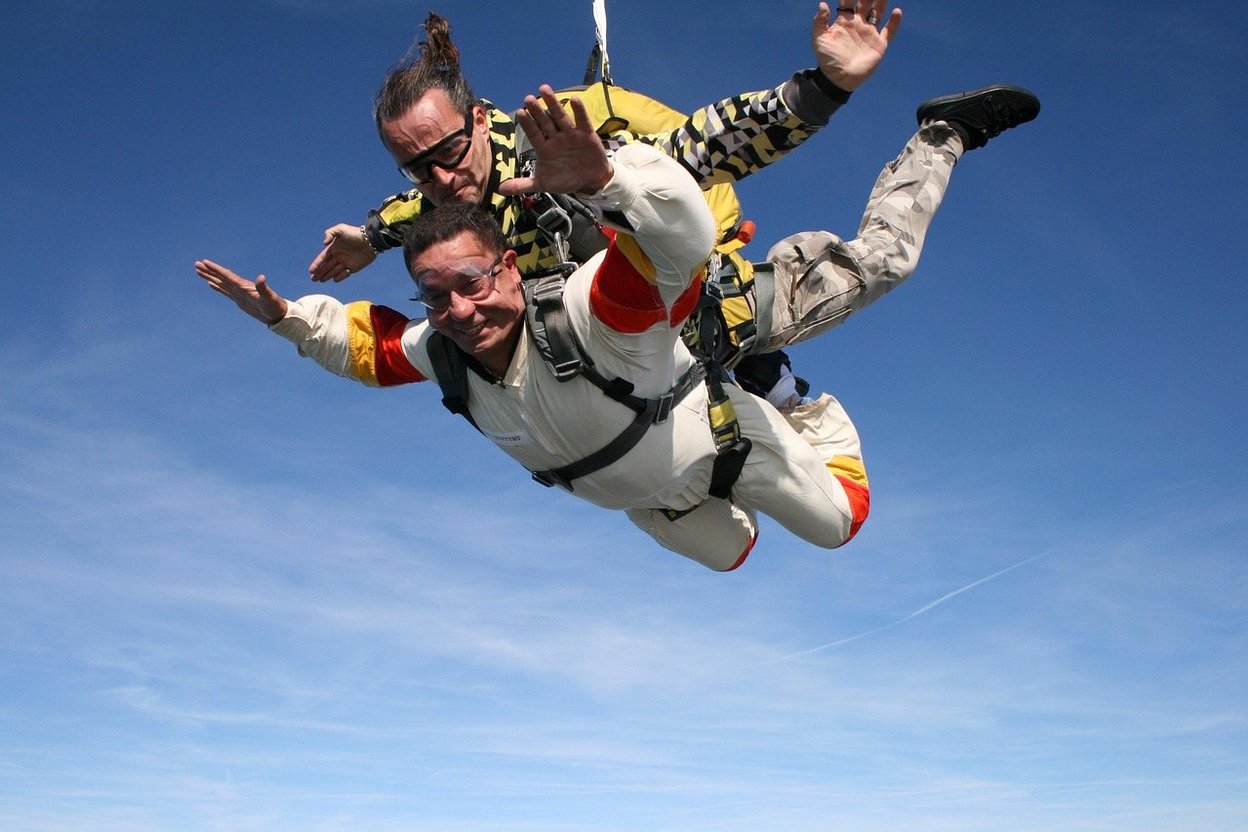
Photo by antonin77 on Pixabay.