Is BASE Jumping From a Building Legal in the United States?
Jumping off a building in the US is usually a trespassing crime, not a BASE jumping crime. Here's why permission matters and where jumps are legal.
You've probably seen the clip: a jumper runs off a skyscraper roof at night, the city lights spin, and a canopy opens just above the street. Then you wonder whether that's actually allowed. In the United States, mostly no, though not for the reason most people assume. No federal law bans BASE jumping as such. The trouble starts with getting onto the roof. Jumping from a building without the owner's permission is usually charged as trespassing, and sometimes as something more serious. Beyond that, the rules depend on the state, the city and who owns the land.
The short answer
BASE stands for Building, Antenna, Span (bridges) and Earth (cliffs), the four kinds of fixed objects people jump from. The US has no single national law that makes jumping from any of them a crime. When BASE jumpers get arrested after a building jump, the charge is almost always about where they were standing, not about the parachute.
A 2021 Virginia news report put it plainly: "Base jumping itself, while not recommended, is not illegal." The crime in that case was trespassing.
That doesn't make building jumps legal. In a city, nearly every tall building is private property with locked roof access. You can't legally reach the edge without permission, and owners almost never give it. On top of that, some cities and states add their own rules. San Francisco, according to a 2017 report, allows BASE jumping only with a specific permit. New York convicted jumpers on a BASE jumping count, as covered below.
Legal BASE jumping does exist in the US. It mostly happens from bridges and cliffs, with permission, and not from downtown towers.
Why buildings get people arrested
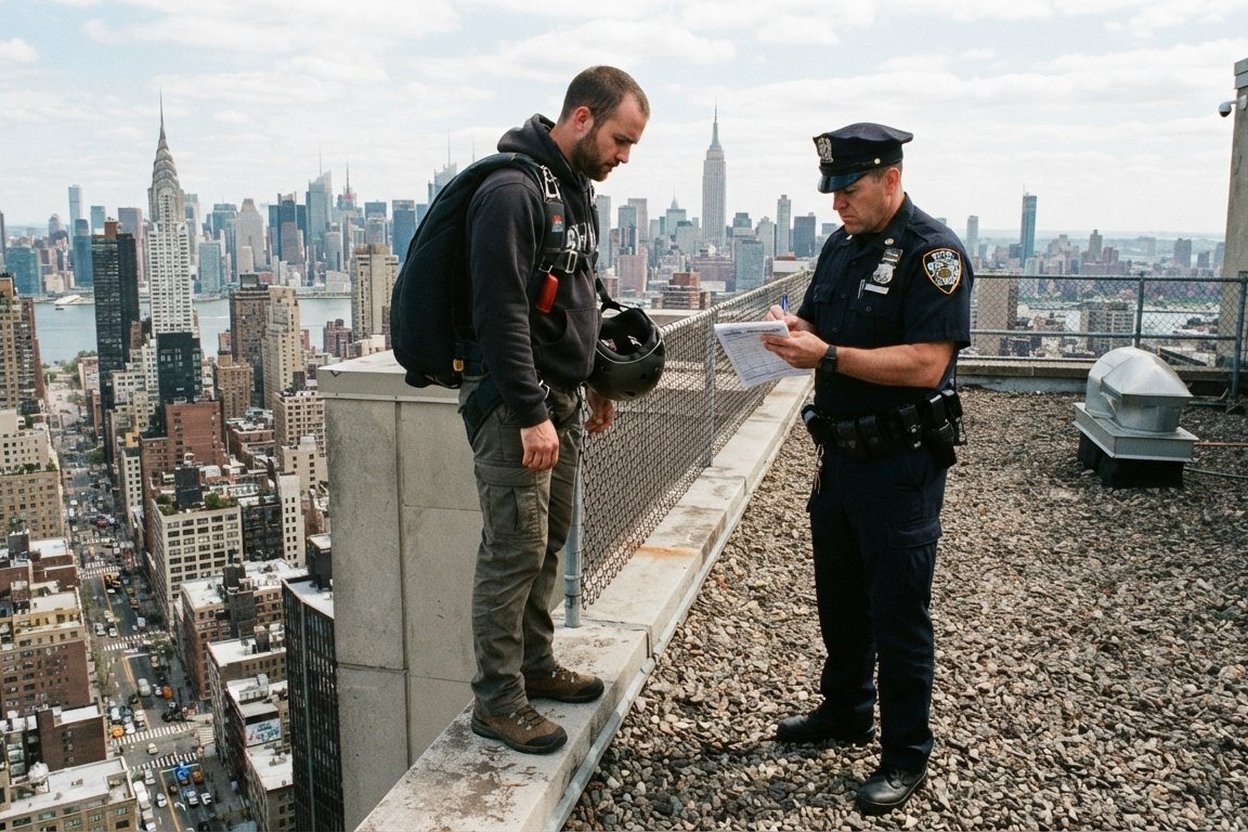
The main problem is roof access. To jump from a building you have to get to the top first. If you aren't a tenant, a worker or an invited guest, getting up there usually means walking past signs, through doors or onto a construction site where you have no right to be. That's trespassing, and in Virginia it's a misdemeanor.
Two cases show how this works in practice.
San Francisco Hilton, 2017. On February 21, 2017, two men aged 25 and 26 jumped from the 493-foot San Francisco Hilton. Police arrested them and charged them with trespassing and conspiracy. Police said the two didn't appear to be hotel guests, which is why the trespassing charge applied. The jump itself wasn't the charge. Being on the roof without permission was.
Northern Virginia, 2020–2021. In December 2021, police in Virginia arrested a 70-year-old man from Sterling on three trespassing charges. Two were for incidents in April 2020. The third was for an October 11 jump from a Capital One building that was still under construction. He disputed the charges, and news coverage said he believed police had the wrong man. That disagreement aside, the charges show what prosecutors used: trespassing again, not a BASE jumping law.
Construction sites come up again and again in these cases. Unfinished towers are tall, often less secure than occupied buildings, and very tempting to jumpers. That's what makes the next case the most famous one in the country.
The big case: One World Trade Center
At about 3 a.m. on September 30, 2013, three men got into One World Trade Center, which was still under construction, and climbed to the top. They jumped from the tallest building in the Western Hemisphere and landed in Lower Manhattan.
The video went viral after the men were identified, and charges followed in 2014. Prosecutors didn't stop at trespassing. In May 2014 the jumpers pleaded not guilty to trespassing and felony burglary. In New York, burglary generally means entering a building unlawfully with intent to commit a crime there, and it carries far more weight than a trespassing misdemeanor. The defense made a pointed argument: BASE jumping "by its very nature, is committed outside of a building." In other words, the crime prosecutors had in mind happened in the air, not inside the tower.
The jury agreed with the defense on the felony. In June 2015 all three men were acquitted of burglary and convicted only of misdemeanors, including reckless endangerment and BASE jumping.
The sentences were light compared with what prosecutors had asked for:
- James Brady: 250 hours of community service, a $2,000 fine and a conditional discharge
- Andrew Rossig: 200 hours of community service, a $2,000 fine and a conditional discharge
- Marko Markovich: sentenced separately at a later hearing
- Kyle Hartwell, the ground lookout: 100 hours of community service
Prosecutors had asked for at least 60 days in jail. Nobody got jail time.
The case shows two things. A prosecutor can reach for a serious charge when a building jump makes headlines. And a jury won't necessarily go along with it. Still, a misdemeanor record, a fine and hundreds of hours of community service is a real cost for one jump.
Where rules change: parks and local laws
Off private property, a different set of rules applies.
National parks. National Park Service rules ban "delivering or retrieving a person or object by parachute, helicopter, or other airborne means" except in emergencies or under a permit (36 CFR 2.17). For BASE jumpers, that means parachuting off a cliff in a national park without a permit breaks federal rules. Yosemite's famous walls are off-limits for exactly this reason. The rule is the clearest thing close to a federal ban on BASE jumping, and it applies only to park land.
State laws. New York goes further than most. The World Trade Center jumpers were convicted on a count specifically for BASE jumping, so New York law treats the jump itself as an offense, not just the trespassing that comes with it.
Cities. Local ordinances vary widely. San Francisco's permit requirement is one example. The 2017 report also said jumping is never allowed in densely populated areas there, but that comes from news coverage, not a quoted ordinance. If you're curious about a particular city, its municipal code is the place to check.
In practice, a building jump in a US city stacks several problems on top of each other: private property, local rules and, in some states, a law aimed at the jump itself. Legal BASE jumping happens somewhere else.
Where BASE jumping is legal
The legal options in the US are bridges, not buildings. Two stand out.
Bridge Day, West Virginia: Saturday, October 17, 2026. Once a year, the New River Gorge Bridge in Fayetteville closes to traffic and becomes, in the local tourism office's words, "the one day when BASE jumpers are legally allowed to leap off the New River Gorge Bridge." BASE jumping and rappelling start at 9 a.m., and the festival runs until 3 p.m. Admission is free for spectators. This year's Bridge Day is only days away, which makes this the right time of year to go watch. The jumpers are experienced BASE jumpers who sign up through the event organizers ahead of time. Anyone hoping to jump in a future year should check the official Bridge Day site for current requirements.
Perrine Bridge, Twin Falls, Idaho. The Perrine Bridge over the Snake River Canyon is described as the only place in the US where people can BASE jump without a permit, and it's open year-round. Years ago, a Twin Falls County sheriff's spokesperson told NBC News that deputies spent more time on lost snowmobilers than on BASE jumpers. Jumpers have died there over the years, though. Legal doesn't mean safe.
A safety note. BASE jumping is a separate sport from skydiving, not a harder version of the same thing. Jumps start much lower, there's little time to fix a problem, and the object you jumped from is right there next to you. Legal sites like Bridge Day are for jumpers with serious parachute experience, not first-timers.
If the video gave you the urge, start here instead:
- Tandem skydive. You're strapped to a licensed instructor at a dropzone, with full permission and proper equipment. It's the usual first step for anyone who might want to go further someday.
- Indoor skydiving. A vertical wind tunnel gives you the feeling of freefall with no airplane and no altitude.
- Watch a legal event. Bridge Day lets you see real BASE jumps up close, for free, on a fall weekend in the gorge.
For now, the skyscraper clip belongs on your screen and not on your to-do list.
Sources (10)
- Fox5 DC: Virginia grandpa arrested in a BASE jumping case says police have the wrong guy
- CBS SF: BASE jumpers arrested after leap from San Francisco Hilton
- CBS New York: WTC BASE jumpers sentenced to community service
- NBC News: World Trade Center jumpers plead not guilty to trespassing, burglary
- NBC New York: World Trade Center BASE jump sentencing
- Cornell LII: 36 CFR 2.17, Aircraft and air delivery
- Visit Fayetteville WV: Bridge Day 2026, everything you need to know
- KMVT: Perrine Bridge celebrates 50 years
- Atlas Obscura: I.B. Perrine Bridge
- NBC News: Twin Falls BASE jumping