Is a Mini Trampoline a Good Christmas Gift for an Older Adult?
Is a mini trampoline a good gift for an older adult? Learn what the studies show, who should skip it, and what to buy after a doctor's okay.
You're working on the holiday list, and your mom keeps saying she wants to "stay active," or your grandfather walks less than he used to. A mini trampoline with a handlebar starts to look like a fun, clever gift. It can be a good one, but only for the right person, with the right model and a doctor's okay first. Below is what the research shows, who should skip it, and what to check before you buy.
The short answer
Sometimes yes. A few small studies have looked at supervised mini-trampoline programs for older adults. One found real gains in balance, walking speed and fear of falling. Another found balance scores that rose a little but not by a meaningful amount. Neither study showed that a rebounder prevents falls, and that's the outcome that matters most at this age.
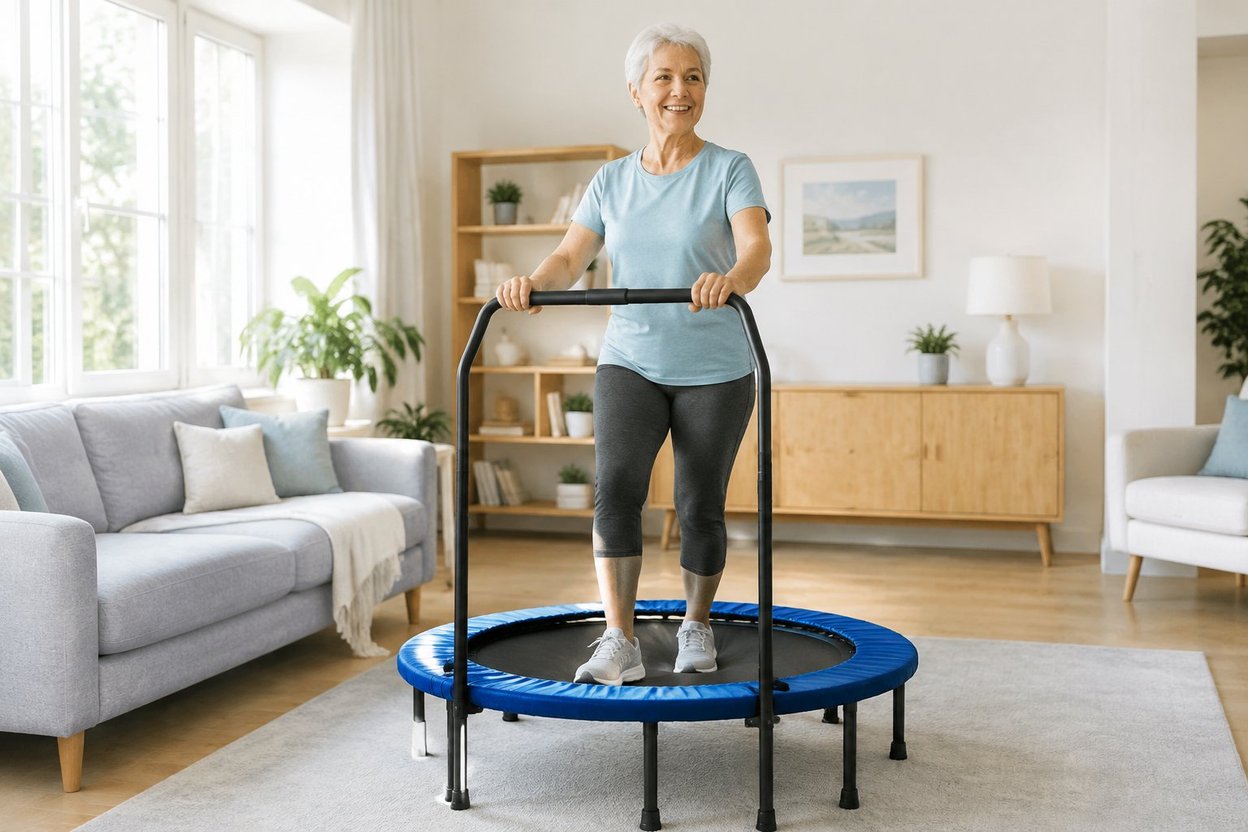
The risk is real too. Falls are the main reason older adults get hurt, and a bouncing surface is an odd place to practice balance if your balance is already shaky. So a rebounder makes sense as a gift for someone who already moves fairly well, who is cleared by a doctor, and who gets a model with a sturdy stability bar. It's a poor gift for someone who already feels unsteady on their feet.
If your relative fits the first group, a rebounder can be a low-impact, fun way to exercise indoors through the winter. If they fit the second, a physical therapist is likely the better "gift" (more on that below).
What the research says
The strongest study is a 2019 randomized trial in Clinical Interventions in Aging. It included 40 women with osteopenia (bone density below normal but not yet osteoporosis). Their average age was 68.5, and they ranged from 56 to 83. For 12 weeks, the trampoline group did a combined balance, strength and jumping program on mini trampolines, twice a week for 45 to 60 minutes per session. Compared with where they started:
- One-leg standing time improved about 33%
- Timed Up and Go (stand up, walk, turn, sit down) got about 19% faster
- Walking speed rose about 25%
- Fear-of-falling scores dropped about 15%
The control group didn't change significantly. No one was hurt during the exercise sessions, and the authors called the program "valuable and safe" for older adults. Bone density at the hip (femoral neck) rose about 2%, but spine density didn't change, and the authors said the bone results were too limited to draw firm conclusions.
They also listed the study's limits themselves: a small sample, no power analysis, short follow-up, and no adjustment for medications or other health conditions. They described it as a pilot.
A second study, from Western Kentucky University, followed 33 adults with an average age of 74.1 for 16 weeks. It compared a mini-trampoline group, a strength-and-balance group and a group that didn't exercise. The trampoline group's Berg Balance Scale score went from 52.2 to 54.3, but the change wasn't statistically significant (p = 0.52), and the groups didn't differ. The authors said more research is needed.
In short, the results are promising, but the studies were small, short and supervised. They measured balance tests, not actual falls.
Why falls matter
Fall risk is the reason this gift needs more thought than a sweater. According to the CDC, more than 14 million older adults fall each year, which is about 1 in 4 people 65 and older. Falls are also becoming more deadly. The CDC reports that the age-adjusted fall death rate among older adults rose 21%, from 64.7 per 100,000 in 2018 to 78.4 per 100,000 in 2024.
The National Safety Council, using National Center for Health Statistics data, reports 43,020 fall deaths among people 65 and older in 2024. It says fall deaths in this age group rose 51% over ten years.
That's why both parts of the question matter. Better balance is worth working toward, and a bad first bounce is worth avoiding. A rebounder that helps someone stay steady is a great gift. A rebounder that causes a fall in the living room is not.
Who should skip it or ask a doctor first
Anyone 65 or older should get a doctor's okay before starting rebounding. It's especially important if your relative:
- Gets dizzy or lightheaded, especially when standing up
- Has poor balance, has fallen in the past year, or uses a cane or walker
- Has osteoporosis or a history of fractures
- Takes five or more medicines. Johns Hopkins Medicine notes that fall risk rises with five or more medications, and says higher-risk people should talk to a doctor or physical therapist before starting new exercises.
Keep in mind who was in the studies. The volunteers could already exercise in a group program, and neither study tested people with serious balance problems. The results don't show what a rebounder would do for someone who is already unsteady.
For that person, a better gift could be a few sessions with a physical therapist. A PT can test balance, build a safe home routine and say whether a rebounder makes sense later. Mention it as part of the gift, not a replacement for it: "We'll get you set up with someone first, and the trampoline can wait."
What to buy
If the doctor says yes, the model matters a lot. Here's what to look for:
A stability bar. For an older adult, this isn't optional. Choose a bar that's sturdy and adjustable to a comfortable height. Know what it's for, though: it's a balance aid, not a hand-rail to lean on. ACON's own product pages say its handlebar "is not designed to support your entire weight." It's there to steady you, not to hold you up. If your relative would need to hang on with their full weight, that's a sign the rebounder isn't the right fit yet.
Bungee or spring. Bungee-cord rebounders are generally described as softer and quieter than spring models, though that comes from product reviews, not testing. A gentler bounce is usually easier on joints and less jarring for a beginner.
Weight limit. Check the user's weight against the listed limit and leave some headroom. Limits vary a lot. JumpSport's 39-inch models range from 250 to 300 lb, and its 48-inch model goes to 425 lb. ACON lists 300 lb for its 55-inch hexagon model.
Size and stability. A wider frame gives more room for small, controlled steps. Make sure there's space around it and a clear path on and off.
Price examples (as of October 2026):
- JumpSport fitness trampolines start at $279 for 39-inch models and go up to $649 for the 48-inch PRO. Handlebars are sold separately as an accessory, so add that to the budget.
- ACON's 55-inch hexagon rebounder with a balance handlebar and bungee suspension is listed at $499 (regularly $558).
- Bellicon rebounders run from about $500 to over $800, according to one roundup. Check Bellicon's own site for current prices.
Skip the cheapest no-name rebounders without a bar. For this person, saving money isn't worth giving up stability.
Gift-giving tips and alternatives
A few things make this gift go better:
- Pair it with a doctor visit. Wrap a card that says the rebounder comes with a check-up first. If you're seeing family at Thanksgiving on November 26, that's a natural time to bring it up before you buy.
- Offer to set it up. Build it, set the bar height and do the first session together.
- Start small. Begin with a few minutes at a time, with both feet on the mat, using gentle "health bounces" and marching in place before any real jumping. Add time slowly.
If your relative says no, take that seriously. Many older adults know their own balance better than anyone. Good alternatives include a balance or tai chi class, physical therapy sessions, walking shoes with good grip, or home safety upgrades like grab bars and better lighting. The goal is to help them stay steady, and a trampoline is only one way to get there.
Sources (10)
- Effectiveness of a Mini-Trampoline Training Program on Balance and Functional Mobility (Dovepress, Clinical Interventions in Aging)
- Western Kentucky University, International Journal of Exercise Science abstracts, vol. 8, iss. 4
- CDC: Older Adult Falls Data
- National Safety Council Injury Facts: Older Adult Falls
- Johns Hopkins Medicine: Fall Prevention Exercises
- ACON Fit 1.41m Hexagon Rebounder with Balance Handlebar
- ACON Fit 55in Hexagon Rebounder with Balance Handlebar (US)
- JumpSport Fitness Trampolines
- The Wearify: Best Rebounder for Seniors
- Cleveland Heart: rebounder roundup