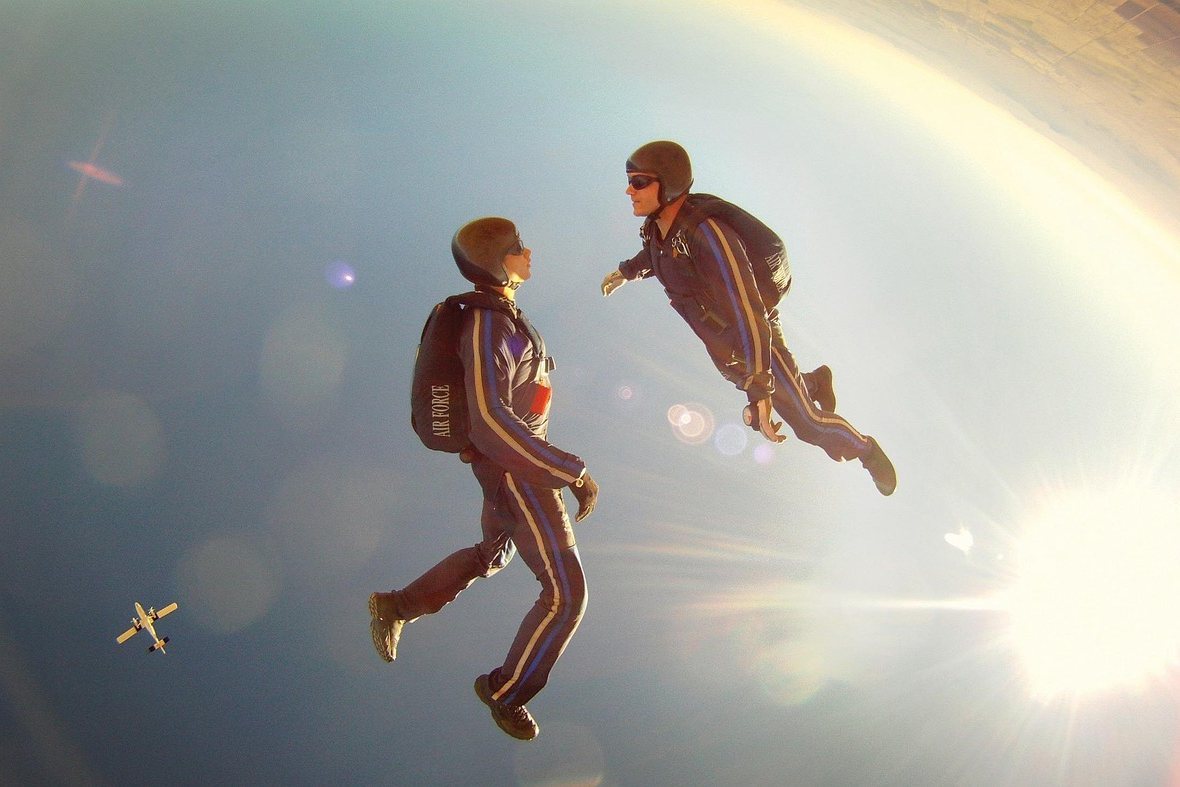
Why Skydiving is a Bucket List Must
Experience the thrill of a lifetime with skydiving. Gain a unique perspective, overcome fear, and feel an immense sense of accomplishment. Find out more!
Skydiving earns its spot on a bucket list because it is a once-in-a-lifetime feeling you can actually book for this weekend. A first-time tandem jump takes one morning, about 30 minutes of training and a few hundred dollars. You get roughly a minute of freefall at about 120 mph, then several quiet minutes under an open parachute. If you are 18 or older, within the dropzone’s weight limit and in reasonable health, you can almost certainly go.
Here is what the day is really like, what it costs, how safe it is, and how to pick where to jump.
What a tandem skydive is
On a tandem, you wear a harness that clips to an instructor’s harness, and you share one large parachute system built for two. The instructor handles everything that matters: the exit, the altitude checks, opening the parachute, steering and landing. You need to hold a body position and follow a few signals.
That instructor has a lot of experience behind them. To attend a USPA tandem instructor course, a skydiver needs a D license (the top license), at least 500 jumps, at least three years in the sport and an FAA Class 3 medical certificate, plus training on the specific tandem equipment they will use.
The gear has backups. Every tandem system carries a reserve parachute, and an automatic activation device (AAD) that opens the reserve by itself if the pair is still falling fast at a set low altitude. Right after exit, the instructor throws a small drogue parachute. It keeps the pair stable belly-down and slows them to about 120 mph. Without it, two people strapped together would fall closer to 200 mph.
How the day goes
- Check-in and waiver. You sign a long liability waiver and confirm your weight. Bring a photo ID.
- Training. USPA says tandem training is generally under 30 minutes. It often happens while you are being fitted into the harness.
- Waiting. This is most of the day. Loads go up in order, and wind or clouds can put everything on hold. Skydive Perris in California tells tandem customers to plan on two to four hours.
- The plane ride. The climb to altitude is the longest quiet stretch of the day. Near the top, your instructor tightens the harness and checks the gear.
- Exit and freefall. The door opens, the noise jumps, and you go.
- Canopy ride. The parachute opens, the roar stops, and you have several minutes to look around.
- Landing. You lift your legs and the instructor lands the two of you, usually by sliding in on the instructor’s feet or on your seat.
How high, and how long you fall
Dropzones advertise altitude in different ways, and it changes how much freefall you get. Altitude above sea level (MSL) is not the same as altitude above the ground (AGL).
Skydive Perris is a good example. It sells its standard tandem from “14,000 feet”, which is above sea level; the ground there is about 1,500 feet up, so you actually exit at 12,500 feet above the ground. That gets you about 60 seconds of freefall. Its high-altitude tandem goes to 18,000 feet MSL (16,500 above the ground) for about 90 seconds, and you breathe supplemental oxygen on the way up, because USPA rules require oxygen on the plane for jumps above 15,000 feet MSL.
USPA’s own figure for first-jump freefall is 30 to 60 seconds, depending on exit altitude. Under USPA rules, a tandem parachute must be opening by 5,000 feet above the ground, so the rest of the descent is under canopy. Skydive Perris puts that part at 5 to 10 minutes.
When you compare dropzones, ask: “Is that altitude above the ground or above sea level?” At a dropzone near sea level the two are about the same. At one on a high plain, they can differ by thousands of feet.
What it actually feels like
No stomach drop. This surprises most people. You leave a plane already flying forward at around 100 mph, so the wind holds you up as you speed up to 120 mph. Dropzones describe it as feeling more like floating on a strong wind than falling. It is very different from a roller coaster dropping off a hill.
Loud. Freefall is a wall of wind noise. You will not hear your instructor shout. That is why they use taps and hand signals.
Cold. In standard conditions, air gets about 3.5°F colder for every 1,000 feet you climb. At 12,500 feet above the ground, expect it to be roughly 40°F colder than it is at the airport. On a 90°F summer day that is comfortable. In spring or fall, dress in layers.
You can breathe. It feels like putting your head out of a car window at highway speed. Many first-timers tense up or hold their breath without noticing. Yelling or just breathing out on purpose helps.
Then, quiet. When the parachute opens, you go from about 120 mph to a gentle glide in a few seconds. Many people say this is the part they remember most: the view of the horizon, the silence, and often a chance to steer if your instructor offers you the toggles.
Your job in the air
Your part is small, but it does make the jump smoother and safer. This is what tandem students are taught at USPA dropzones:
- In the door: hands on your harness, head back against the instructor’s shoulder, hips pushed forward. Bend your knees and bring your feet back toward the sky.
- In freefall: hold an arch, like a banana shape with your belly lowest. Hips forward, head up, legs bent with your feet back. Arch your back hard right at exit.
- On the tap: when the instructor taps your shoulder, let go of the harness and put your arms out in the arch.
- Before landing: when the instructor tells you, a few seconds before touchdown, lift your knees and hold your legs up and out in front of you. Keep them up until you have stopped. Ankles are the most common landing injury, and feet down too early is the easy way to get one.
Listen to your own instructor over anything you read here. Systems and signals differ a little between dropzones.
Who can go
- Age: 18 is the minimum. USPA removed the parental-consent option for 16- and 17-year-olds in 2014, and US tandem equipment makers also require 18. USPA sets no upper age limit; ask the dropzone about its own rules.
- Weight: each dropzone sets its own limit. Skydive Perris caps tandems at 240 pounds and adds a $25 fee over 220. Other dropzones set their own numbers. This is the most common reason people get turned away, so ask before you book and give your real weight.
- Health: Skydive Perris lists ear or sinus problems, seizure disorders, diabetes, fainting spells, heart issues, prior shoulder dislocation, and neck or back pain as conditions that may disqualify you or need a doctor’s note. Other dropzones screen for similar things. If you have any of these, call first.
What it costs
USPA does not publish prices and says to contact your local dropzone. As a rough guide, Skydive Midwest’s 2026 price guide puts the average US tandem at $250 to $300. Prices run higher on the coasts and near big cities, and higher-altitude jumps cost more.
Photos and video usually cost extra. At Skydive Midwest the video packages run $99 to $189. Decide before the jump, because you cannot add it afterward.
How safe is it?
Skydiving is not risk-free, and the dropzone waiver will say so in plain terms. But the numbers are lower than most people expect.
In 2025, USPA members made about 3.47 million jumps, and there were 16 civilian skydiving deaths in the US. That is 0.46 deaths per 100,000 jumps, or about one for every 217,000 jumps. Over 2015 to 2025, the yearly rate stayed between 0.23 and 0.81 per 100,000. The annual death count peaked in the late 1970s and has been falling slowly since.
Those totals cover every kind of jump, from first-timers to very experienced skydivers. Tandem students are flying with an instructor with hundreds or thousands of jumps, on gear with a reserve and an AAD.
The most common injury is more ordinary. USPA’s 2025 survey found 5.6% of members had an injury needing medical treatment that year, most often ankles hurt on landing. For a tandem student, the main thing you control is keeping your legs up for landing.
USPA’s safety FAQ has the full figures.
If you are scared
Almost everyone is. Being scared does not mean you should not go; instructors deal with nervous first-timers all day. Some things that help:
- Book an early slot. The schedule tends to slip as the day goes on, and less waiting means less time to stew.
- Eat a light meal and drink water. Skipping breakfast because you are nervous makes it worse.
- Watch a few other loads land first. Seeing tandem pairs come down and walk away calmly helps.
- Tell your instructor you are nervous. They will talk you through each step and check in more often.
You can also back out. A good dropzone will not pressure you, though you may lose your deposit. Read the refund policy before you book.
After the first one
For a lot of people one tandem is the whole goal, and that is fine. If you want more, the next step is learning to jump on your own. USPA lists Accelerated Freefall (AFF), where you wear your own parachute and jump with two instructors who are not attached to you, after several hours of ground school. That path leads to a USPA A license, which lets you jump without supervision.
Before you book
- Find a dropzone with USPA’s Find a Drop Zone tool. USPA Group Member dropzones pledge to follow USPA safety requirements and use current USPA-rated instructors.
- Confirm the weight limit and any health questions by phone.
- Ask whether the advertised altitude is above ground or above sea level.
- Ask what happens if weather cancels your jump: rescheduling, refunds and how long deposits stay valid.
- Decide on video before the day.
- Wear closed-toe lace-up shoes and close-fitting athletic clothes, bring layers and ID, and plan on most of a morning or afternoon.
Photo by 12019 on Pixabay.