2026 World Trampoline Championships: Dates, Events and How to Watch
Nov. 4–8, 2026 in Nanjing: the event schedule, what each discipline is, how to watch from the U.S., and U.S. start times.
Halloween is over, the clocks have fallen back, and the backyard trampoline is getting its last bounces before winter covers. In the same week, the best trampolinists in the world compete in China. The 39th Trampoline & Tumbling World Championships run November 4–8, 2026, at the Nanjing Yangzi River International Conference Center. Finals get live TV production. A U.S. streaming home hasn't been officially confirmed, though one club says finals will be on Peacock. Because Nanjing is 13 hours ahead of Eastern time, many sessions land overnight or early in the morning for U.S. viewers.
The quick answer (as of October 24, 2026)
- Senior World Championships: November 4–8, 2026, Nanjing, China
- Venue: Nanjing Yangzi River International Conference Center, No. 299 Binjiang Avenue, Jiangbei New Area, Nanjing
- Disciplines: trampoline (individual and synchronized, including mixed synchro), tumbling and double mini, with team finals in each, plus an all-around team final
- Junior Worlds and World Age Group Competitions: the following week, November 12–15, at the same venue
- U.S. viewing: finals are guaranteed live production. Peacock is reported by a U.S. club but not confirmed by a broadcaster. Qualification streaming is listed as TBD
November 4 or November 5?
Some listings, including Wikipedia and an older USA Gymnastics calendar, give the dates as November 5–8. The current World Gymnastics (FIG) event page and USA Gymnastics event page both say November 4–8. The official provisional work plan settles it: November 4 is a competition day, not a travel or training day. Mixed synchro qualifications, men's tumbling qualifications and women's double-mini qualifications all start that day. If you follow qualifying rounds, start on the 4th.
Three championships, two weeks
Nanjing hosts three separate competitions, so the date you need depends on who you're following.
- Senior World Championships, November 4–8. These are the world titles.
- Junior World Championships, November 12–15. USA Gymnastics defines Junior Worlds as ages 15–16.
- World Age Group Competitions, November 12–15. These cover ages 13–14 and 17–21, also at the Nanjing conference center.
If your child's teammate, a local club athlete or a family friend is going, check which event they're in. Answers about senior streaming won't cover the second week.
The events, explained for backyard bouncers
FIG lists three championship disciplines, and the program splits them into more medal events than most quick guides mention.
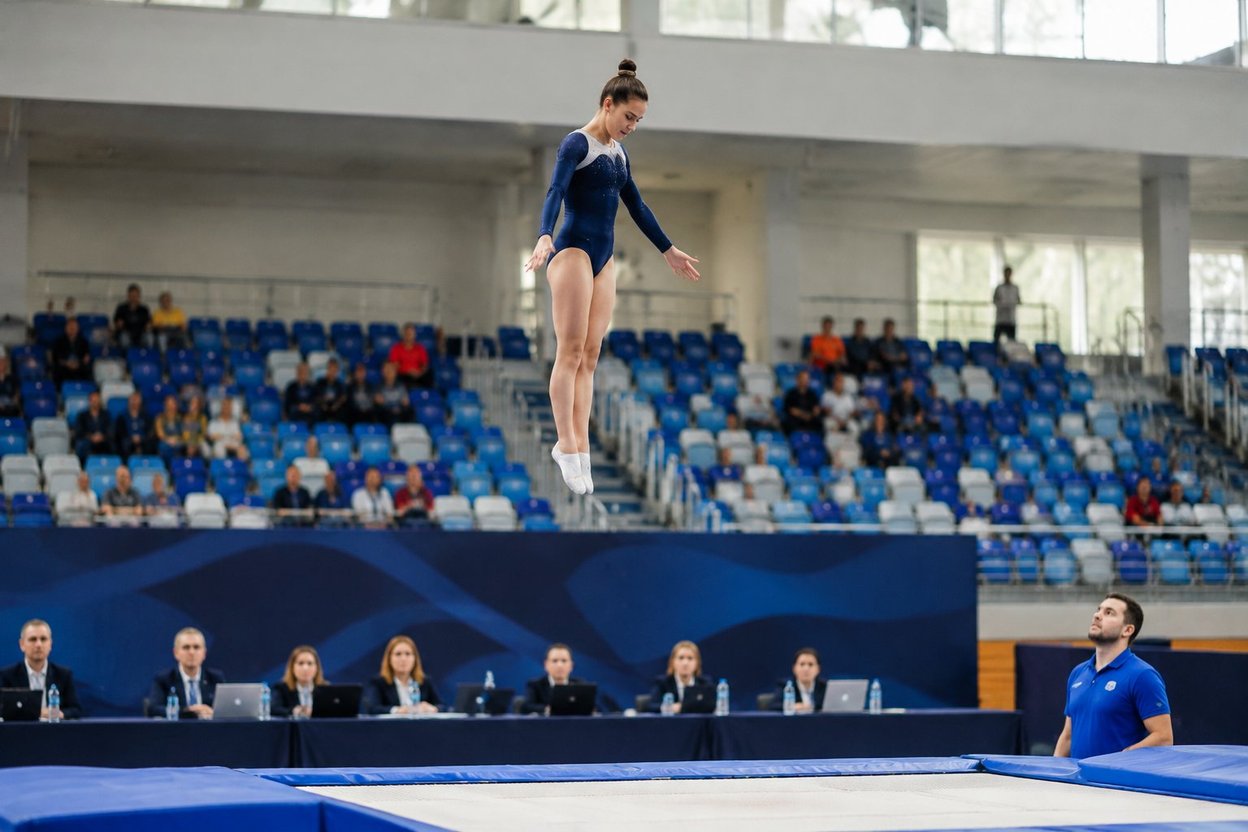
- Individual trampoline: the event you've seen at the Olympics. Athletes do 10-skill routines of twisting, flipping somersaults on a big competition bed, scored on execution, difficulty, time of flight and horizontal displacement (how far they drift from the center of the bed).
- Synchronized trampoline: two athletes on side-by-side trampolines doing the same routine at the same moment. There are men's and women's events, and the 2026 work plan also includes mixed synchro, with one man and one woman.
- Tumbling: fast, explosive passes of flips and twists down a long, springy runway.
- Double mini: a run-up, a skill on a small two-level trampoline, then a skill onto a landing mat. It works a bit like vaulting, only with flips.
- Team events: separate team finals in trampoline, tumbling and double mini, plus an all-around team final on the last day.
A safety note for home trampolines: these athletes train on competition equipment, with coaches and spotting setups. Multi-flip skills don't belong on a backyard trampoline. Keep to one jumper at a time, use the safety net and pads, stay under the manufacturer's weight limit, and always have an adult watching.
Provisional day-by-day program
This comes from the official provisional work plan dated September 29. FIG has since posted a newer training and competition schedule (updated October 20), so check exact session times against that document on the FIG event page before you set an alarm.
- Wednesday, November 4: qualifications start with mixed synchro, men's tumbling and women's double mini
- November 5: more qualifying rounds
- Friday, November 6: tumbling and double-mini team finals
- Saturday, November 7: individual tumbling final, individual double-mini final, mixed synchro final and trampoline team final
- Sunday, November 8: men's and women's synchro finals, individual trampoline finals and the all-around team final
If you only have time for one session, make it Sunday. It has the individual trampoline finals and both synchro finals.
How to watch from the U.S.
The broadcast picture is still settling, so here's what's confirmed and what isn't:
- Finals: the official work plan guarantees live TV production of finals but doesn't name a U.S. distributor. Panhandle Perfection Gymnastics' October meet itinerary says finals will stream on Peacock. That's a club announcement, not word from the broadcaster, so check Peacock's listings or USA Gymnastics channels closer to November 4.
- Qualifications: the same club itinerary lists qualification streaming as TBD.
- Replays and pricing: not confirmed yet. World Gymnastics runs its own streaming platform, World Gymnastics TV, with a page for this event. Check it for availability and access in your region.
- Stick to official links. The work plan restricts spectators from sharing footage publicly, so social media re-posts may not last. Authorized streams are the reliable option.
U.S. start times: do the math once
Nanjing runs on China Standard Time (UTC+8) all year. U.S. daylight saving time ends at 2 a.m. on Sunday, November 1, so by the time competition starts, the whole country is on standard time:
- Eastern (EST): Nanjing is 13 hours ahead
- Central (CST): 14 hours ahead
- Mountain (MST): 15 hours ahead
- Pacific (PST): 16 hours ahead
Some circulating notes say China is 13 hours ahead of Central time. That's wrong: it's 14. Here's how it plays out:
- An evening final at 7 p.m. in Nanjing is 6 a.m. Eastern, 5 a.m. Central, 4 a.m. Mountain and 3 a.m. Pacific, all on the same calendar day.
- A morning session at 10 a.m. in Nanjing is 9 p.m. Eastern, 8 p.m. Central, 7 p.m. Mountain and 6 p.m. Pacific on the previous day.
So a Sunday, November 8 morning session in Nanjing actually starts on Saturday evening, November 7, in the U.S. Use the October 20 schedule from FIG for real session times, then subtract.
Team USA: who to watch
USA Gymnastics named 24 senior athletes on August 13. Counting juniors and age-group athletes, the full U.S. delegation is close to 100. These names give you a reason to set an alarm:
- Ruben Padilla, double mini: the three-time defending individual double-mini world champion. He's going for a fourth straight title.
- Kaden Brown, tumbling: a three-time World Championships medalist in individual tumbling, who won his seventh straight U.S. men's tumbling title in Tulsa on June 27, 2026.
- Aliaksei Shostak, trampoline: the 2026 U.S. men's trampoline champion with 58.940. He and Padilla won men's synchronized silver at the Riccione World Cup in October with 53.040, which makes them a pair to watch in Sunday's synchro final.
- Leah Garafalo, trampoline: the 2026 U.S. women's trampoline champion with 54.040.
Rosters can change. The current USA Gymnastics event page lists Kate Arakawa among the trampoline participants, though the August announcement marked her as a non-traveling replacement. Check the final start lists before you cheer for a name.
Azerbaijan: a team that's climbing
The Azerbaijan Gymnastics Federation has had a strong year in trampoline and tumbling, and its results show why the team is worth watching in Nanjing:
- At the European Championships in Portimão, Portugal, in April, Azerbaijan sent 23 gymnasts. Its tumbling team won silver, and its senior trampoline team finished fourth in the final. That was the first time Azerbaijan reached team trampoline finals in both junior and senior categories.
- At the World Cup final in Portugal in July, Mikhail Malkin won tumbling gold with 32.300 and Tofig Aliyev took bronze with 29.300. Magsud Mahsudov and Huseyn Abbasov won men's synchronized trampoline bronze, and Mahsudov placed seventh in individual trampoline with 61.440.
Tumbling and men's synchro are where Azerbaijan has been winning medals this season, so those are its best chances. Check the official entries for its final Nanjing roster.
The cost behind the second week
Not every athlete in Nanjing is chasing a senior medal, and the trip costs real money. One U.S. age-group family, raising money for Leighton Hester's trip to the World Age Group Competitions, estimates $9,635 for his trip plus family travel. That includes a $3,315 athlete travel package, a $195 competition entry fee and $515 of required Team USA apparel. That's one household's estimate, not a standard figure for every athlete. Still, it's a reminder that many of the jumpers you'll see in week two have families paying out of pocket to get them there.
Your watch checklist
- Download the latest schedule (updated October 20) from the FIG event page.
- Convert session times using the offsets above, and note when a session falls on the previous U.S. day.
- Look for an official Peacock or USA Gymnastics announcement about finals before November 4.
- Check World Gymnastics TV for qualifications and replays.
- If you're following a junior or age-group athlete, the dates are November 12–15.
The championships end Sunday, November 8, which leaves a little over two weeks before Thanksgiving. That's plenty of time to talk about who stuck the landing.
Last updated October 24, 2026. Session times and U.S. broadcast details will be updated once they're officially confirmed.
Sources (18)
- World Gymnastics (FIG): 39th Trampoline & Tumbling World Championships event page
- FIG: Official venue information
- FIG: Provisional work plan (September 29)
- USA Gymnastics: 2026 T&T World Championships event page
- USA Gymnastics: 2026 T&T Junior World Championships
- USA Gymnastics: 2026 T&T World Age Group Competitions
- USA Gymnastics: 2026 WAGC selection procedures (PDF)
- USA Gymnastics: Rosters announced for 2026 Worlds and WAGC
- USA Gymnastics: 2026 USA Gymnastics Championships recap
- USA Gymnastics: Riccione World Cup recap
- Panhandle Perfection Gymnastics: World Championships meet information
- World Gymnastics TV: 2026 Trampoline event page
- timeanddate.com: Nanjing time zone
- NIST: Daylight saving time
- Wikipedia: 2026 Trampoline Gymnastics World Championships
- AzerNEWS: National gymnasts claim medals at Trampoline and Tumbling World Cup
- Azerbaijan Gymnastics Federation: Portimão European Championships report
- GiveSendGo: Leighton's Road to China