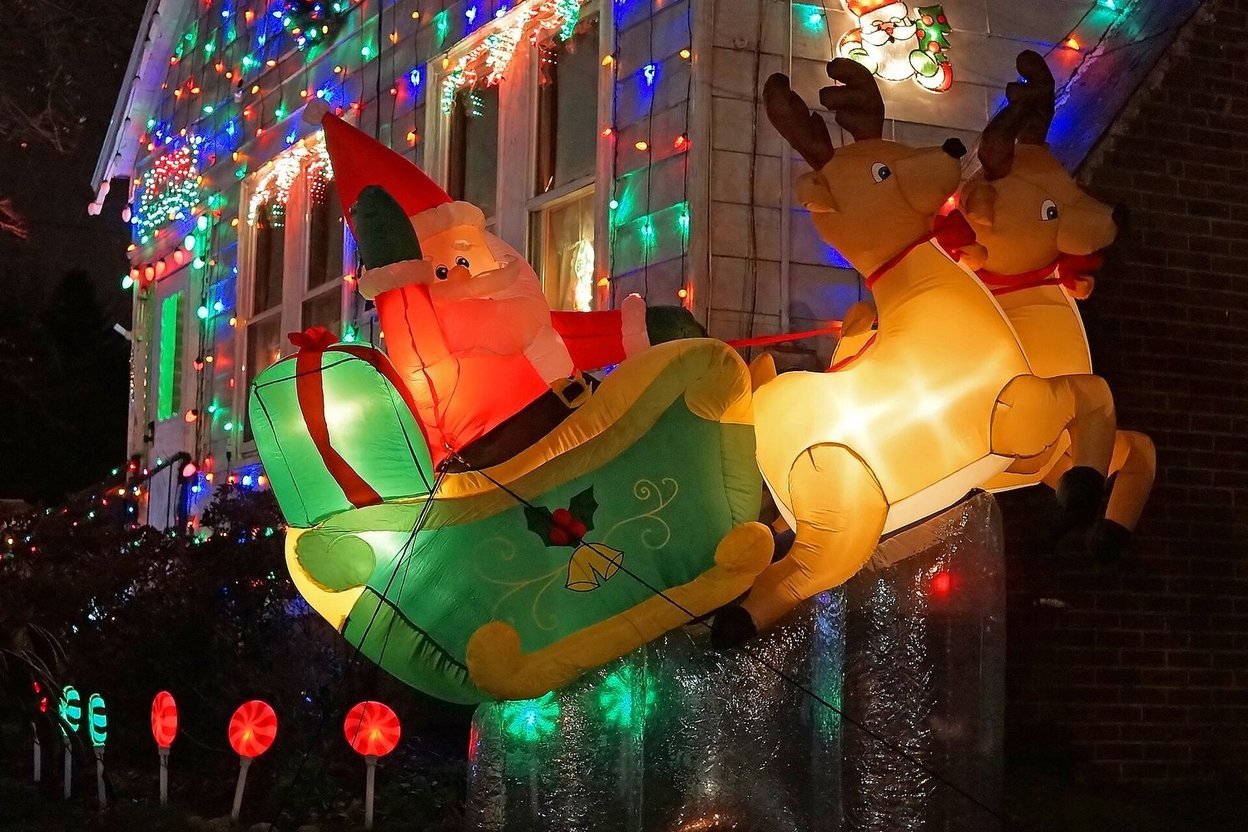
Can a bounce house share a circuit with Christmas inflatables?
Usually, no. Learn why a bounce house blower needs its own breaker, how to estimate the load of holiday inflatables, and how to check your outlets and cords.
The birthday party is Saturday, the bounce house is unrolled on the lawn, and the inflatable pumpkin (or the early Santa) is already glowing by the porch. There's one outdoor outlet, and it looks like there's room to plug in one more thing. Usually there isn't. A bounce house blower should have a breaker to itself. Adding holiday inflatables to that circuit makes a tripped breaker more likely, and a deflating bounce house with kids inside is the worst time for one.
The short answer: usually no
Bounce house rental companies are clear about this. Skyhigh Party Rentals tells customers that each blower needs its own dedicated 20-amp breaker and outlet. It also names the most common way parties lose power: someone plugs another item into the outlets the inflatables are using, and the breaker trips.
Reservety's generator calculator, built for bounce house rentals, gives a similar rule: one blower per 15-amp household circuit, or two small 1.0 HP blowers per 20-amp circuit.
Holiday inflatables are smaller loads, but they still add to the total. Outdoor outlets also tend to share a breaker with each other, so the reindeer on the porch outlet and the bounce house on the patio outlet could be on the same wire without you knowing it.
The numbers in this article are rough guides. Blowers differ by model, and so does the wiring in different homes. The label on your blower and the rating on your breaker are what count. Some sellers say a smaller 1.5 HP blower runs fine on a standard 15-amp circuit by itself. That fits the rental-company advice, because the key words are "by itself."
How much power a bounce house blower uses
The blower is the reason a bounce house can't share well. It runs the whole time the inflatable is up, which is often hours. According to Reservety's calculator, typical running draw is:
- 1.0 HP blower: about 900 watts
- 1.5 HP blower: about 1,300 watts
- 2.0 HP blower: about 1,700 watts
Startup is more demanding. Reservety says blowers draw about 50% more power for a few seconds when they start. For a 1.5 HP blower, that works out to roughly 1,950 watts for a moment, which is our estimate based on that 50% figure.
Now compare that with the circuit. A 15-amp household circuit supplies about 1,800 watts. Reservety points out that a 1.5 HP blower uses about 72% of that capacity just running, and that adding a second blower of that size will trip the breaker.
Skyhigh's figures, in amps, are about 9 to 13 amps per blower. Most household breakers are 15 or 20 amps. So one blower can use most of a 15-amp circuit before anything else is plugged in.
Many electricians and lighting guides also follow a common rule of thumb: keep a continuous load to about 80% of the circuit's rating. On a 15-amp circuit, that's about 1,440 watts. Treat this as a cautious guideline, not a code citation. By that measure, a 1.5 HP blower leaves only about 140 watts of headroom.
How much Christmas inflatables use
Airblown yard inflatables, like the 8-foot snowman or the giant turkey that shows up around Thanksgiving, use small built-in fans plus a few lights. They draw far less than a bounce house blower, but how much less depends on the model.
The few published figures give a sense of scale. A Canadian Tire listing for a 14-foot Airblown Santa gives 200 watts. A replacement fan sold for Gemmy inflatables is rated at 120 volts and about 168 watts. Smaller decorations are likely to use less and the biggest ones more, but there is no single typical number you can count on.
Here's why even small numbers matter. A 1,300-watt blower plus two 200-watt inflatables comes to about 1,700 watts. That's already near the 1,800-watt limit of a 15-amp circuit before you count the blower's startup surge. It also leaves out anything else on that breaker, like garage lights, a fridge on the porch, or a phone charger.
To check your own setup:
- Find the rating label on each inflatable's fan or power cord.
- Note the amps. If only watts are listed, divide by 120 to get approximate amps.
- Add up every inflatable on the circuit, then add the blower.
- Compare the total with the breaker's rating, and leave plenty of room to spare.
Shared outdoor outlets, GFCI and cords
The tricky part is that two outlets on opposite sides of the house can share a breaker. Skyhigh notes that this is common for outdoor outlets. So moving the Christmas display to the other outlet may not move it to a different circuit at all.
GFCI protection. Outdoor power around kids and wet grass should be GFCI-protected. A GFCI cuts power when it detects current leaking where it shouldn't. Many retail bounce house blowers come with a GFCI plug built into the cord. One example is a 550-watt blower sold at Home Depot with a 25-foot GFCI cord. If yours has one, don't bypass it. Outdoor outlets in many homes have GFCI protection too. If a GFCI keeps tripping, look for moisture or damaged cords. Don't try to work around it.
Cords. The Electrical Safety Foundation International (ESFI) advises using cords marked for outdoor use with an amp rating that matches what you plug into them. It also warns that overloaded circuits can start fires. As a general guide, a 14-gauge cord handles about 15 amps and a 12-gauge cord about 20 amps. Longer cords carry less, so keep runs as short as you can. A thin indoor cord stretched across the lawn to a blower is the wrong tool.
No daisy-chaining. Don't plug one extension cord into another, and don't run a power strip of holiday inflatables off the same cord as the blower. Every added connection is another place for heat, water and loose plugs.
What commercial rules require. New Jersey's rules for commercial inflatable rides require the blower to be specific to the ride and guarded at the inlet and outlet. They also require extension cords to be as short as possible, the proper gauge, and connected to a GFCI. Those rules cover businesses, not backyards, but they're a good standard to copy at home.
What to do instead
You don't have to choose between the birthday party and the holiday decorations. You just need to keep them apart.
- Give the blower its own circuit. That's the rental companies' main rule, and it's the simplest one to follow.
- Unplug the decorations during the party. A deflated snowman for a few hours costs nothing. Plug the display back in after the bounce house comes down. This is Skyhigh's own fix for a tripped breaker: unplug the extra items and move them to another part of the house.
- Use an outlet on a different breaker. Don't guess which one that is. Plug a lamp or radio into the outlet you want to use, then switch off breakers one at a time until it goes off. Write down the result on the panel for next time.
- Running more than one blower? For a combo unit with a slide or two inflatables, a generator sized for the job is often easier than finding several separate circuits. Zoom, a blower maker, recommends a generator for more than one blower. Reservety suggests choosing a generator with about 20% headroom above your total startup watts. If you're renting, ask the rental company what its units need. They answer that question every weekend.
- Not sure? Call an electrician. If breakers trip often, outlets feel warm, or you can't tell what's on which circuit, a licensed electrician can map the circuits or add a dedicated outdoor one. That's a reasonable upgrade if your yard hosts parties all year and a light show every winter.
One last point: a breaker that trips is doing its job, but a bounce house that deflates still needs supervision. Keep an adult watching the inflatable the whole time it's in use, and have kids get out at once if it starts to sag.
Sources (12)
- Skyhigh Party Rentals: How do bounce houses stay inflated?
- Skyhigh Party Rentals: How many blowers does my bounce house need?
- Skyhigh Party Rentals: 1.5 HP blower
- Reservety: Bounce house generator power calculator
- Zoom Blowers XLT 3 HP listing
- Canadian Tire: Airblown pre-lit inflatable Santa, 14 ft
- Replacement fan for Gemmy inflatables
- Home Depot: Costway 550-watt blower with GFCI plug
- N.J.A.C. 5:14A-13.10 (Cornell LII)
- ESFI: Outdoor decoration safety tips
- Techloy: Extension cord gauge guide
- The Christmas Light Emporium: How many Christmas lights on one circuit
Photo: Lighted Santa Reindeer by Anthony92931, CC BY-SA 3.0.